
Catalogue Search | MBRL


Are you sure you want to remove the book from the shelf?

{{itemTitle}}
243
result(s) for
"SELF-HELP - Creativity."
Sort by:

Design the life you love : a step-by-step guide to building a meaningful future
\"A joyful, inspirational guide to building the life you've always dreamed of, using the principles and creative process of an award-winning product designer. Life, just like a design problem, is full of constraints--time, money, age, location, and circumstances. You cannot have everything, and if you want more out of it, you have to be creative about how to make what you need and what you want co-exist. This requires design thinking. Design the Life You Love uses a simple but proven creative thinking and design process to give ordinary people new tools to think about life differently, and also includes fascinating examples from the world of art and design that relate to each step of the process, plus guided creative exercises. Turn constraints into opportunities with optimism and holistic thinking using four simple steps: taking the whole apart, forming a new point of view, putting it back together, and giving it form. The striking design and Ayse Birsel's hand-drawn art and type set off her brilliant, life-changing design process, empowering and inspiring readers to create a better life\"-- Provided by publisher.
Book

Creativity : theories and themes : research, development, and practice
An integrative introduction to the theories and themes in research on creativity, this book is both a reference work and text for courses in this burgeoning area of research. The book begins with a discussion of the theories of creativity (Person, Product, Process, Place), the general question of whether creativity is influenced by nature or nurture, what research has indicated of the personality and style of creative individuals from a personality analysis standpoint, how social context affects creativity, and then coverage of issues like gender differences, whether creativity can be enhanced, if creativity is related to poor mental or physical health, etc. The book contains boxes covering special interest items including one page biographies of famous creative individuals and activities for a group or individual to test and/or encourage creativity, as well as references to internet sites relating to creativity.
eBook

The stress management handbook : a practical guide to staying calm, keeping cool, and avoiding blow-ups
\"Shift negativity into positivity in seconds. In our search for happiness, many of us find ourselves pleasing everyone else over ourselves until we end up with feelings of resentment, frustration, and stress. Whether you're looking for love, work, or solutions to a problematic marriage or the pressures of facing an empty nest, The Stress Management Handbook will teach you how to speak and live from a place of love rather than a place of stress. Dr. Eva's laser coach methods will help you: understand stress; calm your madness; uncover your triggers; find your power. Hone in on the cause of your stress and release it to find bliss.\"--Back cover.
Book


The art of noticing : 131 ways to spark creativity, find inspiration, and discover joy in the everyday
\"A handsome, beautifully produced compilation of meditations and exercises to inspire us to find joy and expand the ways we engage with the people and places, the objects and tasks we encounter in our everyday lives. Long-time workplace advice columnist for The New York Times, Rob Walker, draws from his annual School for Visual Arts course and from interviews he conducted with men and women from a wide range of disciplines, has designed 131 exercises and meditations to encourage and guide us in rediscovering joy and creativity in our lives. ℗¿℗¿℗¿℗¿ In a world ruled by distraction and increasing demands on our attention, it's never been more important to notice what matters to you. To stay eager, to connect, to find interest in the everyday, to notice what others overlook, these are skills that are both vital and delightful--and this gorgeously illustrated volume can help you acquire and hone these very skills. The short, playful entries that make up The Art of Noticing include \"Look for Ghosts and Ruins,\" \"Look Slowly,\" \"Make It Art,\" \"Compose a Personal Plaque.\" Here is a book that will provide inspiration to everyone, from the artist or designer developing an aesthetic to the techie looking to disrupt a new market. But, it will be its own joyful reward for anyone, in any walk of life, who takes a chance at noticing\"-- Provided by publisher.
BOOK

Creativity Across Domains
Creativity Across Domains: Faces of the Muse sorts through the sometimes-confusing theoretical diversity that domain specificity has spawned. It also brings together writers who have studied creative thinkers in different areas, such as the various arts, sciences, and communication/leadership. Each contributor explains what is known about the cognitive processes, ways of conceptualizing and solving problems, personality and motivational attributes, guiding metaphors, and work habits or styles that best characterize creative people within the domain he or she has investigated.
In addition, this book features:
*an examination of how creativity is similar and different in diverse domains;
*chapters written by an expert on creativity in the domain about which he or she is writing;
*a chapter on creativity in psychology which examines patterns of performance leading to creative eminence in different areas of psychology; and
*a final chapter proposing a new theory of creativity--the Amusement Park Theoretical Model.
This book appeals to creativity researchers and students of creativity; cognitive, education, social, and developmental psychologists; and educated laypeople interested in exploring their own creativity.
Contents: J.C. Kaufman, J. Baer, Introduction: How People Think, Work, and Act Creatively in Diverse Domains. J. Piirto, The Creative Process in Poets. S.K. Perry, Flow and the Art of Fiction. R.K. Sawyer, Acting. E. Zimmerman, Should Creativity Be a Visual Arts Orphan? J.I. Morris, Creativity and Dance: A Call for Balance. M. Leman, Musical Creativity Research. G.J. Feist, Domain-Specific Creativity in the Physical Sciences. D.K. Simonton, Creativity in Psychology: On Becoming and Being a Great Psychologist. D. Saunders, P. Thagard, Creativity in Computer Science. D. Cropley, A. Cropley, Engineering Creativity: A Systems Concept of Functional Creativity. R.M. Milgram, N.L. Livne, Creativity as a General and a Domain-Specific Ability: The Domain of Mathematics as an Exemplar. M.D. Mumford, J.M. Strange, G.M. Scott, B.P. Gaddis, Creative Problem-Solving Skills in Leadership: Direction, Actions, and Reactions. J.R. Averill, Emotions as Mediators and as Products of Creative Activity. C.M. Ford, D.M. Sullivan, Selective Retention Processes That Create Tensions Between Novelty and Value in Business Domains. M. Basadur, Management: Synchronizing Different Kinds of Creativity. D. Ambrose, Creativity in Teaching: Essential Knowledge, Skills, and Dispositions. R.J. Sternberg, The Domain Generality Versus Specificity Debate: How Should It Be Posed? J.A. Plucker, The (Relatively) Generalist View of Creativity. J. Baer, J.C. Kaufman, Whence Creativity? Overlapping and Dual-Aspect Skills and Traits. J.C. Kaufman, J. Baer, The Amusement Park Theory of Creativity.
eBook

Way more than luck : commencement speeches on living with bravery, empathy, and other existential skills
\"The commencement speech is the most popular public address of our time, shared every spring and remembered for years. Here, in an anthology of some of the finest of the genre, ... creative minds in every sector offer their wisdom: David Foster Wallace on living a compassionate life, Debbie Millman on the importance of taking risks, Michael Lewis on the responsibility that good fortune merits--and so many other greats\"-- Provided by publisher.
Book

Creativity and Art
Margaret Boden presents a series of essays in which she explores the nature of creativity in a wide range of art forms. Creativity is the generation of novel, surprising, and valuable ideas. Boden identifies three forms of creativity (combinational, exploratory, and transformational) each eliciting a different form of surprise.
eBook

Curious : the desire to know and why your future depends on it
\"Everyone is born curious. But only some retain the habits of exploring, learning, and discovering as they grow older. Those who do so tend to be smarter, more creative, and more successful. So why are many of us allowing our curiosity to wane? In Curious, Ian Leslie makes a passionate case for the cultivation of our \"desire to know.\" Just when the rewards of curiosity have never been higher, it is misunderstood, undervalued, and increasingly monopolized by a cognitive elite. A \"curiosity divide\" is opening up. This divide is being exacerbated by the way we use the Internet. Thanks to smartphones and tools such as Google and Wikipedia, we can answer almost any question instantly. But does this easy access to information guarantee the growth of curiosity? No - quite the opposite. Leslie argues that true curiosity the sustained quest for understanding that begets insight and innovation - is in fact at risk in a wired world. Drawing on fascinating research from psychology, economics, education, and business, Curious looks at what feeds curiosity and what starves it, and finds surprising answers. Curiosity isn't, as we're encouraged to think, a gift that keeps on giving. It is a mental muscle that atrophies without regular exercise and a habit that parents, schools, and workplaces need to nurture. Filled with inspiring stories, case studies, and practical advice, Curious will change the way you think about your own mental habits, and those of your family, friends, and colleagues.\" -- Publisher
Book
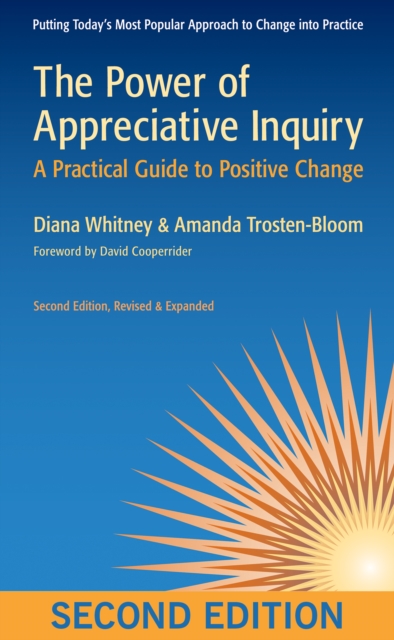
The power of appreciative inquiry : a practical guide to positive change
NEW EDITION, REVISED AND UPDATEDThe Power of Appreciative Inquiry describes the internationally embraced approach to organizational change that dramatically improves performance by engaging people to study, discuss, and build upon what's working – strengths – rather than trying to fix what's not. Diana Whitney and Amanda Trosten-Bloom, pioneers in the development and practice of Appreciative Inquiry (AI), provide a menu of eight results-oriented applications, along with case examples from a wide range of organizations to illustrate Appreciative Inquiry in action. A how-to book, this is the most authoritative and accessible guide to the newest ideas and practices in the field of Appreciative Inquiry since its inception in 1985.The second edition includes new examples, tools, and tips for using AI to create an enduring capacity for positive change, along with a totally new chapter on award-winning community applications of Appreciative Inquiry.
eBook