
Catalogue Search | MBRL


Are you sure you want to remove the book from the shelf?

{{itemTitle}}
612
result(s) for
"SHARE OF HEALTH SPENDING"
Sort by:
Twenty years of health system reform in brazil
It has been more than 20 years since Brazil's 1988 Constitution formally established the Unified Health System (Sistema Unico de Saude, SUS). Building on reforms that started in the 1980s, the SUS represented a significant break with the past, establishing health care as a fundamental right and duty of the state and initiating a process of fundamentally transforming Brazil's health system to achieve this goal. This report aims to answer two main questions. First is have the SUS reforms transformed the health system as envisaged 20 years ago? Second, have the reforms led to improvements with regard to access to services, financial protection, and health outcomes? In addressing these questions, the report revisits ground covered in previous assessments, but also brings to bear additional or more recent data and places Brazil's health system in an international context. The report shows that the health system reforms can be credited with significant achievements. The report points to some promising directions for health system reforms that will allow Brazil to continue building on the achievements made to date. Although it is possible to reach some broad conclusions, there are many gaps and caveats in the story. A secondary aim of the report is to consider how some of these gaps can be filled through improved monitoring of health system performance and future research. The introduction presents a short review of the history of the SUS, describes the core principles that underpinned the reform, and offers a brief description of the evaluation framework used in the report. Chapter two presents findings on the extent to which the SUS reforms have transformed the health system, focusing on delivery, financing, and governance. Chapter three asks whether the reforms have resulted in improved outcomes with regard to access to services, financial protection, quality, health outcomes, and efficiency. The concluding chapter presents the main findings of the study, discusses some policy directions for addressing the current shortcomings, and identifies areas for further research.
eBook
Financing health care in East Asia and the Pacific : best practices and remaining challenges
This is an exciting time in East Asia and the Pacific region. No region will appear to be moving so rapidly. In this dynamic environment, many countries in the region have been approaching the World Bank requesting technical assistance and knowledge about health financing best practices and options. There is great interest in expanding knowledge sharing and learning from other East Asian and Pacific countries about their experiences in health financing. Moreover, some common issues appear to be emerging: universal insurance, options for financing health insurance, institutional setups of health financing options, provider payment mechanisms, equity considerations, ways to reach the poor and impoverished, and ways to meet the challenges of a changing demographics and epidemiologic profile. Under a generous grant from the Health, Nutrition, and population hub in the World Bank in fiscal year 2008, the region was requested to provide an overview of health financing systems in the region. This overview examined the different health financing mechanisms in terms of performance on dimensions of efficiency and equity and in terms of relative roles of government. In addition, the analysis was to identify, gaps in knowledge needing to be addressed strengthen and reform existing health financing mechanisms and thereby expand health coverage and benefits.
eBook

Working in health : financing and managing the public sector health workforce
'Working in Health' addresses two key questions related to health workforce policy in developing countries: • What is the impact of government wage bill policies on the size of the health wage bill and on health workforce staffing levels in the public sector? • Do current human resources management policies and practices lead to effective use of wage bill resources in the public sector? Health workers play a key role in increasing access to health services for poor people in developing countries. Global and country level estimates show that staffing levels in many developing countries—particularly in sub-Saharan Africa—are far below what is needed to deliver essential health services to the population. One factor that potentially limits scaling up the health workforce in developing countries is the government overall wage bill policy which sometimes creates restrictions. Through a review of literature, analysis of data, and country case studies in Kenya, Zambia, Rwanda, and the Dominican Republic, this book examines the process that determines the health wage bill budget in the public sector, how this is linked to overall wage bill policies, how this affects staffing levels in the health sector, and the relevant policy options. But staff numbers are not everything and more money for the health wage bill alone will not solve the health workforce problems of developing countries. 'Working in Health' looks at how effectively governments use the available wage bill resources in the health sector and policy options. Policies and practices in recruitment, deployment, promotion, transfer, sanctioning, and remuneration for health workers are reviewed to identify their influence on budget execution rates, geographic distribution, and productivity of health workers.
eBook
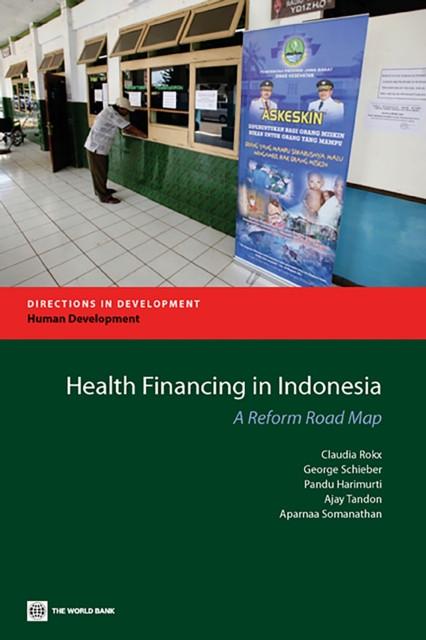
Health financing in Indonesia : a reform road map
In 2004 the Indonesian government made a commitment to provide its entire population with health insurance coverage through a mandatory public health insurance scheme. It has moved boldly already provides coverage to an estimated 76.4 million poor and near poor, funded through the public budget. Nevertheless, over half the population still lacks health insurance coverage, and the full fiscal impacts of the government's program for the poor have not been fully assessed or felt. In addition, significant deficiencies in the efficiency and equity of the current health system, unless addressed will exacerbate cost pressures and could preclude the effective implementation of universal coverage (UC) and the desired result of improvements in population health outcomes and financial protection. For Indonesia to achieve UC, systems' performance must be improved and key policy choices with respect to the configuration of the health financing system must be made. Indonesia's health system performs well with respect to some health outcomes and financial protection, but there is potential for significant improvement. High-level political decisions are necessary on key elements of the health financing reform package. The key transitional questions to get there include: • the benefits that can be afforded and their impacts on health outcomes and financial protection; • how the more than 50 percent of those currently without coverage will be insured; • how to pay medical care providers to assure access, efficiency, and quality; • developing a streamlined and efficient administrative structure; • how to address the current supply constraints to assure availability of promised services; • how to raise revenues to finance the system, including the program for the poor as well as currently uninsured groups that may require government subsidization such as the more than 60 million informal sector workers, the 85 percent of workers in firms of less than five employees, and the 70 percent of the population living in rural areas.
eBook

Health financing and delivery in Vietnam : looking forward
Vietnam's successes in the health sector are remarkable. Between 2000 and 2005, Vietnam achieved reductions in mortality rates for all ages, while some of its neighbors saw little change or even increases. To date, its infant and under-five mortality rates are comparable to those of countries with substantially higher per capita incomes. According to the data assembled in 'Health Financing and Delivery in Vietnam', the country continues to perform strongly in the sector, but its health care system is facing new challenges, as do those of other countries. By international standards, for example, a large percentage of Vietnamese households make out-of-pocket health care payments that exceed a reasonable fraction of their income. The country has been expanding the breadth of health insurance coverage, but questions remain on how to further expand coverage, how to decrease health care costs, and how to increase the overall quality of care. 'Health Financing and Delivery in Vietnam' reviews the country's successes and the challenges it faces, and suggests some options for further reforming the country's health system. These include the issue of stewardship—what different parts of government (for example, the Health Ministry and the health insurer) should be doing at each level of government, and what different levels of government (for example, the central government and the provincial government) ought to be doing. 'Health Financing and Delivery in Vietnam' will be of interest to readers working in the areas of public health and social analysis and policy.
eBook

Healthy partnerships : how governments can engage the private sector to improve health in Africa
Health systems across Africa are in urgent need of improvement. The public sector should not be expected to shoulder the burden of directly providing the needed services alone, nor can it, given the current realities of African health systems. Therefore to achieve necessary improvements, governments will need to rely more heavily on the private health sector. Indeed, private providers already play a significant role in the health sector in Africa and are expected to continue to play a key role, and private providers serve all income levels across sub- Saharan Africa's health systems. The World Health Organization (WHO) and others have identified improvements in the way governments interact with and make use of their private health sectors as one of the key ingredients to health systems improvements. Across the African region, many ministries of health are actively seeking to increase the contributions of the private health sector. However, relatively little is known about the details of engagement; that is, the roles and responsibilities of the players, and what works and what does not. A better understanding of the ways that governments and the private health sector work together and can work together more effectively is needed. This Report assesses and compares the ways in which African governments are engaging with their private health sectors. Engagement is defined, for the purposes of this report, to mean the deliberate, systematic collaboration of the government and the private health sector according to national health priorities, beyond individual interventions and programs. With effective engagement, one of the main constraints to better private sector contributions can be addressed, which in turn should improve the performance of health systems overall.
eBook

Financing Health Care in East Asia and the Pacific : Best Practices and Remaining Challenges
This is an exciting time in East Asia and the Pacific region. No region will appear to be moving so rapidly. In this dynamic environment, many countries in the region have been approaching the World Bank requesting technical assistance and knowledge about health financing best practices and options. There is great interest in expanding knowledge sharing and learning from other East Asian and Pacific countries about their experiences in health financing. Moreover, some common issues appear to be emerging: universal insurance, options for financing health insurance, institutional setups of health financing options, provider payment mechanisms, equity considerations, ways to reach the poor and impoverished, and ways to meet the challenges of a changing demographics and epidemiologic profile. Under a generous grant from the Health, Nutrition, and population hub in the World Bank in fiscal year 2008, the region was requested to provide an overview of health financing systems in the region. This overview examined the different health financing mechanisms in terms of performance on dimensions of efficiency and equity and in terms of relative roles of government. In addition, the analysis was to identify, gaps in knowledge needing to be addressed strengthen and reform existing health financing mechanisms and thereby expand health coverage and benefits.
Publication

Vertical Integration: Hospital Ownership Of Physician Practices Is Associated With Higher Prices And Spending
We examined the consequences of contractual or ownership relationships between hospitals and physician practices, often described as vertical integration. Such integration can reduce health spending and increase the quality of care by improving communication across care settings, but it can also increase providers' market power and facilitate the payment of what are effectively kickbacks for inappropriate referrals. We investigated the impact of vertical integration on hospital prices, volumes (admissions), and spending for privately insured patients. Using hospital claims from Truven Analytics MarketScan for the nonelderly privately insured in the period 2001-07, we constructed county-level indices of prices, volumes, and spending and adjusted them for enrollees' age and sex. We measured hospital-physician integration using information from the American Hospital Association on the types of relationships hospitals have with physicians. We found that an increase in the market share of hospitals with the tightest vertically integrated relationship with physicians-ownership of physician practices-was associated with higher hospital prices and spending. We found that an increase in contractual integration reduced the frequency of hospital admissions, but this effect was relatively small. Taken together, our results provide a mixed, although somewhat negative, picture of vertical integration from the perspective of the privately insured. [PUBLICATION ABSTRACT]
Journal Article
Moving toward universal coverage of social health insurance in Vietnam
To address the growth in resultant out-of-pocket (OOP) payments and associated problems of financial barriers to access, the government issued several policies aimed at expanding coverage throughout the 1990s and 2000s, particularly for the poor and other vulnerable groups. Universal coverage (UC) can be an elusive concept and is about three objectives: (a) equity (linking care to need, and not to ability to pay); (b) financial protection (ensuring that health care use does not lead to impoverishment); (c) effective access to a comprehensive set of quality services (ensuring that providers make the right diagnosis and prescribe a treatment that is appropriate and affordable; and (d) to ensure that the financing needed to achieve UC is mobilized in a fiscally sustainable manner, and is used efficiently and equitably. The objective of this report is to assess the implementation of Vietnam social health insurance (SHI) and provide options for moving toward UC, with a view to contributing to the law revision process. It analyzes progress to date on the two major goals of the master plan. The report assesses Vietnam's readiness to meet these goals, the challenges it will face in achieving UC, and key reforms needed to overcome those challenges. It does so through a health financing lens, focusing on how resources are mobilized, pooled, and allocated, and how services are purchased. The report also examines the stewardship of financing that is, the organization, management, and governance of SHI as it has direct implications for achieving UC. The report ends by pulling together the recommendations in the form of an implementation road map.
eBook

Investing in Children: Changes in Parental Spending on Children, 1972—2007
Parental spending on children is often presumed to be one of the main ways that parents invest in children and a main reason why children from wealthier households are advantaged. Yet, although research has tracked changes in the other main form of parental investment—namely, time—there is little research on spending. We use data from the Consumer Expenditure Survey to examine how spending changed from the early 1970s to the late 2000s, focusing particularly on inequality in parental investment in children. Parental spending increased, as did inequality of investment. We also investigate shifts in the composition of spending and linkages to children's characteristics. Investment in male and female children changed substantially: households with only female children spent significantly less than parents in households with only male children in the early 1970s; but by the 1990s, spending had equalized; and by the late 2000s, girls appeared to enjoy an advantage. Finally, the shape of parental investment over the course of children's lives changed. Prior to the 1990s, parents spent most on children in their teen years. After the 1990s, however, spending was greatest when children were under the age of 6 and in their mid-20s.
Journal Article