
Catalogue Search | MBRL


Are you sure you want to remove the book from the shelf?

{{itemTitle}}
1,293
result(s) for
"SHIITE MOSLEMS"
Sort by:

The shifts in hizbullah's ideology
The Lebanese Shi'ite resistance movement, Hizbullah, is going through a remarkable political and ideological transformation. Hizbullah was founded in 1978 by various sectors of Lebanese Shi'ite clergy and cadres, and with Iranian backing as an Islamic movement protesting against social and political conditions. Over the years 1984/85 to 1991, Hizbullah became a full-fledged social movement in the sense of having a broad overall organization, structure, and ideology aiming at social change and social justice, as it claimed. Starting in 1992, it became a mainstream political party working within the narrow confines of its pragmatic political program. The line of argument in this dissertation is that Hizbullah has been adjusting its identity in the three previously mentioned stages by shifting emphasis among its three components: (1) from propagating an exclusivist religious ideology (2) to a more encompassing political ideology, and (3) to a down-to-earth political program.
De Libanese Shi'itische verzetsbeweging Hizbullah ondergaat een opzienbarende politieke en ideologische transformatie. Ten tijde van de stichting in 1978, door Libanese geestelijken en leiders en met Iranese steun, was Hizbullah vooral een islamitische beweging die zich verzette tegen sociale en politieke omstandigheden. Gaandeweg ontwikkelde de beweging zich tot een 'volwassen' sociale beweging, met een solide organisatie, structuur en ideologie, gericht op sociale verandering en rechtvaardigheid. Vanaf 1992 manifesteert Hizbullah zich als politieke partij. Deze publicatie schetst een veranderende identiteit door een verschuivende nadruk: van exclusivistische religieuze ideologie, via een ruimere politieke ideologie tot een pragmatisch politiek programma.
eBook

Global Dynamics of Shi'a Marriages
Muslim marriages have been the focus of considerable public debate in Europe and beyond, in Muslim-majority countries as well as in settings where Muslims are a minority. Most academic work has focused on how the majority Sunni Muslims conclude marriages. This volume, in contrast, focuses on Twelver Shi'a Muslims in Iran, Pakistan, Oman, Indonesia, Norway, and the Netherlands. The volume makes an original contribution to understanding the global dynamics of Shi'a marriage practices in a wide range of contexts--not only its geographical spread but also by providing a critical analysis of the socio-economic, religious, ethnic, and political discourses of each context. The book sheds light on new marriage forms presented through a bottom up approach focusing on the lived experiences of Shi'a Muslims negotiating a diverse range of relationships and forms of belonging.
eBook

Exploring pro-environmental behavior in Azerbaijan: an extended value-belief-norm approach
Purpose
This paper aims to explore pro-environmental behavior (PEB) in Azerbaijan. Therefore, the authors used value-belief-norm (VBN) theory, extended by the construct of social norms (SN), as a basis.
Design/methodology/approach
Data were collected by establishing a link within various social media platforms. The final sample consisted of 407 respondents. The authors analyzed four dimensions of PEB using higher-order structural equations. The authors also examined both direct and (serial) indirect effects for cross-cultural validation of the extended VBN theory.
Findings
The authors were able to confirm the VBN theory in its entirety. However, SN, which are influential in collectivistic and Sunni-majority states, do not contribute significantly to explaining PEB in predominantly Shiite Azerbaijan.
Research limitations/implications
The authors could not establish a direct effect of SN on PEB within this study. However, the authors observed an indirect “values-beliefs-norms-behavior” effect. The different (partly abbreviated) effect channels of the four tested value antecedents provide interesting insights for marketing research.
Practical implications
Based on the results, it seems crucial to make Muslim consumers aware of the negative outcomes of their consumption behavior and to emphasize individual responsibility. However, SN may not need to be addressed depending on cultural and/or religious values.
Originality/value
The authors examined PEB in Azerbaijan by testing the serial mediation effects in the VBN model. Further, the authors tested the influence of SN within the framework of the original VBN theory, contributing to a better understanding of the possibility of integrating components of the theory of planned behavior.
Journal Article

The New Political Islam
Explains how various Islamists have endorsed human rights, democracy, and justice to gain influence and mobilize supporters Islamist political parties and groups are on the rise throughout the Muslim world and in Muslim communities in the West. Owing largely to the threat of terrorism, political Islam is often portrayed as a monolithic movement embodying fundamentalism and theocracy, an image magnified by the rise of populism and xenophobia in the United States and Europe. Reality, however, is far more complicated. Political Islam has evolved considerably since its spectacular rise decades ago, and today it features divergent viewpoints and contributes to discrete but simultaneous developments worldwide. This is a new political Islam, more global in scope but increasingly local in action. Emmanuel Karagiannis offers a sophisticated analysis of the different manifestations of contemporary Islamism. In a context of global economic and social changes, he finds local manifestations of Islamism are becoming both more prevalent and more diverse. Many Islamists turn to activism, still more participate formally in the democratic process, and some, in far fewer numbers, advocate violence—a wide range of political persuasions and tactics that reflects real and perceived political, cultural, and identity differences. Synthesizing prodigious research and integrating insights from the globalization debate and the literature on social movements, The New Political Islam seeks to explain the processes and factors leading to distinctive fusions of \"the global\" and \"the local\" across the landscape of contemporary political Islam. Examining converts to Islam in Europe, nonviolent Islamists with global reach, Islamist parties in Turkey, Egypt, and Tunisia, and militant Shia and Sunni groups in Syria and Iraq, Karagiannis demonstrates that Islamists have embraced ideas and practices from the global marketplace and have attempted to implement them locally. He looks closely at the ways in which Islamist activists, politicians, and militants have utilized the language of human rights, democracy, and justice to gain influence and popular support and to contend for power.
eBook

The Shiʿis of Jabal ʿAmil and the new Lebanon : community and nation state, 1918-1943
Tamara Chalabi highlights the development of a 'politics of demand' and the increased political activism of this community in a time of great change. It also explores how Arab nationalism was transformed from an ideology of opposition and empowerment of marginal communities, into a tool for the assertion of political domination.
eBook

The Shi'ites of Lebanon
The complex history of Lebanese Shi'ites has traditionally been portrayed as rooted in religious and sectarian forces. The Abisaabs uncover a more nuanced account in which colonialism, the modern state, social class, and provincial politics profoundly shaped Shi'i society.The authors trace the sociopolitical, economic, and intellectual transformation of the Shi'ites of Lebanon from 1920 during the French colonial period until the late twentieth century. They shed light on the relationship of contemporary Islamic militancy with traditions of religious modernism and leftism in both Lebanon and Iraq. Analyzing the interaction between sacred and secular features of modern Shi'ite society, the authors clearly follow the group's turn toward religious revolution and away from secular activism. This book transforms our understanding of twentieth-century Lebanese history and demonstrates how the rise of Hizbullah was conditioned by Shi'ites' consistent marginalization and neglect by the Lebanese state.
eBook

Challenges for America in the Middle East
This book offers a contemporary analysis of the foreign policy challenges the United States faces in the Middle East and takes a close look at the critical policy dilemmas posed by radical Islam, the Arab Spring, the Shia Crescent, and Israel-Palestine relations.
eBook
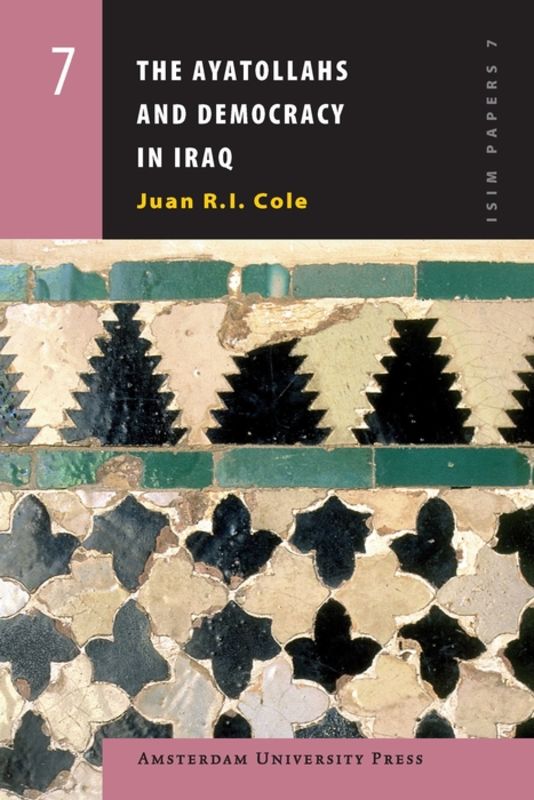
The ayatollahs and democracy in iraq
Iraqi Shiism is undergoing profound changes, leading to new elaborations of the relationship between clerics and democratic principles in an Islamic state. The Najaf tradition of thinking about Shiite Islam and the modern state in Iraq, which first developed during the Iranian constitutional revolution of 1905–1911, rejects the principle that supreme power in an Islamic state must be in clerical hands. Grand Ayatollah Ali Sistani of Iraq stands in this tradition, and he has striven to uphold and develop it since the fall of Saddam Hussein. At key points he came into conflict with the Bush administration, which was not eager for direct democracy. Parliamentary politics have also drawn in clerics of the Dawa Party, the Sadr movement, and the Supreme Council for Islamic Revolution in Iraq, all of which had earlier been authoritarian in outlook. Is Iraqi Shiism experiencing its enlightenment moment?
eBook
The Struggle of the Shi'is in Indonesia
The Struggle of the Shi'is in Indonesia is a pioneering work. It is the first comprehensive scholarly examination in English of the development of Shiism in Indonesia. It focuses primarily on the important period between 1979 and 2004 – a period of nearly a quarter of a century that saw the notable dissemination of Shi'i ideas and a c
eBook
Shi'i Cosmopolitanisms in Africa
Mara A. Leichtman offers an in-depth study of Shi'i Islam in two very different communities in Senegal: the well-established Lebanese diaspora and Senegalese \"converts\" from Sunni to Shi'i Islam of recent decades. Sharing a minority religious status in a predominantly Sunni Muslim country, each group is cosmopolitan in its own way. Leichtman provides new insights into the everyday lives of Shi'i Muslims in Africa and the dynamics of local and global Islam. She explores the influence of Hizbullah and Islamic reformist movements, and offers a corrective to prevailing views of Sunni-Shi'i hostility, demonstrating that religious coexistence is possible in a context such as Senegal.
eBook