
Catalogue Search | MBRL


Are you sure you want to remove the book from the shelf?

{{itemTitle}}
92,217
result(s) for
"SOCIAL ACTION"
Sort by:

Yes you can! : your guide to becoming an activist
Guides readers through nine steps to social change and discusses strategies on running an effective meeting, writing a petition, and lobbying governments.
Book

Fighting for Reliable Evidence
Once primarily used in medical clinical trials, random assignment experimentation is now accepted among social scientists across a broad range of disciplines. The technique has been used in social experiments to evaluate a variety of programs, from microfinance and welfare reform to housing vouchers and teaching methods. How did randomized experiments move beyond medicine and into the social sciences, and can they be used effectively to evaluate complex social problems?Fighting for Reliable Evidenceprovides an absorbing historical account of the characters and controversies that have propelled the wider use of random assignment in social policy research over the past forty years.
Drawing from their extensive experience evaluating welfare reform programs, noted scholar practitioners Judith M. Gueron and Howard Rolston portray randomized experiments as a vital research tool to assess the impact of social policy. In a random assignment experiment, participants are sorted into either a treatment group that participates in a particular program, or a control group that does not. Because the groups are randomly selected, they do not differ from one another systematically. Therefore any subsequent differences between the groups can be attributed to the influence of the program or policy. The theory is elegant and persuasive, but many scholars worry that such an experiment is too difficult or expensive to implement in the real world. Can a control group be truly insulated from the treatment policy? Would staffers comply with the random allocation of participants? Would the findings matter?
Fighting for Reliable Evidencerecounts the experiments that helped answer these questions, starting with the income maintenance experiments and the Supported Work project in the 1960s and 1970s. Gueron and Rolston argue that a crucial turning point came during the 1980s, when Congress allowed states to experiment with welfare programs and foundations, states, and the federal government funded larger randomized trials to assess the impact of these reforms. As they trace these historical shifts, Gueron and Rolston discuss the ways that strategies for resolving theoretical and practical problems were developed, and they highlight the strict conditions required to execute a randomized experiment successfully. What emerges is a nuanced portrait of the potential and limitations of social experiments to advance empirical knowledge.
Weaving history, data analysis and personal experience,Fighting for Reliable Evidenceoffers valuable lessons for researchers, policymakers, funders, and informed citizens interested in isolating the effect of policy initiatives. It is an essential primer on welfare policy, causal inference, and experimental designs.
eBook

Big bets : how large-scale change really happens
\"Rajiv J. Shah, president of the Rockefeller Foundation and former administrator of President Barack Obama's United States Agency for International Development, shares a dynamic new model for creating large scale change, inspired by his own involvements with some of the largest humanitarian projects of our time\"-- Provided by publisher.
Book

The next American revolution : sustainable activism for the twenty-first century
The Strategist's Best Books About Asian American Identity, New York Magazine
The pioneering Asian American labor organizer and writer's vision for intersectional and anti-racist activism.
In this powerful, deeply humanistic book, Grace Lee Boggs, a legendary figure in the struggle for justice in America, shrewdly assesses the current crisis-political, economical, and environmental-and shows how to create the radical social change we need to confront new realities. A vibrant, inspirational force, Boggs has participated in all of the twentieth century's major social movements-for civil rights, women's rights, workers' rights, and more. She draws from seven decades of activist experience, and a rigorous commitment to critical thinking, to redefine \"revolution\" for our times.
From her home in Detroit, she reveals how hope and creativity are overcoming despair and decay within the most devastated urban communities. Her book is a manifesto for creating alternative modes of work, politics, and human interaction that will collectively constitute the next American Revolution-which is unraveling before our eyes.
eBook
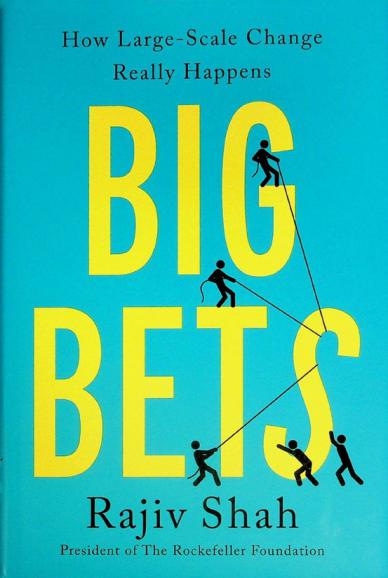
Big bets : how large-scale change really happens
\"Rajiv J. Shah, president of the Rockefeller Foundation and former administrator of President Barack Obama's United States Agency for International Development, shares a dynamic new model for creating large scale change, inspired by his own involvements with some of the largest humanitarian projects of our time\" -- Provided by publisher.
Book

We Make Each Other Beautiful
We Make Each Other Beautiful
focuses on woman of color and queer of color artists and
artist collectives who engage in direct political action as a part
of their art practice. Defined by public protest,
rule-breaking, rebellion, and resistance to governmental and
institutional abuse, direct-action \"artivism\" draws on the aims,
radical spirit, and tactics of the civil rights and feminist
movements and on the struggles for disability rights, queer rights,
and immigrant rights to seek legal and social change.
Yxta Maya Murray traces the development of artivism as a
practice from the Harlem Renaissance to Yoko Ono, Judy Baca, and
Marsha P. Johnson. She also studies its role in transforming law
and society. We Make Each Other Beautiful profiles the
work and lives of four contemporary artivists -Carrie Mae Weems,
Young Joon Kwak, Tanya Aguiñiga, and Imani Jacqueline Brown-and the
artivist collective Drawn Together, combining new oral histories
with sharp analyses of how their diverse and expansive artistic
practices bear important aesthetic and politicolegal meanings that
address a wide range of injustices.
eBook
The global historical and contemporary impacts of voluntary membership associations on human societies : a literature review
\"Reviewed here is global research on how 13 types of Voluntary Membership Associations (MAs) have significantly or substantially had global impacts on human history, societies, and life. Such outcomes have occurred especially in the past 200+ years since the Industrial Revolution circa 1800 CE, and its accompanying Organizational Revolution. Emphasized are longer-term, historical, and societal or multinational impacts of MAs, rather than more micro-level (individual) or meso-level (organizational) outcomes. MAs are distinctively structured, with power coming from the membership, not top-down. The author has characterized MAs as the dark matter of the nonprofit/third sector, using an astrophysical metaphor. Astrophysicists have shown that most physical matter in the universe is dark in the sense of being unseen, not stars or planets.\"--Page 4 of cover.
Book

Between War and the State
In Between War and the
State , Van Nguyen-Marshall examines an array
of voluntary activities, including mutual-help, professional,
charitable, community development, student, women's, and rights
organizations active in South Vietnam from 1954 to 1975.
By bringing focus to the public lives of South Vietnamese people,
Between War and the State challenges persistent
stereotypes of South Vietnam as a place without society or agency.
Such robust associational life underscores how an active civil
society survived despite difficulties imposed by the war,
government restrictions, economic hardship, and external political
forces. These competing political forces, which included the United
States, Western aid agencies, and Vietnamese communist agents,
created a highly competitive arena wherein the South Vietnamese
state did not have a monopoly on persuasive or coercive power. To
maintain its influence, the state sometimes needed to accommodate
groups and limit its use of violence. Civil society participants in
South Vietnam leveraged their social connections, made alliances,
appealed to the domestic and international public, and used street
protests to voice their concerns, secure their interests, and carry
out their activities.
eBook


Rebel Girls
From anti-war walkouts to anarchist youth newspapers, rallies against educational privatization, and workshops on fair trade, teenage girls are active participants and leaders in a variety of social movements. Rebel Girls: Youth Activism and Social Change Across the Americas illuminates the experiences and perspectives of these uniquely positioned agents of social change. Jessica K. Taft introduces readers to a diverse and vibrant transnational community of teenage girl activists in the San Francisco Bay Area, Mexico City, Caracas, Buenos Aires, and Vancouver. Expansive in scope and full of rich details, Taft brings to life the voices of these inspiring activists who are engaged in innovative and effective organizing for global and local social justice, highlighting their important contributions to contemporary social movements and social theory.Rebel Girls explores how teenage girls construct activist identities, rejecting and redefining girlhood and claiming political authority for youth in the process. Taft examines the girl activists' social movement strategies and collective political practices, detailing their shared commitments to process-based political education, participatory democracy, and hopeful enthusiasm. Ultimately, Rebel Girls has substantial implications for social movements and youth organizations, arguing that adult social movements could learn a great deal from girl activists and making clear the importance of increased collaboration between young people and adults.
eBook