
Catalogue Search | MBRL


Are you sure you want to remove the book from the shelf?

{{itemTitle}}
310
result(s) for
"SONIDO"
Sort by:


Real Sound Synthesis for Interactive Applications
Virtual environments such as games and animated and \"real\" movies require realistic sound effects that can be integrated by computer synthesis. The book emphasizes physical modeling of sound and focuses on real-world interactive sound effects. It is intended for game developers, graphics programmers, developers of virtual reality systems and training simulators, and others who want to learn about computational sound. It is written at an introductory level with mathematical foundations provided in appendices.
eBook

ON CHAINSAWS AND ACOUSTIC VIOLENCE
This article explores distinct practices of sounding and listening that have emerged in a context of severe deforestation in Ajusco-Chichinautzin, a region south of Mexico City. It applies the concept of acoustic violence to this setting, as part of wider attempts to build constructive responses to climate breakdown through sound and music scholarship. As the first indication of occurring logging, the sound of chainsaws proves vital in attempts by forest guards and police to detect and halt deforestation Equally, attentiveness to acoustic violence allows us to cut through sensationalist media presentations of the problem of deforestation, to perceive how local populations—often blamed for complicity with loggers—are in fact direct victims of environmental loss. The concept of acoustic violence can also illuminate how, in a context not just environmental loss but of dispossession, modalities of listening may become simplified instrumentalized, or lost.
Este artículo explora distintas prácticas de sonar y escuchar que han surgido en un contexto de severa deforestación en Ajusco-Chichinautzin, una región al sur de la Ciudad de México. Aplica el concepto de violencia acústica a este contexto, como parte de intentos más amplios de construir respuestas constructivas al colapso climático a través de la investigación sonora y musical. Como primer indicio de la tala en curso, el sonido de las motosierras resulta vital en los intentos de los guardabosques y la policía por detectar y detener la deforestación. De igual modo, prestar atención a la violencia acústica nos permite trascender las presentaciones sensacionalistas de los medios de comunicación sobre el problema de la deforestación y percibir cómo las poblaciones locales, a menudo culpadas de complicidad con los taladores, son de hecho víctimas directas de la pérdida ambiental. El concepto de violencia acústica también puede iluminar cómo, en un contexto no sólo de pérdida ambiental sino de despojo, las modalidades de escucha pueden simplificarse, instrumentalizarse o perderse.
Journal Article


Psychoacoustics: Facts and Models
Psychoacoustics - Facts and Models represents a comprehensive collection of data describing the processing of sound by the human hearing system. It includes quantitative relations between sound stimuli and auditory perception in terms of hearing sensations. In addition, quantitative psychoacoustic models of hearing sensations are given. The monograph contains a unique collection of data on the human hearing system as a receiver of acoustic information as well as many examples of the practical application of the results of basic research in fields such as audiology, noise evaluation, and sound engineering. Many helpful hints for the solution of practical problems will be of particular benefit to engineers, and the book as a whole should serve as an important benchmark in the field of psychoacoustics. The treatment given in this second edition has been thoroughly updated with recent results.
eBook

Margaret Watts Hughes: The Forgotten Pioneer of Sound Art
Margaret Watts Hughes es la primera mujer en concebir el sonido como una herramienta plástica en el contexto del arte visual, adelantándose en décadas a los considerados hasta ahora precursores de dicha disciplina. Se presentarán pruebas y evidencias documentales, que demuestran su papel innovador incorporando métodos científicos a la hora de construir obras visuales centradas en las vibraciones sonoras ya a finales del siglo XIX. Su legado artístico de gran interés, debe hacernos replantear la figura y el papel que ejercieron las mujeres pioneras en el arte y su papel contemporáneo.
When we carefully analyze the role of women in the history of art, we will observe how the vast majority of museums and collections in the world have in their funds deposited works by prominent artists to whom the deserved attention they require is seldom paid. In the context of sound art, from a historical point of view there have been many women who have stood out for their careers, but the visibility of their work has been practically anecdotal and marginal in most of the reference manuals that study it.
This article aims to give visibility and relevance to the prominent role played by the Welsh Margaret Watts Hughes, the first woman to conceive of sound as a plastic tool in the context of visual art, ahead of those considered until now precursors of this discipline. Documentary evidence will be presented, demonstrating its innovative role by incorporating scientific methods when constructing visual works focused on sound vibrations as early as the end of the 19th century. Her artistic legacy of great interest should make us rethink the figure and role played by these women pioneers.
Journal Article
Más Allá del Yo: el Concepto de Espacio Autobiográfico en la Cultura Audiovisual Contemporánea
En este trabajo introduzco el concepto de espacio autobiográfico como una perspectiva para abordar la exposición de la intimidad del cuerpo y sus vivencias, en el contexto de la creación audiovisual contemporánea. A partir de una revisión crítica de planteamientos procedentes de los estudios literarios (Phillipe Lejeune y Leonor Arfuch) y de la teoría del arte contemporáneo (Lea Vergine, Amelia Jones, Estrella de Diego y Rosalind Krauss), busco delinear las principales características del término para aplicarlas al estudio de obras donde coexisten distintos lenguajes audiovisuales (cine experimental, documental, videoclip, etc.) y donde los elementos sonoros colaboran de manera particular a la configuración del espacio autobiográfico.
Journal Article
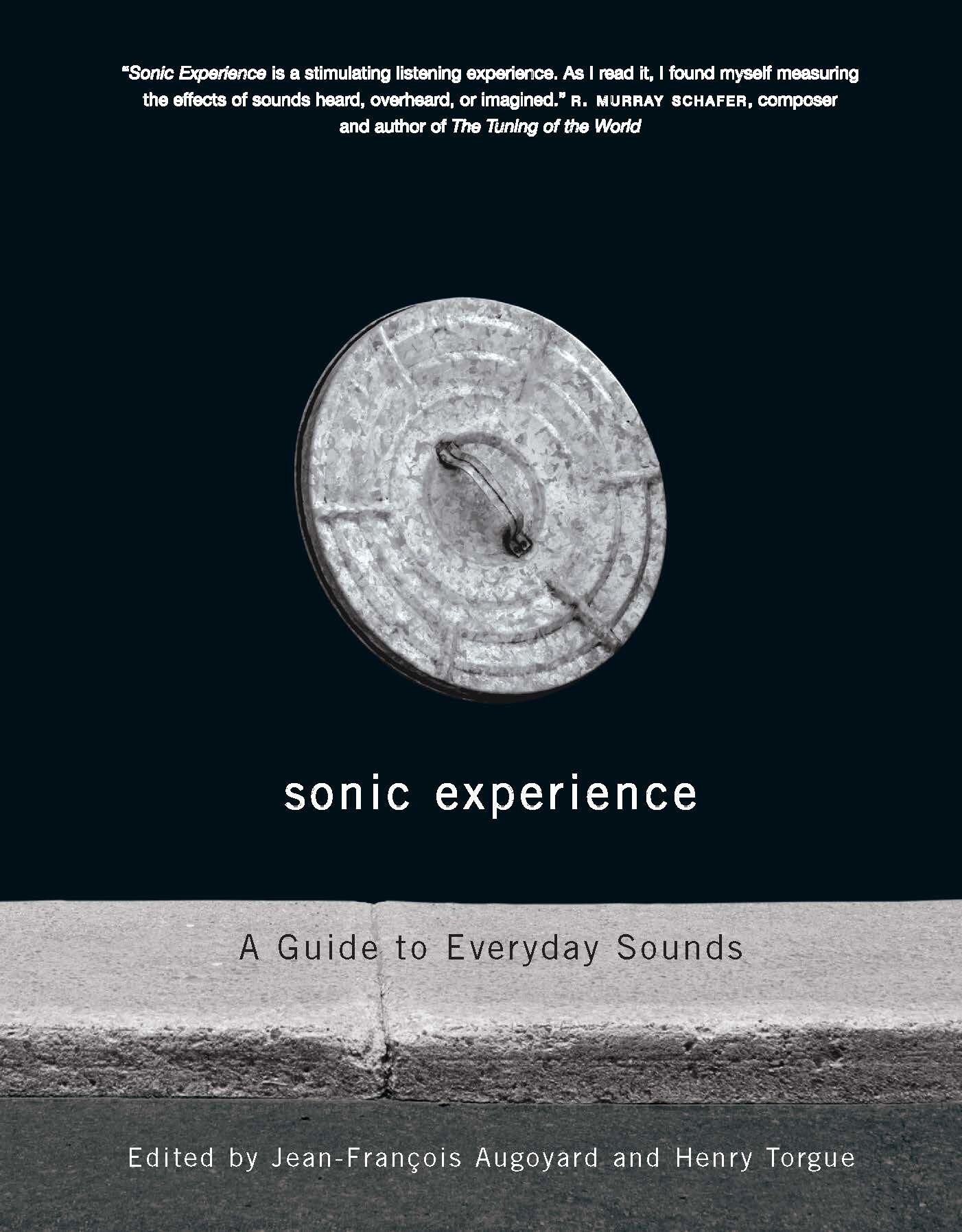
Sonic Experience
In a multidisciplinary work spanning musicology, electro-acoustic composition, architecture, urban studies, communication, phenomenology, social theory, physics, and psychology, Jean-François Augoyard, Henry Torgue, and their associates at the Centre for Research on Sonic Space and the Urban Environment (CRESSON) in Grenoble, France, provide an alphabetical sourcebook of eighty sonic/auditory effects. Their accounts of sonic effects such as echo, anticipation, vibrato, and wha-wha integrate information about the objective physical spaces in which sounds occur with cultural contexts and individual auditory experience. Sonic Experience attempts to rehabilitate general acoustic awareness, combining accessible definitions and literary examples with more in-depth technical information for specialists.
eBook

Dickinson’s Prosodic Music: Subtlety and Exuberance
This essay explores Dickinson’s prosodic music by evidencing its expressions of subtlety and exuberance. The essay unfolds in four steps. The first step finds the poet’s prosodic music in distinctive word arrangements with these three features: interlaced phonic echoes, the rhythms of short-lined verse where rhyme marks stanzas, and the motions of intonation. The second step instances Dickinson’s prosodic subtlety in one of her envelope poems, “A Pang is more conspicuous in Spring” (Fr1545B). The third step identifies Dickinson’s prosodic exuberance in two of her bee poems, “There is a flower that Bees prefer” (Fr642) and “I suppose the time will come” (Fr1389). In this step, we discern a hermeneutic key to Dickinson’s lyric art: when a sound in the world catches her ear, the poet’s prosodic music intensifies to reflect her enchantment. The essay’s last step applies the hermeneutic key to a superlative sound in Dickinson’s poetry, that of the wind in “Of all the Sounds despatched abroad” (Fr334).
Journal Article

Introduction to the Sociology of Music Technologies: An Ontological Review
Adorno’s work, in particular the texts dealing with the relationship between music and social behaviors or structures, has been the target of criticism, especially in the second half of the 20th century, being considered by many to be generalist, dogmatic or even elitist. This work proposes the analysis of musical technologies not only as a set of compositional techniques, as Adorno does, but, in fact, as material conditions for the realization of a certain type of sound/music. The colonialist character of these technologies is also analyzed. Based on a review of some key concepts in Adornian theory, a dialogue is sought with more contemporary authors from the sociology of music. El trabajo de Adorno, en particular los textos que tratan de la relación entre la música y los comportamientos o estructuras sociales, ha sido objeto de críticas, especialmente en la segunda mitad del siglo XX, siendo considerado por muchos como generalista, dogmático o incluso elitista. Este trabajo propone el análisis de las tecnologías musicales no solo como un conjunto de técnicas compositivas, como hace Adorno, sino como, de hecho, condiciones materiales para la realización de un determinado tipo de sonido/música. También se observa el carácter colonialista de estas tecnologías. A partir de una revisión de algunos conceptos clave de la teoría adorniana, se busca un diálogo con autores más contemporáneos en la sociología de la música.
Journal Article