
Catalogue Search | MBRL


Are you sure you want to remove the book from the shelf?

{{itemTitle}}
213,209
result(s) for
"STATE UNIVERSITY"
Sort by:

We demand
This title is part of American Studies Now and available as an e-book first. Visit ucpress.edu/go/americanstudiesnow to learn more.
In the post-World War II period, students rebelled against the university establishment. In student-led movements, women, minorities, immigrants, and indigenous people demanded that universities adapt to better serve the increasingly heterogeneous public and student bodies. The success of these movements had a profound impact on the intellectual landscape of the twentieth century: out of these efforts were born ethnic studies, women's studies, and American studies.
In We Demand, Roderick A. Ferguson demonstrates that less than fifty years since this pivotal shift in the academy, the university is moving away from \"the people\" in all their diversity. Today the university is refortifying its commitment to the defense of the status quo off campus and the regulation of students, faculty, and staff on campus. The progressive forms of knowledge that the student-led movements demanded and helped to produce are being attacked on every front. Not only is this a reactionary move against the social advances since the '60s and '70s-it is part of the larger threat of anti-intellectualism in the United States.
eBook

Critical storytelling in urban education
\"Critical Storytelling in Urban Education shares poems and stories written by college students attending Metropolitan State University in Saint Paul, Minnesota, and Wayne State University in Detroit, Michigan. The poets and storytellers in this gripping volume address challenges they have faced, issues of sexual abuse, racial politics, cultural identity, stigmatization of marginalized communities, immigration, and other forms of struggle within and outside of urban educational settings. They are students in Education, Communication Studies, Business, and English, among other disciplines. Academic writing has been frequently reserved to professors and doctoral students. This collection is different in that the writing of undergraduate and master students is featured. In a world of unrest, strife, and division, critical stories are sacrosanct\"-- Provided by publisher.
Book

No longer separate, not yet equal
Against the backdrop of today's increasingly multicultural society, are America's elite colleges admitting and successfully educating a diverse student body? No Longer Separate, Not Yet Equal pulls back the curtain on the selective college experience and takes a rigorous and comprehensive look at how race and social class impact each stage--from application and admission, to enrollment and student life on campus. Arguing that elite higher education contributes to both social mobility and inequality, the authors investigate such areas as admission advantages for minorities, academic achievement gaps tied to race and class, unequal burdens in paying for tuition, and satisfaction with college experiences. The book's analysis is based on data provided by the National Survey of College Experience, collected from more than nine thousand students who applied to one of ten selective colleges between the early 1980s and late 1990s. The authors explore the composition of applicant pools, factoring in background and \"selective admission enhancement strategies\"--including AP classes, test-prep courses, and extracurriculars--to assess how these strengthen applications. On campus, the authors examine roommate choices, friendship circles, and degrees of social interaction, and discover that while students from different racial and class circumstances are not separate in college, they do not mix as much as one might expect. The book encourages greater interaction among student groups and calls on educational institutions to improve access for students of lower socioeconomic status.
eBook

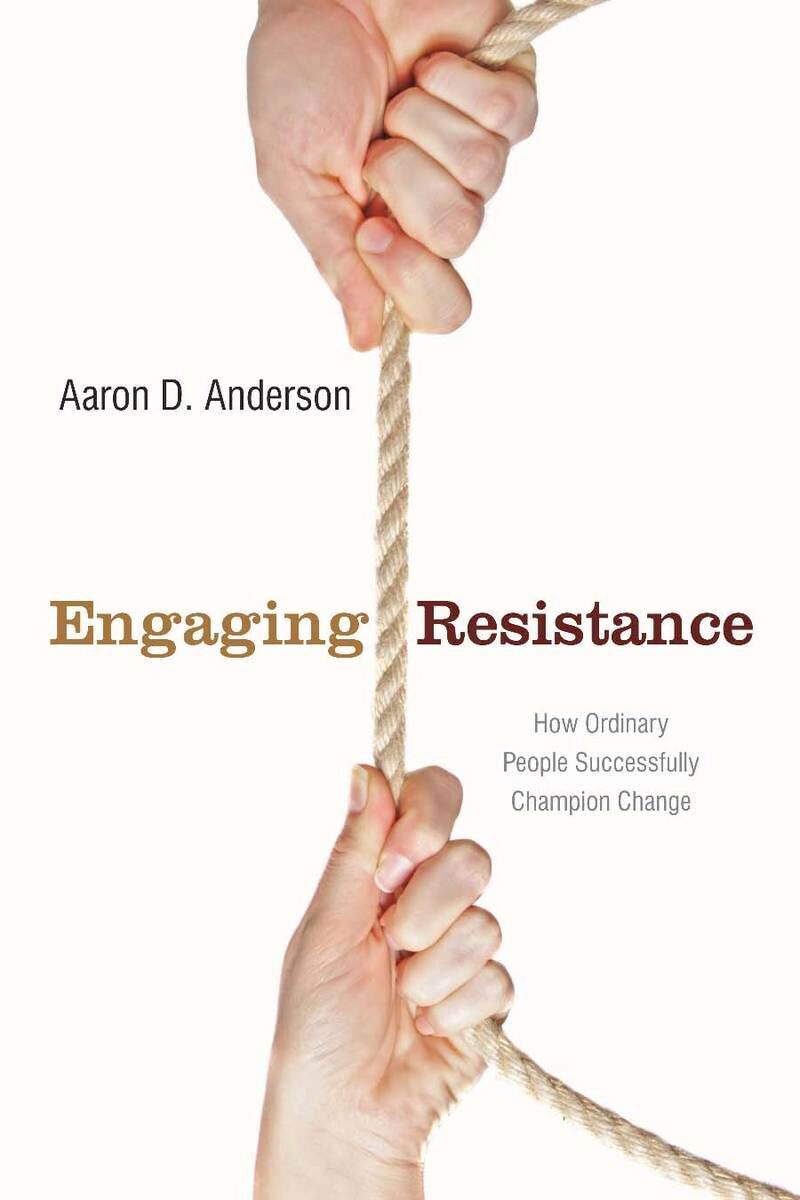
Engaging resistance : how ordinary people successfully champion change
Engaging Resistance: How Ordinary People Successfully Champion Change offers an empirically based explanation that expands our understanding about the nature of resistance to organizational change and the effects of champion behavior. The text presents a new model describing how resistance occurs over time and details what change proponents can do throughout three engagement periods to effectively work with hesitant colleagues.
The book's findings are illuminated by examples of six different resistance cases, embedded in the transformation sagas of two real-world organizations. A fundamental premise of this work is that resistance should not be something to avoid or squash as people work to change their organizations. In fact, resistance can be viewed as a natural, healthy part of an organic process. When engaged properly, resisters can help to improve change efforts and strengthen an organization's overall transformation.
eBook


The university and the people
The University and the People chronicles the influence of Populism—a powerful agrarian movement—on public higher education in the late nineteenth century. Revisiting this pivotal era in the history of the American state university, Scott Gelber demonstrates that Populists expressed a surprising degree of enthusiasm for institutions of higher learning. More fundamentally, he argues that the mission of the state university, as we understand it today, evolved from a fractious but productive relationship between public demands and academic authority. Populists attacked a variety of elites—professionals, executives, scholars—and seemed to confirm academia’s fear of anti-intellectual public oversight. The movement’s vision of the state university highlighted deep tensions in American attitudes toward meritocracy and expertise. Yet Populists also promoted state-supported higher education, with the aims of educating the sons (and sometimes daughters) of ordinary citizens, blurring status distinctions, and promoting civic engagement. Accessibility, utilitarianism, and public service were the bywords of Populist journalists, legislators, trustees, and sympathetic professors. These “academic populists” encouraged state universities to reckon with egalitarian perspectives on admissions, financial aid, curricula, and research. And despite their critiques of college “ivory towers,” Populists supported the humanities and social sciences, tolerated a degree of ideological dissent, and lobbied for record-breaking appropriations for state institutions.
eBook


Public university governance in China and Australia: a comparative study
There are several common trends and challenges in the higher education (HE) system around the world, like expansion and diversification of HE, fiscal pressure and orientation to markets, demand for greater accountability and great quality and efficiency (e.g. The financing and management of higher education: a status report on worldwide reforms, 1998; Internationalisation of higher education and global mobility 43-58, 2014; Global policy and policy-making in education, 2014; Higher Education Policy 21:5-27, 2008). These trends and changes have reshaped university governance as well. Public universities are the main institutions to carry out HE in Australia and China. The engagement between Australia and China in HE sector has become closer and closer in recent years. To conduct better and further cooperation and collaboration between Australian and Chinese universities, it is critical to understand and acknowledge the differences in two nations' university governance. Moreover, by conducting this comparative study of two nations, it also helps us to figure out the changes in university governance over times under the global trends and the interactions between global and local factors. This comparative study focuses on the university level and attempts to identify the differences of university governance in Australian and Chinese public universities in three dimensions, state-university relation, university internal governance and university finance. This paper sketches the university governance in Australia and China and finds that the relationship between government and university is looser in Australia than that in China and Australian universities enjoy more autonomy and power than Chinese universities; as to university internal governance, Australian universities use a more business-oriented management mechanism; funding associated with full-fee paying international students has become very important for Australian HE while Chinese government funding has been decreasing as well but funds from international students play a minimal financial role. (HRK / Abstract übernommen).
Journal Article