
Catalogue Search | MBRL


Are you sure you want to remove the book from the shelf?

{{itemTitle}}
112,308
result(s) for
"Saint"
Sort by:

The St. Lawrence : river route to the Great Lakes
This book follows the St. Lawrence River, once a main route of the fur and timber trades. This important commercial waterway forms part of the boundary between Canada and the United States and connects the Great Lakes with the Atlantic Ocean.
Book

Your Pocket Is What Cures You
In the wake of structural adjustment programs in the 1980s and health reforms in the 1990s, the majority of sub-Saharan African governments spend less than ten dollars per capita on health annually, and many Africans have limited access to basic medical care. Using a community-level approach, anthropologist Ellen E. Foley analyzes the implementation of global health policies and how they become intertwined with existing social and political inequalities in Senegal.Your Pocket Is What Cures Youexamines qualitative shifts in health and healing spurred by these reforms, and analyzes the dilemmas they create for health professionals and patients alike. It also explores how cultural frameworks, particularly those stemming from Islam and Wolof ethnomedicine, are central to understanding how people manage vulnerability to ill health.
While offering a critique of neoliberal health policies,Your Pocket Is What Cures Youremains grounded in ethnography to highlight the struggles of men and women who are precariously balanced on twin precipices of crumbling health systems and economic decline. Their stories demonstrate what happens when market-based health reforms collide with material, political, and social realities in African societies.
eBook

St. Petersburg
\"Neil Kent considers the extraordinary history of St. Petersburg along with its political, religious, cultural, and social dimensions, rich in stories and anecdotes from its various periods. Its musical heritage is unrivaled: Mussorgsky, Rimsky-Korsakov, Tchaikovsky, and Rachmaninov are all associated with the city ... As Kent stresses, St. Petersburg remains a city of paradox, full of tragedy but also of breathtaking beauty and endurance\"--Page 4 of cover.
Book

The Métis of Senegal
The Métis of Senegal is a history of politics and society among an influential group of mixed-race people who settled in coastal Africa under French colonialism. Hilary Jones describes how the métis carved out a niche as middleman traders for European merchants. As the colonial presence spread, the métis entered into politics and began to assert their position as local elites and power brokers against French rule. Many of the descendants of these traders continue to wield influence in contemporary Senegal. Jones's nuanced portrait of métis ascendency examines the influence of family connections, marriage negotiations, and inheritance laws from both male and female perspectives.
eBook


Mapping Decline
Once a thriving metropolis on the banks of the Mississippi, St. Louis, Missouri, is now a ghostly landscape of vacant houses, boarded-up storefronts, and abandoned factories. The Gateway City is, by any measure, one of the most depopulated, deindustrialized, and deeply segregated examples of American urban decay. \"Not a typical city,\" as one observer noted in the late 1970s, \"but, like a Eugene O'Neill play, it shows a general condition in a stark and dramatic form.\"
Mapping Declineexamines the causes and consequences of St. Louis's urban crisis. It traces the complicity of private real estate restrictions, local planning and zoning, and federal housing policies in the \"white flight\" of people and wealth from the central city. And it traces the inadequacy-and often sheer folly-of a generation of urban renewal, in which even programs and resources aimed at eradicating blight in the city ended up encouraging flight to the suburbs. The urban crisis, as this study of St. Louis makes clear, is not just a consequence of economic and demographic change; it is also the most profound political failure of our recent history.
Mapping Declineis the first history of a modern American city to combine extensive local archival research with the latest geographic information system (GIS) digital mapping techniques. More than 75 full-color maps-rendered from census data, archival sources, case law, and local planning and property records-illustrate, in often stark and dramatic ways, the still-unfolding political history of our neglected cities.
eBook

Reassessing paleolithic subsistence : the Neandertal and modern human foragers of Saint-Césaire
\"In the field of human evolution, few subjects have generated as much controversy as the fate of the Neandertals. Most debates have centered on the problem of their affiliation with early modern humans. This book examines the hypothesis that Neandertals and early modern humans differed in terms of subsistence. To assess this hypothesis, the analysis focuses on animal bones accumulated by these groups at Saint-Cesaire, a collapsed cave in western France. The faunal evidence suggests that Neandertals and early modern humans exploited a similar range of game species\"-- Provided by publisher.
Book
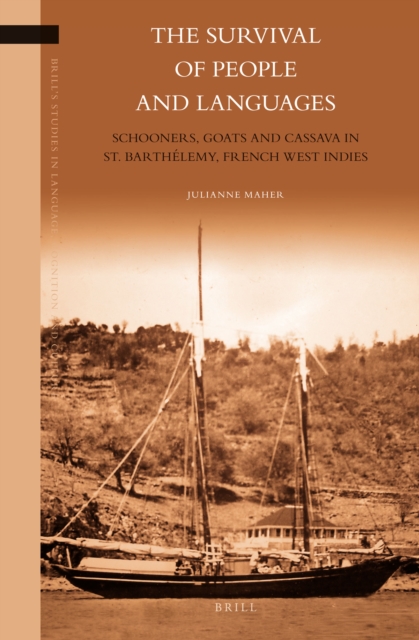
The survival of people and languages : schooners, goats and cassava in St. Barthélemy, French West Indies
In The Survival of People and Languages: Schooners, Goats and Cassava in St. Barthelemy, French West Indies, Julianne Maher explains a rare linguistic anomaly, how a small homogeneous population of seventeenth century French settlers in the tiny island of St. Barth came to speak four separate languages. With a range of historical documents and eighteenth century eye-witness accounts, Maher reconstructs the island's social ecology that led to its fragmentation. The four speech varieties are closely examined and analyzed, using extensive native speaker interviews; with the impending demise of these languages such documentation is unique. Maher concludes that social factors such as poverty, economics, geography and small population size served to maintain linguistic barriers on the island for over two hundred fifty years.
eBook


Saints Alive
David Williams shows that images associated with saints are not simply illustrations of written accounts, nor are the gestures, prayers, and liturgical practices of devotees of saints' cults simply derivative of them. Rather, images and enactments expand and complete the text, adding visual and dramatic dimensions. Williams demonstrates his ideas through discussion and case studies of three saints: the biblical figure of Saint Anne, mother of the Virgin; the medieval English martyr Saint Thomas Becket; and Saint Maximillian Mary Kolbe, who gave his life to save that of another in the Auschwitz concentration camp. A remarkable study of text, image, and enactment, Saints Alive presents a complete study of the depiction of saints that will change the way they are understood.
eBook