
Catalogue Search | MBRL


Are you sure you want to remove the book from the shelf?

{{itemTitle}}
10,302
result(s) for
"Sale of business enterprises"
Sort by:


Selling Your Startup
Learn how to sell your startup from an acquisition expert Many entrepreneurs dream of the day their company is acquired and they secure a perfect exit. But information about the process of getting your business acquired usually comes from expensive investment bankers who typically advise late-stage startups. In Selling Your Startup, serial entrepreneur Alejandro Cremades delivers an accessible guide on how to sell your startup. With first-hand experience as a fully exited entrepreneur, investment banker, and lawyer, Cremades describes the tips and tricks startup founders need to sell their early-stage to growth-stage business. In this book, you'll discover: The role that investment bankers play in the acquisition process, how they add value, and how to break down their fees Preparing your company for sale, including compiling a pitch book, putting its finances in order, and building a target list of potential acquirers How to get to a Letter of Intent, perform due diligence, and reach a purchase agreement Perfect for entrepreneurs of all kinds, Selling Your Startup is a must-have roadmap to the practical realities of company acquisition and contains proven guidance on crafting your perfect exit.
eBook


Moving On
Selling a business is a critical event that may occur only once in a lifetime. This is an event when you can't afford to make a mistake. Small business owners need basic guidance from someone who doesn't have a stake in the sale of their business. Moving On: Getting the Most from the Sale of Your Small Business is a straightforward, highly pragmatic discussion that will guide you through the sales process and help you avoid some of the common pitfalls faced by business owners that lack experience with the process. This book will assist you in finding the right professional help when you are ready.
James F. Grebey, an operations management specialist who provides small business owners with insight into the sales process, helps you recognize pitfalls that could impact your sale negotiations. This book is replete with tips and tools that you will need to drive a successful sale of your business, such as writing the \"book\" used to market the business, and recommendations to create a working model with a dynamic (what if) spreadsheet to justify your sales projections. Readers will learn where to reach out for qualified professionals that can help with the sale process.
Click here ( https://goo.gl/GgLNM8 ) for the author's related article \"The Benefits of Effective Due Diligence for Investors and Business Owners\" featured as the cover article on Divestopedia.
eBook
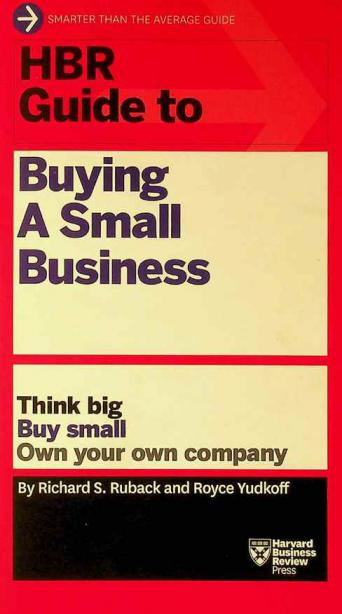
HBR guide to buying a small business
\"Are you looking for an alternative to a career path at a big firm? Does founding your own start-up seem too risky? There is a radical third path open to you: You can buy a small business and run it as CEO. Purchasing a small company offers significant financial rewards--as well as personal and professional fulfillment. Leading a firm means you can be your own boss, put your executive skills to work, fashion a company environment that meets your own needs, and profit directly from your success. But finding the right business to buy and closing the deal isn't always easy. In the 'HBR Guide to Buying a Small Business,' Harvard Business School professors Richard Ruback and Royce Yudkoff help you: Determine if this path is right for you; Raise capital for your acquisition; Find and evaluate the right prospects; Avoid the pitfalls that could derail your search; Understand why a 'dull' business might be the best investment; Negotiate a potential deal with the seller; Avoid deals that fall through at the last minute\" -- Provided by publisher.

Exit strategy planning : grooming your business for sale or succession
This book shows the owners of private businesses how to plan for the most important event in their business lives - a successful exit from their businesses. It is unique because it is written from the owner's point of view, bringing together in one place all you need to know about planning for this key event.
eBook

Business exit planning
\"The most viable exit strategies for owners of mid-sized companies. For many business owners, cashing out of a business is a lifelong dream. For some, exiting a business can be a nightmare. Business Exit Planning: Options, Value Enhancement, and Transaction Management for Business Owners provides a comprehensive view of what every business owner needs to know to plan and execute a business exit. The book includes 30 relevant mini-case studies on business exit planning and transaction management, as well as a glossary of frequently used technical terms. Details options for those owners who no longer want to be active in the business, as well as for those who want to remain invested. Covers a wide range of topics related to business exit planning and transaction management, including IPO, MBO, refinancing, ESOPs, building an exit team, business plan and valuation, due diligence, and estate planning. Regardless of whether a business owner seeks an immediate exit or a staged exit over time, Business Exit Planning provides a comprehensive strategy and road map to define exit-related objectives\"
eBook

Drafting Purchase Price Adjustment Clauses in M&A
This book is for drafters of Mergers & Acquisitions (M&A) contracts. It provides an overview of purchase price adjustment tools, manipulation issues, purchase price calculation standards and the inter-relationship of such clauses.Chapter 2 discusses the basics of M&A, such as the scope of definition for M&A, and the different motives and phases during the M&A process. Chapter 3 provides a brief introduction into company valuation methods. Various valuation methods are involved in purchase price adjustment issues, hence it is essential to know their components to obviate manipulation potentials.In chapter 4, various guarantees are highlighted where its breaches can also result in purchase price adjustment. Discussion focuses on the guarantees under German law, which have different impacts depending on the magnitude. An ambiguously drafted clause can have the surprising opposite effect desired by the parties. This leads to one of the central themes of the paper; precise formulation of clauses is the foundation for good contract drafting as it reduces potential future disputes.The main chapter of this book is chapter 5 where the two tools which directly influence the purchase price will be discussed: retrospective purchase price adjustments (post-closing adjustments) and future-oriented purchase price adjustments (earn-outs). The differences, advantages and disadvantages for both parties, the appropriate metric, manipulation issues and the calculation of the purchase price adjustment will be covered to guide the drafter of common foreseeable problems. Chapter 6 provides a brief introduction to issues which can arise relating to dispute resolution, which are common avenues in international M&A transactions as arbitration does not necessary always follow the set international rules. Other clauses in an M&A contract also have influence indirectly, on
the purchase price, so chapter 7 covers the matter of coordination of purchase price influencing clauses.
eBook
Exit Strategy Planning
For private business owners, managing a successful exit from their business is one of the most important events in their business lives. This book shows you how to do so with the minimum of fuss and maximum return. It is unique because the author writes from the owner's point of view, bringing together in one place all you need to know about planning this complex process. Exit Strategy Planning emphasises the need to place exit planning on a firm foundation, with taxation planning and business continuity planning providing the basis to ensure a smooth transition that will yield the maximum return. The first three parts of the book ('Laying the Foundations', 'Choosing your Exit Strategy' and 'Preparing and Implementing your Plans') present a best practice approach to this complex subject. Here the book highlights the importance of planning, often several years in advance, and explains the need to make the business 'investor ready' by identifying and removing impediments to sale. Part 3 culminates in a step-by-step guide to producing and implementing your Master Exit Strategy Plan. Following on from this the extensive appendices in Part 4 discuss in detail each of the exit options open to you (many of which you have probably never considered) and show how to choose the optimum exit route. Exit Strategy Planning is a book that will do more than save you time and money now and in the future; it will help you to maximise on what may well be a lifetime's investment.
Contents: Introduction: The story of Bill and Carol. Part 1: Laying the Foundations: The importance of time and timing; How to plan for the continuity of your business; Establishing the value of your business. Part 2: Choosing Your Exit Strategy: What are the exit options for your business?; How to choose the best exit strategy; Impediments to sale. Part 3: Preparing and Implementing Your Plans: Business planning - the essential elements; Short-term exit strategy planning; How to design your master exit strategy plan; The integrated financial plan; Putting your master exit strategy plan into action. Part 4: Appendices: What about tax?; Valuation principles and methods; Agents and franchisees; Family succession planning; Management buyouts and buy-ins; Flotation or public listing; Franchising or licensing; Trade sales; The sole trader merger; Ceasing to trade. Index.
John Hawkey BA (Hons), Dip Law, MCom, CPA, Barrister at Law, has had extensive experience in business, professional practice and consulting, including being an owner/manager in manufacturing, publishing and printing. For several years he worked in the fields of insolvency and reconstruction before spending the last 15 years as a consultant providing specialist services in mergers and acquisitions, business sales and exit strategy planning. John is a Director of Exit Strategies Limited, a UK-based consultancy offering exit strategy planning advice. More information is available from the company's website at www.exitstrategyplanning.com, or you can contact John at johnhawkey@aol.com
eBook

Moving on
Selling a business is a critical event that may occur only once in a lifetime. This is an event when you can’t afford to make a mistake. Small business owners need basic guidance from someone who doesn’t have a stake in the sale of their business. Moving On: Getting the Most from the Sale of Your Small Business is a straight forward, highly pragmatic discussion that will guide you through the sales process and help you avoid some of the common pitfalls faced by business owners that lack experience with the process. This book will assist you in finding the right professional help when you are ready. James F. Grebey, an operations management specialist who provides small business owners with insight into the sales process, helps you recognize pitfalls that could impact your sale negotiations. This book is replete with tips and tools that you will need to drive a successful sale of your business, such as writing the \"book\" used to market the business, and recommendations to create a working model with a dynamic (what if) spreadsheet to justify your sales projections. Readers will learn where to reach out for qualified professionals that can help with the sale process.
Publication