
Catalogue Search | MBRL


Are you sure you want to remove the book from the shelf?

{{itemTitle}}
1,528
result(s) for
"Samurai"
Sort by:

How to live like a Samurai warrior
\"Describes the skills and training needed to become a samurai, from combat training to lessons in reading, writing, and poetry, and provides information on living in a samurai castle\"-- Provided by publisher.
Book
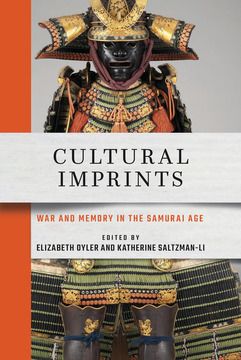
Cultural Imprints
Cultural Imprints draws on
literary works, artifacts, performing arts, and documents that were
created by or about the samurai to examine individual \"imprints,\"
traces holding specifically grounded historical meanings that
persist through time. The contributors to this
interdisciplinary volume assess those imprints for what they can
suggest about how thinkers, writers, artists, performers, and
samurai themselves viewed warfare and its lingering impact at
various points during the \"samurai age,\" the long period from the
establishment of the first shogunate in the twelfth century through
the fall of the Tokugawa in 1868.
The range of methodologies and materials discussed in
Cultural Imprints challenges a uniform notion of warrior
activity and sensibilities, breaking down an ahistorical,
monolithic image of the samurai that developed late in the samurai
age and that persists today. Highlighting the memory of warfare and
its centrality in the cultural realm, Cultural Imprints
demonstrates the warrior's far-reaching, enduring, and varied
cultural influence across centuries of Japanese history.
Contributors: Monica Bethe, William Fleming, Andrew Goble,
Thomas Hare, Luke Roberts, Marimi Tateno, Alison Tokita, Elizabeth
Oyler, Katherine Saltzman-Li
eBook


A samurai’s Saint Helena
The laboratory was quiet in the early morning light. Just as all people hold myths and every person a memory, perhaps even the smallest and quietest of things bears a history -- buried, unnamed, but not forgotten. Teramoto switched on the fluorescent lights, filled the electric kettle, and waited as the soft hum of the room came to life. With a cup of coffee in hand, he approached the microscope -- an old companion of mine -- and placed the last slide from yesterday onto the stage. The glass was cool, the stain still vivid. As he adjusted the focus, a familiar shape emerged: pear-shaped, faintly granular, resting on the smear like a slow memory. Trichomonas vaginalis. An ordinary finding in a Pap smear, one of many specimens he sees each week. And yet, in that moment, he found himself motionless -- not because of the organism itself, but because of what its presence quietly stirred in him, like a memory surfacing unbidden. He did not forget the patient. But his thoughts were drawn elsewhere -- toward a man long buried and, specifically, the soil above his bones. A samurai. A man who died centuries ago, far from home, forgotten by most.
Journal Article


The History of Modern Japanese Education
The History of Modern Japanese Education is the first account in English of the construction of a national school system in Japan, as outlined in the 1872 document, the Gakusei. Divided into three parts tracing decades of change, the book begins by exploring the feudal background for the Gakusei during the Tokugawa era which produced the initial leaders of modern Japan. Next, Benjamin Duke traces the Ministry of Education's investigations of the 1870s to determine the best western model for Japan, including the decision to adopt American teaching methods. He then goes on to cover the eventual \"reverse course\" sparked by the Imperial Household protest that the western model overshadowed cherished Japanese traditions. Ultimately, the 1890 Imperial Rescript on Education integrated Confucian teachings of loyalty and filial piety with Imperial ideology, laying the moral basis for a western-style academic curriculum in the nation's schools.
eBook


Anatomical Proposal for Botulinum Neurotoxin Injection for Glabellar Frown Lines
Botulinum neurotoxin injection for treating glabellar frown lines is a commonly used method; however, side effects, such as ptosis and samurai eyebrow, have been reported due to a lack of comprehensive anatomical knowledge. The anatomical factors important for the injection of the botulinum neurotoxin into the corrugator supercilii muscle has been reviewed in this study. Current understanding on the localization of the botulinum neurotoxin injection point from newer anatomy examination was evaluated. We observed that for the glabellar-frown-line-related muscles, the injection point could be more accurately demarcated. We propose the injection method and the best possible injection sites for the corrugator supercilii muscle. We propose the optimal injection sites using external anatomical landmarks for the frequently injected muscles of the face to accelerate effective glabellar frown line removal. Moreover, these instructions would support a more accurate procedure without adverse events.
Journal Article

Samurai
\"A countdown of five of the most legendary samurai provides thrills as readers explore the lives, weapons, and battle tactics of these Japanese fighters\"-- Provided by publisher.
Book

The Buddhist Goddess Marishiten
In The Buddhist Goddess Marishiten, David A. Hall provides an in-depth exploration of the Buddhist cult of the warrior goddess Mārīcī, its evolution, and its efficacy and psychological impact on the Japanese warrior.
eBook