
Catalogue Search | MBRL


Are you sure you want to remove the book from the shelf?

{{itemTitle}}
2,706
result(s) for
"Sandal"
Sort by:

Anatomy and functional status of haustoria in field grown sandalwood tree (Santalum album L.)
A study on the physiology of root parasitism in sandal (Santalum album L.) was conducted by comparing a six-year-old sandal grown alone and along with a host (Casuarina equisetifolia). Although maximum haustorial connections were observed when grown along with the host, sandal formed haustorial connections with plants including grass up to a distance of 3 m. Anatomical studies on haustoria indicated a vascular connectivity between the host and sandal. While the haustoria functioned as a physiological unit supporting nutritional requirements of sandal, direct lumen–lumen xylem connections between sandal and host were absent. Functional status of the haustorial connection was studied by radio-labelling the host (Casuarina) and nearby grass with phosphorus (32P). Presence of translocated 32P in sandal was noticed after six hours of labelling the host. 32P activity was noticed from eight days up to 16 days after which then it started decreasing. Study with multiple hosts revealed that the extent of translocation from hosts to sandal varied from 28.9% (coconut + Casuarina + rubber as host) to 78.5% (Casuarina + rubber as hosts). Reverse translocation of 32P from sandal to host was also observed. The study concludes that it is not necessary to plant the host along with the sandal as it is practiced presently.
Journal Article

Host-specific influence on early growth and physiological attributes of sandal (Santalum album) grown in farmlands
Aim: The present study aimed to investigate the host- specific compatibility of sandal (Santalum album) for better root proliferation and boosting the growth of tree. Methodology: Sandal (Santalum album) was grown with 8 different leguminous and non-leguminous species at early stage to evaluate its biometric growth (height and basal diameter) and physiological (chlorophyll, photosynthesis rate and transpiration rate) performance under field conditions. Results: Sandal grown with Sesbania grandiflora recorded highest biometric observations, chlorophyll, photosynthesis and transpiration rate followed by Sandal + Albizia lebbeck and sandal + Casuarina junghuhniana. The sandal grown with leguminous host showed superior growth performance than sandal grown with non-leguminous host. Interpretation: The present study recommended that Sesbania grandiflora can be grown as transit host for boosting the growth of sandal.
Journal Article

Influences of Polycarboxylic Acid EDTA on the Compatibility and Physical Properties of Sandal Wood Flour Reinforced Poly(lactic acid)/poly(butylene adipate-co-terephthalate) Biocomposites
Utilizing poly(lactic acid) (PLA)/poly(butylene adipate-co-terephthalate) (PBAT) as polymer matrix and sandal wood flour (SWF) as the reinforced filler, different ratios of PLA/PBAT/SWF ternary biocomposites are prepared via melt reactive extrusion. To improve the interfacial adhesion of SWF and PLA/PBAT, ethylene diamine tetra acetic acid (EDTA) as a cheap and available polycarboxylic acid is incorporated into the blending system as a reactive compatibilizer. The chemical compatibilization of EDTA in these materials is confirmed by the molecular weight test results. EDTA is found to be capable to react with the terminal functional groups of the hydrophobic PLA/PBAT matrix by chain extension/ crosslinking reactions during reactive blending. Meanwhile, the esterification reaction of EDTA with the hydroxyl group of hydrophilic SWF can form a chemical bonding interface between the filler and the polymer matrix, which means an enhancement in their mechanical properties. In particular, after adding 10 wt% SWF, the flexibility and rigidity of PLA/PBAT/SWF are better than PLA/PBAT matrix. Additionally, the effects of different contents of EDTA and SWF on the phase morphology, water absorption, crystallization properties and melt flowability of the PLA/PBAT/SWF composites are also systematically investigated. This study provides some insights on further development of PLA-based wood plastic biocomposites with favorable properties.
Journal Article
Sandal reactive dyes decolorization and cytotoxicity reduction using manganese peroxidase immobilized onto polyvinyl alcohol-alginate beads
BackgroundFungal manganese peroxidases (MnPs) have great potential as bio-remediating agents and can be used continuously in the immobilized form like many other enzymes.ResultsIn the present study, purified manganese peroxidase (MnP) enzyme isolated from Ganoderma lucidum IBL-05 was immobilized onto polyvinyl alcohol-alginate beads and investigated its potential for the decolorization and detoxification of new class of reactive dyes and textile wastewater. The optimal conditions for MnP immobilization were 10 % (w/v) PVA, 1.5 % sodium alginate, 3 % boric acid and 2 % CaCl2 solution. The optimum pH, temperature and kinetic parameters (Km and Vmax) for free and immobilized MnP were found to be significantly altered after immobilization. The immobilized MnP showed high decolorization efficiency for Sandal reactive dyes (78.14–92.29 %) and textile wastewater (61–80 %). Reusability studies showed that after six consecutive dye decolorization cycles, the PVA coupled MnP retained more than 60 % of its initial activity (64.9 % after 6th cycle form 92.29 % in 1st cycle) for Sandal-fix Foron Blue E2BLN dye. The water quality assurance parameters (BOD, COD and TOC) and cytotoxicity (haemolytic and brine shrimp lethality tests) studies before and after treatment were employed and results revealed that both the dyes aqueous solution and textile wastewater were cytotoxic that reduced significantly after treatment.ConclusionsThe decolorization and cytotoxicity outcomes indicated that immobilized MnP in PVA–alginate beads can be efficiently exploited for industrial and environmental applications, especially for remediation of textile dyes containing wastewater effluents.
Journal Article

The Effect of Need for Uniqueness on Word of Mouth
This research examines the psychosocial cost associated with positive word of mouth (WOM), which can decrease the uniqueness of possessions and thus harm high-uniqueness consumers (pilot study). As a result, high- (versus low-) uniqueness consumers are less willing to generate positive WOM for publicly consumed products that they own. However, high uniqueness does not decrease willingness to generate WOM for privately consumed products (Study 1). Study 2 demonstrates that for publicly consumed products, WOM that includes positive recommendations is more persuasive than WOM that only contains product details. Consequently, the effect of uniqueness is more pronounced for WOM recommendations than for WOM that only provides details (Study 3). Study 4 confirms that high- (versus low-) uniqueness consumers are less willing to recommend a public product to others but are equally willing to discuss product details. Study 5 analyzes real-world WOM content and finds evidence in support of these results.
Journal Article
Sandalwood: history, uses, present status and the future
Sandalwood (Santalum album L.) is a valuable tree associated with Indian culture. It is the second most expensive wood in the world. The heartwood of the tree is treasured for its aroma and is one of the finest natural materials for carving. Sandalwood oil is used in perfumes, cosmetics, aromatherapy and pharmaceuticals. The monopoly of sandalwood trade by the Governments of Karnataka, Tamil Nadu and Kerala and its consequences have resulted in severe exploitation, pushing S. album into the vulnerable category of the IUCN Red List. Extensive research has shown that sandalwood exhibits considerable genetic diversity for different traits. However, information pertaining to heartwood and oil content is meagre mainly because of non-availability of sandalwood plantations. Carrying out further research on these two important traits is difficult as natural populations have dwindled rapidly. We strongly urge that it is essential to encourage the establishment of community/corporate sandalwood plantations in different parts of India with appropriate incentives and adequate protective measures. These plantations can form the base population sources to regain the leadership of India in the sandalwood industry for perfumery and the precious art of carving.
Journal Article

Sandals of the Basketmaker and Pueblo Peoples
The decorated sandals worn by prehistoric southwesterners with their complex fiber structures and designs have been dissected, described, and interpreted for a century. Nevertheless, these artifacts remain mysterious in many respects. Teague and Washburn examine these sandals as sources of information on the history of the people known as the Basketmakers.
The unique sandals of early southwestern farmers appear in Basketmaker II and reach their greatest elaboration with the complex fabric structures and colorbanded designs of Basketmaker III. The appearance of this footwear coincides with the transition to fully sedentary maize agriculture. The authors address the origins of these sandals and what they may reveal about population movements onto and around the Colorado Plateau and about the cosmology of early farmers.
eBook

When Imitation Doesn’t Flatter: The Role of Consumer Distinctiveness in Responses to Mimicry
In a series of four experiments, the authors examine the implications of one consumer’s possession being mimicked by another consumer. The results demonstrate that when distinctiveness concerns are heightened, greater dissociation responses (i.e., possession disposal intentions, recustomization behaviors, and exchange behaviors) arise in response to being mimicked by a similar as opposed to dissimilar other. These effects are driven by threats to distinctiveness. Finally, these effects are mitigated when the imitated possession is nonsymbolic in nature and when a low degree of effort is exerted to initially obtain the possession. Implications for marketers and consumers are discussed.
Journal Article

‘Surabhi Candanam’: the First Acquaintance of Fragrant Sandal: a Problem
Sometimes seeing sandal from non-smellable distance we obtain cognition in the form ‘surabhi candanam’ (that sandal out there is fragrant). According to the Naiyāyikas, this cognition is a single qualified visual perception, where fragrance is grasped by visual sense-faculty. Normally visual sense cannot grasp fragrance. But here fragrance is grasped by visual sense through an extraordinary sense-connection. The Nyāya holds that the memory of fragrance, working as cognition-induced extraordinary sensory connection (jñānalakṣaṇa alaukika sannikarṣa), connects its object, fragrance, with visual sense. The Naiyāyikas use this thesis of jñānalakṣaṇa to explain illusion. For a direct realist like the Naiyāyikas, it is always difficult to explain illusion. But jñānalakṣaṇa explains how an object, which is absent in front, can be accessed directly by the operating sense-organ through an extraordinary sensory connection. However, there is a possible threat to the thesis of jñānalakṣaṇa. In the mechanism of jñānalakṣaṇa, memory plays a vital role. If one is already acquainted with the fragrance of sandal in some previous occasion, then the memory of fragrance can work as an extraordinary sensory connection for her. But the question arises as to what happens when she acquires the knowledge of fragrant sandal for the first time? Is it also an instance of extraordinary jñānalakṣaṇa perception? It is obvious that in such case no memory is there to help her connect her visual sense to fragrance. However, this first acquaintance is a precondition for the possibility of the later acquaintances of fragrant sandal. Hence, it is necessary for the Naiyāyikas to explain the mechanism of the first acquaintance of fragrant sandal. The Naiyāyikas will be able to save their thesis of jñānalakṣaṇa (and also their direct realism) if they can depict a moment-wise account of the whole process of the first acquaintance of fragrant sandal remaining consistent with their own basic tenets. It would require moment-analysis (kṣaṇavicāra) of that cognitive situation. In Nyāya-Vaiśeṣika tradition, several attempts have been made to solve the problem. Jayanta Bhaṭṭa in Nyāyamañjarī mentions that ‘madhura śarkarā’ or ‘sugandhi ketakī’ are cases of mental perception or mānasa pratyakṣa. He says that here manas functions as the means of perception being aided by external senses to produce such cognition. Jayanta Bhaṭṭa explains the other cases like illusion and recognition by the same model. On the other hand, Śrīdhara Bhaṭṭa in Nyāyakandalī says that in the case of the first acquaintance, at first the fragrance is grasped by the olfactory sense. Then, the visual sense-faculty, taking the perception of the fragrance as an associate cause, produces a cognition of the qualificand. The paper constructs several versions of moment examinations (kṣaṇavicāra) for both of these suggestions and evaluates them. It is observed that although Jayanta’s thesis may be accepted as an alternative Nyāya account of the first acquaintance of fragrant sandalwood, Śrīdhara’s account fails partially. On the other hand, Jayanta fails to explicate the inner psychological steps involved in the said cognition. This paper suggests that we can successfully construct moment examination of the first acquaintance of fragrant sandal; hence, the Nyāya thesis of jñānalakṣaṇa suffers no threat of internal inconsistency. However, the relevant sensory connection working there is not an olfactory perception. Rather, it also is a memory cognition, which is generated out of the memory-trace of fragrance produced on the spot from the aforesaid olfactory perception. Thus, the Naiyāyikas may save their thesis of jñānalakṣaṇa pratyakṣa as well as their direct realism.
Journal Article
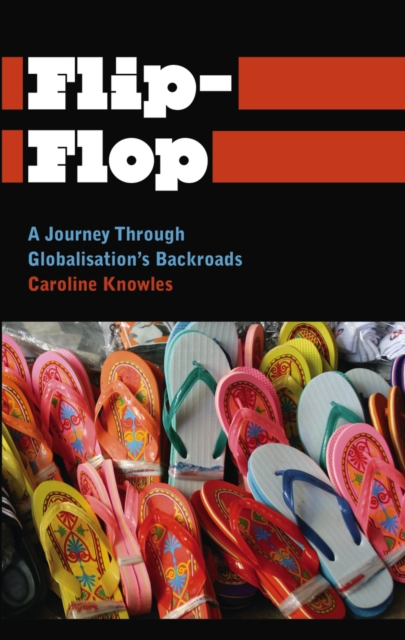
Flip-Flop
*Shortlisted for the BBC Radio 4 Thinking Allowed Award for Ethnography 2015* This book follows the global trail of one of the world's most unremarkable and ubiquitous objects - flip-flops. Through this unique lens, Caroline Knowles takes a ground level view of the lives and places of globalisation's back roads, providing new insights that challenge contemporary accounts of globalisation. Rather than orderly product chains, the book shows that globalisation along the flip-flop trail is a tangle of unstable, shifting, ad hoc and contingent connections. This book displays both the instabilities of the 'chains' and the complexities, personal topographies and skills with which people navigate these global uncertainties. Flip-Flop provides new ways of thinking about globalisation from the vantage point of the shifting landscape crossed by a seemingly ordinary and everyday commodity.
eBook