
Catalogue Search | MBRL


Are you sure you want to remove the book from the shelf?

{{itemTitle}}
144
result(s) for
"Sander, August."
Sort by:

August Sander
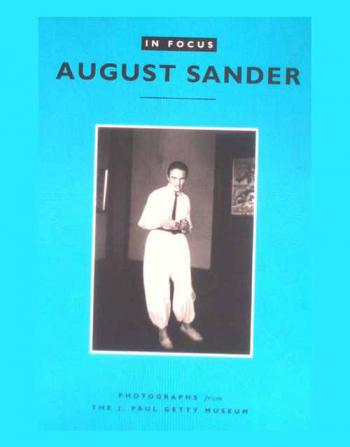
August Sander (1876-1964) was a documentary photographer whose greatest project lasted his entire working life. His series of portrait studies of the German people spanned three eras - the German Empire, the Weimar Republic and Nazi Germany - and every social class, combining to form a fascinating social mirror of the country over a tumultuous period in its history. Working with calm determination, Sander cast the same lucid eye on bankers and boxers, soldiers and circus performers, creating strikingly honest images that fulfill his sole ambition: to tell the truth about humanity.
Book

PRAKSA FOTOGRAFIRANJA SKUPIN S SKUPNIM LOKALNIM ALI DRUZBENIM OZADJEM
The article presents five world-renowned photographers with a common local or sociological background: August Sander, Irving Penn, Diane Arbus, Richard Avedon, and Josef Koudelka. Examining their photographic creations, the author looks for parallels with the photographic opus of Stojan Kerbler, one of the most successful Slovene photographers and the recipient of the 2012 Trend Lifetime Achievement Award. [PUBLICATION ABSTRACT]
Journal Article


Coal Mine Tipples, Pennsylvania
Both as artists and teachers, Bernd and Hilla Becher are the most important figures in European photography since 1960. Influenced by the formal rigor and typological method of prewar artists such as August Sander and Walker Evans, they were considered equals and fellow travelers by Minimalist sculptors such as Carl Andre and Sol LeWitt and paved the way for the medium's integration into the broader arena of contemporary art. The Bechers treated their subjects as \"anonymous sculpture\" that could be fully rendered only through either multiple views from different perspectives or, more often, through the typological accumulation and serial presentation of multiple specimens. Although they were artists not scientists, the Bechers used an almost Linnean system of classification, which they made resolutely modern. The subject of the Coal Mine Tipples, Pennsylvania is a type of wooden winding tower built clandestinely by jobless miners to extract coal in remote Pennsylvania regions during the Great Depression.
Trade Publication Article

PHOTOGRAPHY REVIEW; Citizens of Germany Before the Nation Shattered
A crowning achievement of photography in this century is a small book published in 1929 by a longtime studio photographer from Cologne, Germany. On the surface, August Sander's \"Antlitz der Zeit\" (\"Face of Our Time\") is simply a collection of 60 portraits of a wide variety of people, from farmers to industrialists. Sander's work was intended to be only the first installment in a grand project to record the entire scope of contemporary society, under the title \"Citizens of the 20th Century.\" But in 1934 the Nazis ordered \"Antlitz der Zeit\" withdrawn from circulation and destroyed the printing blocks for it; Sander was forced to turn to landscape and nature photography. August Sander's \"Antlitz der Zeit\" (\"Face of Our Time\") remains on view at the Robert Miller Gallery, 41 East 57th Street, Manhattan, through Oct. 8.
Newspaper Article
Art in Review
On display in a back gallery are 12 of Sander's portraits of farm children, taken between 1910 and 1930. Selected and printed by Gerd Sander, the gallery's owner and the photographer's grandson, these simple images demonstrate why Sander is so famous as a portraitist.
Newspaper Article

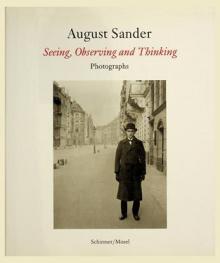
Guardian Weekly: Weekly review: Culture: Photography: Seeing, Observing, Thinking - August Sander, Fondation Henri-Cartier-Bresson, Paris
In an attempt to do justice to Sander's approach the designers of the show have mixed portraits with landscapes. He treated both types of subject in the same, systematic way, but apart from one strikingly modern view of a motorway his landscapes lack the power of his faces. By mixing the two genres the exhibition (until 20 December) brings [August Sander] closer to the fine arts, which is surely odd. But if you concentrate on the beauty of the faces this interpretation makes sense, providing further proof of the richness of Sander's work.
Newspaper Article
Sander photographs on display at gallery
Each of the prints was produced from the original plates by Sander's grandson, Gerd Sander, and his assistant, Jean Luc Differdange, and they were unveiled yesterday by the artist's great-grandson Julian Sander.
Newspaper Article