
Catalogue Search | MBRL


Are you sure you want to remove the book from the shelf?

{{itemTitle}}
403
result(s) for
"Sanitary microbiology."
Sort by:

Food Microbiology
This book covers application of food microbiology principles into food preservation and processing. Main aspects of the food preservation techniques, alternative food preservation techniques, role of microorganisms in food processing and their positive and negative features are covered. Features subjects on mechanism of antimicrobial action of heat, thermal process, mechanisms for microbial control by low temperature, mechanism of food preservation, control of microorganisms and mycotoxin formation by reducing water activity, food preservation by additives and biocontrol, food preservation by modified atmosphere, alternative food processing techniques, and traditional fermented products processing. The book isdesigned for students in food engineering, health science, food science, agricultural engineering, food technology, nutrition and dietetic, biological sciences and biotechnology fields. It will also be valuable to researchers, teachers and practising food microbiologists as well as anyone interested in different branches of food.
eBook

Disposal and management of solid waste : pathogens and diseases
\"In developed countries wastewater and sewage sludge are disposed by means that reduce or minimize exposure by humans to disease organisms. Most municipal solid waste goes to landfills which have liners to protect ground water. Humans are often exposed to pathogens, resulting in serious diseases from the disposal of human and animal wastes. This book describes the various pathogens and diseases that can be found in solid waste and describes the means and opportunities for disposal and management of various solid waste materials\"-- Provided by publisher.
Book

Impact of sampling depth on pathogen detection in pit latrines
Wastewater based epidemiology (WBE) is increasingly used to provide decision makers with actionable data about community health. WBE efforts to date have primarily focused on sewer-transported wastewater in high-income countries, but at least 1.8 billion people in low- and middle-income countries (LMIC) use onsite sanitation systems such as pit latrines and septic tanks. Like wastewater, fecal sludges from such systems offer similar advantages in community pathogen monitoring and other epidemiological applications. To evaluate the distribution of enteric pathogens inside pit latrines–which could inform sampling methods for WBE in LMIC settings unserved by sewers–we collected fecal sludges from the surface, mid-point, and maximum-depth of 33 pit latrines in urban and peri-urban Malawi and analyzed the 99 samples for 20 common enteric pathogens via multiplex quantitative reverse transcription PCR. Using logistic regression adjusted for household population, latrine sharing, the presence of a concrete floor or slab, water source, and anal cleansing materials, we found no significant difference in the odds of detecting the 20 pathogens from the mid-point (adjusted odds ratio, aOR = 1.1; 95% confidence interval = 0.73, 1.6) and surface samples (aOR = 0.80, 95% CI = 0.54, 1.2) compared with those samples taken from the maximum depth. Our results suggest that, for the purposes of routine pathogen monitoring, pit latrine sampling depth does not strongly influence the odds of detecting enteric pathogens by molecular methods. A single sample from the pit latrines’ surface, or a composite of surface samples, may be preferred as the most recent material contributed to the pit and may be easiest to collect.
Journal Article

Impact of sanitary and phytosanitary measures on agri-products quality upgrading and environmental protection
Protecting human, animal, and plant life or health from additives, toxins, and contaminants in agri-products and promoting green free trade are the main components of Sanitary and Phytosanitary (SPS) measures. However, the SPS measures are heterogeneous. This study examines the impact of SPS measures on the measured export quality and discusses their influence on the environmental protection of the exporting country. International heterogeneous measures do not necessarily promote quality upgrading but greatly increase transaction costs. By contrast, China’s agri-product’ quality upgrading and environmental pollution are in sharp contrast. Based on a heterogeneous firm-trade model, this study obtains three hypothetical propositions and conducts empirical regressions using the Tobit method. This study finds that heterogeneous SPS measures hinder quality upgrading because firms present a different quality upgrading trend, which in turn impedes the environmental protection of the exporting country; the quality upgrading made by diversified SOEs is higher than that of foreign firms and private firms; the quality upgrading made by general firms is higher than that of processing firms; and protective SPS measures have a stronger negative effect on quality upgrading and environmental protection.
Journal Article

handbook of water and wastewater microbiology
\"Access to safe water is a fundamental human need and therefore a basic human right\" --Kofi Annan, United Nations Secretary GeneralEdited by two world-renowned scientists in the field, The Handbook of Water and Wastewater Microbiology provides a definitive and comprehensive coverage of water and wastewater microbiology.
eBook

Comparison of three neutralizing broths for environmental sampling of low levels of Listeria monocytogenes desiccated on stainless steel surfaces and exposed to quaternary ammonium compounds
Background
An effective environmental sampling method involves the use of a transport/neutralizing broth with the ability to neutralize sanitizer residues that are collected during sampling and to maintain viability of stressed
Listeria monocytogenes
(
Lm
) cells.
Results
We applied
Lm
onto stainless steel surfaces and then subjected
Lm
to desiccation stress for 16–18 h at room temperature (RT, 21–24 °C). This was followed by the subsequent application of Whisper™ V, a quaternary ammonium compound (QAC)-based sanitizer, diluted to 400 ppm and 8000 ppm of active quat, for 6 h. We then sampled
Lm
with sponges pre-moistened in three transport broths, Dey/Engley (D/E) broth, Letheen broth and HiCap™ broth, to generate environmental samples that contained sanitizer residues and low levels of stressed
Lm
, which were subsequently analyzed by an enrichment-based method. This scheme conformed with validation guidelines of AOAC International by using 20 environmental test portions per broth that contained low levels of
Lm
such that not all test portions were positive (i.e., fractional positive). We showed that D/E broth, Letheen broth and HiCap™ broth performed similarly when no quat or 400 ppm of quat was applied to the
Lm
contaminating stainless steel surfaces. However, when 8000 ppm of quat was applied, Letheen broth did not effectively neutralize the QAC in the samples. These comparisons were performed on samples stored under three conditions after collection to replicate scenarios of sample transport, RT for 2 h, 4 °C for 24 h and 4 °C for 72 h. Comparisons under the three different scenarios generally reached the same conclusions. In addition, we further demonstrated that storing Letheen and HiCap™ broths at RT for two months before sampling did not reduce their capacity to neutralize sanitizers.
Conclusions
We developed a scheme to evaluate the ability of transport broths to neutralize QAC sanitizers. The three transport broths performed similarly with a commonly used concentration of quat, but Letheen broth could not effectively neutralize a very high concentration of QAC. The performance of transport broths was not significantly affected under the assessed pre-sampling and post-sampling storage conditions.
Journal Article
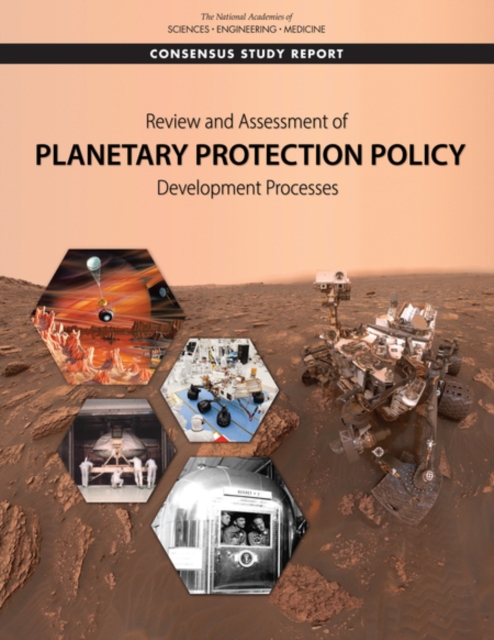
Review and Assessment of Planetary Protection Policy Development Processes
Protecting Earth's environment and other solar system bodies from harmful contamination has been an important principle throughout the history of space exploration. For decades, the scientific, political, and economic conditions of space exploration converged in ways that contributed to effective development and implementation of planetary protection policies at national and international levels. However, the future of space exploration faces serious challenges to the development and implementation of planetary protection policy. The most disruptive changes are associated with (1) sample return from, and human missions to, Mars; and (2) missions to those bodies in the outer solar system possessing water oceans beneath their icy surfaces.
Review and Assessment of Planetary Protection Policy Development Processes addresses the implications of changes in the complexion of solar system exploration as they apply to the process of developing planetary protection policy. Specifically, this report examines the history of planetary protection policy, assesses the current policy development process, and recommends actions to improve the policy development process in the future.
eBook
Lactic acid fermentation for the production of pyranoanthocyanins as food colorants
The long-discussed safety of synthetic colorants and the demand of customers for more healthy and natural products have resulted in research on natural sources to substitute those artificial colorants. Among natural alternatives, anthocyanins are well-known, nevertheless their use is limited to acidic products due to their poor stability at higher pH and elevated temperatures. Black carrot juice is a remarkable coloring food product mainly used since it has been reported to be a rich source of highly stable acylated anthocyanins and phenolic acids. Pyranoanthocyanins are pigments presented in processed fruit products like juices and wines. The enhanced stability of pyranoanthocyanins at different pH-values renders them as good candidates to be used as natural food colorant. They are reaction products of anthocyanins and different compounds from microbial metabolism. Due to the phenolic composition presented by black carrots, they are a good source of precursors for the synthesis of pyranoanthocyanins. These precursors are anthocyanins and hydroxycinnamic acids. As hydroxycinnamic acids are predominantly bound to quinic acid or sugars, cinnamoyl esterase activity is necessary. Therefore, lactic acid bacteria, able to hydrolyze the ester bond and release the free acids were used. Once released, the hydroxycinnamic acids can be converted into vinylphenols by a second group of LAB displaying hydroxycinnamate decarboxylase enzymes. The formed products react with the anthocyanins to pyranoanthocyanins. The process reported in this study thus demonstrates a very attractive approach to formulate a coloring foodstuff highly stable to be used for the food industry.Die viel diskutierten Sicherheitsbedenken bezüglich der Nutzung von synthetischen Farbstoffen und die Nachfrage von Konsumenten nach gesünderen und natürlicheren Produkten fördert die Forschung nach alternativen Farbstoffen natürlichen Ursprungs. Anthocyane stellen eine bekannte Alternative zu synthetischen Farbstoffen dar. Ihr Einsatzgebiet ist aufgrund der geringen Prozessstabilität jedoch auf Produkte mit einem hohen Säuregehalt beschränkt. Schwarzer Karottensaft wird bereits als Färbendes Lebensmittel eingesetzt, da er reich an hochstabilen acylierten Anthocyanen und Phenolsäuren ist. Pyranoanthocyane sind Farbpigmente, die in verarbeiteten Fruchtprodukten vorkommen, wie z.B. in Säften oder in Weinen. Sie eignen sich für die Verwendung als Lebensmittelfarbstoff, da sie eine hohe Stabilität bei verschiedenen pH-Werten aufweisen. Im mikrobiellen Organismus entstehen Pyranoanthocyane als Reaktionsprodukte bei der Reaktion von Anthocyanen mit Metaboliten des mikrobiellen Stoffwechsels. Vorstufen für die Gewinnung von Pyranoanthocyanen sind Anthocyane und u.a. Hydroxyzimtsäuren. Beide finden sich neben anderen phenolischen Inhaltsstoffen in der schwarzen Karotte. Hydroxyzimtsäuren liegen in dieser zum größten Teil an Chinasäure oder Zucker gebunden vor. Die vorliegende Studie beschreibt somit einen sehr attraktiven Ansatz für die Gewinnung von stabilen Farbstoffen natürlichen Ursprungs, die in der Lebensmittelindustrie verwendet werden können.
eBook

Essentials of Thermal Processing
ESSENTIALS OF THERMAL PROCESSING Explore this fully updated new edition of a practical reference on food preservation from two leading voices in the industry Among all food preservation methods in use today, thermal processing remains the single most important technique used in the industry.
eBook