
Catalogue Search | MBRL


Are you sure you want to remove the book from the shelf?

{{itemTitle}}
2,594
result(s) for
"Satire, American."
Sort by:

Funny because it's true : how the onion created modern American news satire
In 1988, a band of University of Wisconsin-Madison undergrads set out to publish a free weekly newspaper with no editorial stance other than 'You Are Dumb', and-over the course of twenty years-changed the way we consume both our comedy and our news. The Onion served as a hilarious and brutally perceptive satire of the absurdity and horrors of late twentieth century American life and grew into a global phenomenon. Here, the full history of the publication is told by one of its original staffers, author and historian Christine Wenc. Wenc charts The Onion's rise, its position as one of the first online humor sites on the internet, and the way it influenced television programs like The Daily Show and The Colbert Report through dozens of interviews.
BOOK
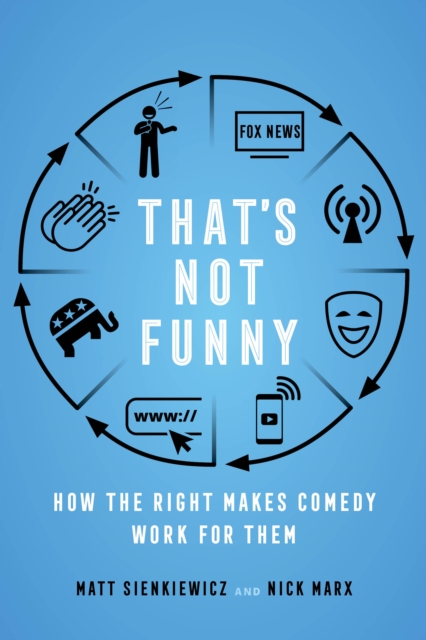
That's Not Funny
A 2022 Best Comedy Book, Vulture
A rousing call for liberals and progressives to pay
attention to the emergence of right-wing comedy and the political
power of humor. \"Why do conservatives hate comedy? Why is
there no right-wing Jon Stewart?\" These sorts of questions launch a
million tweets, a thousand op-eds, and more than a few scholarly
analyses. That's Not Funny argues that it is both an
intellectual and politically strategic mistake to assume that
comedy has a liberal bias. Matt Sienkiewicz and Nick Marx take
readers--particularly self-described liberals--on a tour of
contemporary conservative comedy and the \"right-wing comedy
complex.\" In That's Not Funny , \"complex\" takes on an
important double meaning. On the one hand, liberals have developed
a social-psychological complex-it feels difficult, even dangerous,
to acknowledge that their political opposition can produce comedy.
At the same time, the right has been slowly building up a
comedy-industrial complex, utilizing the humorous, irony-laden
media strategies of liberals such as Jon Stewart, Samantha Bee, and
John Oliver to garner audiences and supporters. Right-wing comedy
has been hiding in plain sight, finding its way into mainstream
conservative media through figures ranging from Fox News's Greg
Gutfeld to libertarian podcasters like Joe Rogan. That's Not
Funny taps interviews with conservative comedians and
observations of them in action to guide readers through media
history, text, and technique. You will find many of these comedians
utterly appalling, some surprisingly funny, and others just plain
weird. They are all, however, culturally and politically
relevant-the American right is attempting to seize spaces of comedy
and irony previously held firmly by the left. You might not like
this brand of humor, but you can't ignore it.
eBook

The Mueller report : the leaked investigation into President Donald J. Trump and his inner circle of con men, circus clowns, and children he named after himself
\"The entire country is waiting to see what former FBI director and current special counsel Robert Mueller has dug up on former mail-order steak salesman and current US president Donald Trump. The wait is over-sort of-with the publication of The Mueller Report by Jason O. Gilbert. Leaked by an anonymous and vengeful White House source who goes only by the mysterious code name “Melania T.,” The Mueller Report is a hilarious inventory of the dirt, grime, and Big Mac crumbs that the special counsel has collected on President Trump during his months of investigation. Filled with interview transcripts, intercepted phone calls, incriminating emails, text exchanges, ALL-CAPS TRUMP TWEETS WITH SPELING ERRORS, and more, it whisks readers from the leaky White House to an even leakier Ritz-Carlton hotel room in Moscow, from Donald Trump Jr.'s covert meeting with Russians in Trump Tower to Michael Cohen's secret sale of a Trump Tower apartment to a shell corporation called Oligarch LLC. And, for the first time, you'll find out what really happened in that Moscow hotel room between Donald Trump and two well-hydrated Russian escorts. Bring an umbrella! Unlike the Trump presidency, The Mueller Report is so much fun you won't want it to end. Read it right away, while books are still legal in America!\"-- Provided by publisher.
BOOK

Satire and Dissent
In an age when Jon Stewart frequently tops lists of most-trusted
newscasters, the films of Michael Moore become a dominant topic of
political campaign analysis, and activists adopt ironic, fake
personas to attract attention-the satiric register has attained
renewed and urgent prominence in political discourse. Amber Day
focuses on the parodist news show, the satiric documentary, and
ironic activism to examine the techniques of performance across
media, highlighting their shared objective of bypassing standard
media outlets and the highly choreographed nature of current
political debate.
eBook

The price of the haircut
\"A collection of stories featuring absurdist plot twists and trenchant wit\"-- Provided by publisher.
Book


Negrophobia : an urban parable
\"A provocative, raucous dark comedy about race and racism in America, now back in print after twenty-five years. Negrophobia, with its outrageous and electrifying mix of screenplay, poetry, and performance piece on paper, pushes the conventional territory of the novel to its outer, outer limits. Raunchy and rambunctious, Darius James turns words into flesh and flesh into monstrous forms. His writing is as intoxicating as the works of William Burroughs and Ishmael Reed. Under the earthshattering effects of a voodoo spell, blond teenage sex-bomb Bubbles Brazil is plunged into a startling realm of grotesque racist visions. Horrific figures populate this parallel world wherein the demagogic Uncle H. Rap Remus calls for the instant extermination of the white race by spontaneous combustion and various citizens of Harlem are found floating in a haunting underwater dreamscape. In Negrophobia worlds collapse and re-form, people explode into strange and unnatural beings from conga-drumming Muslims and ill-tempered young Negroes with numbers instead of names to Muppet-like crack-heads and a visionary extraterrestrial who never combs his hair. By the final scene, Bubbles herself has been transformed after the strangest trip a girl can have\"-- Provided by publisher.
Book

Post-Soul Satire
A collection that explores the role of current satire in shaping what it means to be black.
eBook

Make something up : stories you can't unread
\"Stories you'll never forget--just try--from literature's favorite transgressive author. Representing work that spans several years, Make Something Up is a compilation of 21 stories and one novella (some previously published, some not) that will disturb and delight. The absurdity of both life and death are on full display; in \"Zombies,\" the best and brightest of a high school prep school become tragically addicted to the latest drug craze: electric shocks from cardiac defibrillators. In \"Knock, Knock,\" a son hopes to tell one last off-color joke to a father in his final moments, while in \"Tunnel of Love,\" a massage therapist runs the curious practice of providing 'relief' to dying clients. And in \"Excursion,\" fans will be thrilled to find to see a side of Tyler Durden never seen before in a precusor story to Fight Club. Funny, caustic, bizarre, poignant; these stories represent everything readers have come to love and expect from Chuck Palahniuk\"-- Provided by publisher.
BOOK

The Dance of the Comedians
Why did Barack Obama court Jon Stewart and trade jokes with Stephen Colbert during the campaign of 2008? Why did Sarah Palin forgo the opportunity to earn votes on the Sunday morning political talk shows but embrace the chance to get laughs on Saturday Night Live? The Dance of the Comedians examines the history behind these questions—the merry, mocking, and highly contested anarchies of standup political comedy that have locked humorists, presidents, and their fellow Americans in an improvisational threeway “dance” since the early years of the American republic. Peter M. Robinson shows how the performance of political humor developed as a celebration of democracy and an expression of political power, protest, and commercial profit. He places special significance on the middle half of the twentieth century, when presidents and comedians alike—from Calvin Coolidge to Ronald Reagan, from Will Rogers to Saturday Night Live’s “Not Ready for Prime Time Players”—developed modern understandings of the power of laughter to affect popular opinion and political agendas, only to find the American audience increasingly willing and able to get in on the act. These years put the longstanding traditions of presidential deference profoundly in play as all three parties to American political humor—the people, the presidents, and the comedy professionals—negotiated their way between reverence for the office of the presidency and ridicule of its occupants. Although the focus is on humor, The Dance of the Comedians illuminates the process by which Americans have come to recognize that the performance of political comedy has serious and profound consequences for those on all sides of the punch line.
eBook