
Catalogue Search | MBRL


Are you sure you want to remove the book from the shelf?

{{itemTitle}}
116,642
result(s) for
"Saudi"
Sort by:

Oil and Security Policies
In Oil and security: Saudi Arabia 1950-2012 Islam Y. Qasem explains how the world's largest oil producer and exporter, Saudi Arabia, used oil resources to maximize internal and external security since the mid-twentieth century.
eBook

Changing Saudi Arabia : art, culture, and society in the Kingdom
Explores the role of Saudi Arabia's arts movement in promoting progressive social reform in the kingdom.
Book

A Most Masculine State
Women in Saudi Arabia are often described as either victims of patriarchal religion and society or successful survivors of discrimination imposed on them by others. Madawi Al-Rasheed's new book goes beyond these conventional tropes to probe the historical, political and religious forces that have, across the years, delayed and thwarted their emancipation. The book demonstrates how, under the patronage of the state and its religious nationalism, women have become hostage to contradictory political projects that on the one hand demand female piety, and on the other hand encourage modernity. Drawing on state documents, media sources and interviews with women from across Saudi society, the book examines the intersection between gender, religion and politics to explain these contradictions and to show that, despite these restraints, vibrant debates on the question of women are opening up as the struggle for recognition and equality finally gets under way.
eBook

Eunuchs and sacred boundaries in Islamic society
In this thought-provoking interdisciplinary work, Shaun Marmon describes how eunuchs, as a category of people who embodied ambiguity, both defined and mediated critical thresholds of moral and physical space in the household, in the palace and in the tomb of pre-modern Islamic society. The author's central focus is on the sacred society of eunuchs who guarded the tomb of the Prophet Muhammad in Medina for over six centuries and whose last representatives still perform many of their time honored rituals to this day. Through Marmon's account, the \"sacred\" eunuchs of Medina become historical guides into uncharted dimensions of Islamic ritual, political symbolism, social order, gender and time.
eBook
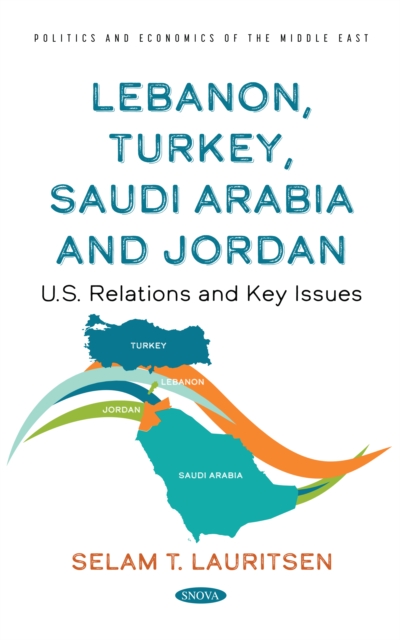
Lebanon, Turkey, Saudia Arabia and Jordan: U.S. relations and key issues
This book is a compilation of reports on Lebanon, Turkey, Saudi Arabia and Jordan.
eBook


Contesting the Saudi State
The terms Wahhabi or Salafi are seen as interchangeable and frequently misunderstood by outsiders. However, as Madawi al-Rasheed explains in a fascinating exploration of Saudi Arabia in the twenty-first century, even Saudis do not agree on their meaning. Under the influence of mass education, printing, new communication technology, and global media, they are forming their own conclusions and debating religion and politics in traditional and novel venues, often violating official taboos and the conservative values of the Saudi society. Drawing on classical religious sources, contemporary readings and interviews, Al-Rasheed presents an ethnography of consent and contest, exploring the fluidity of the boundaries between the religious and political. Bridging the gap between text and context, the author also examines how states and citizens manipulate religious discourse for purely political ends, and how this manipulation generates unpredictable reactions whose control escapes those who initiated them.
eBook