
Catalogue Search | MBRL


Are you sure you want to remove the book from the shelf?

{{itemTitle}}
1,117
result(s) for
"Saudi Arabia -- Foreign relations -- United States"
Sort by:


Saudi Arabia and the new strategic landscape
Joshua Teitelbaum evaluates Saudi foreign policy in the Persian Gulf and in the Arab-Israeli peace process and provides a shrewd assessment of the Saudi-U.S. relationship. He debunks the traditional view of Saudi foreign policy that emphasizes the Saudi concern with the Israeli-Palestinian conflict and explains how the true concern of Arabia's rulers is the ideological battle that has been opened up by Iran's push into Arab affairs.
eBook


Thicker than oil : America's uneasy partnership with Saudi Arabia
Drawing on a wide range of archival material, declassified documents, and interviews with leading Saudi and American officials, Bronson chronicles a history of close, and always controversial, contacts between the US and Saudi Arabia. She argues that contrary to popular belief the relationship was never simply about \"oil for security.\" Saudi Arabia's geographic location and religiously motivated foreign policy figured prominently in American efforts to defeat \"godless communism.\" From Africa to Afghanistan, the two worked to beat back Soviet expansion. But decisions made for hardheaded Cold War purposes left behind a legacy that today enflames the Middle East.
eBook

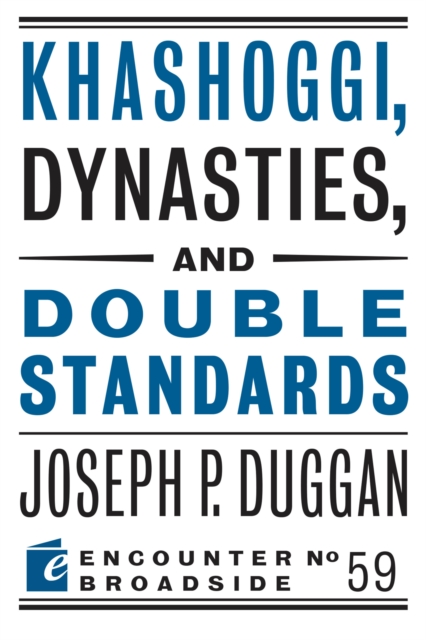
Khashoggi, Dynasties, and Double Standards
As 2018 ended, an orchestrated propaganda campaign paralyzed U.S. foreign policy. The trigger was the killing in Istanbul of Jamal Khashoggi, a member of Saudi Arabia's wealthy and politically powerful oligarchy. Mainstream media and misguided, melodramatic politicians hoodwinked millions by portraying Khashoggi as a martyr for press freedom and democracy. The real Khashoggi was nothing of the sort. President Trump's efforts to restore realism to foreign policy must contend not only with Democrats but also with naïve Republicans who reject the national-interest realism of Jeane Kirkpatrick, author of \"Dictatorships and Double Standards.\"
eBook

Desert Diplomat
In the spring of 2001, George W. Bush selected Dallas attorney
Robert W. Jordan as the ambassador to Saudi Arabia. Jordan's
nomination sped through Congress in the wake of the terrorist
attacks on 9/11, and he was at his post by early October, though
with no prior diplomatic experience, as Saudi Arabia mandates that
the U.S. Ambassador be a political appointee with the ear of the
president. Hence Jordan had to learn on the job how to run an
embassy, deal with a foreign culture, and protect U.S. interests,
all following the most significant terrorist attacks on the United
States in history.
From 2001 through 2003, Jordan worked closely with Crown Prince
Abdullah and other Saudi leaders on sensitive issues of terrorism
and human rights, all the while trying to maintain a positive
relationship to ensure their cooperation with the war in
Afghanistan and the invasion of Iraq. At the same time he worked
with top officials in Washington, including President Bush, Dick
Cheney, Colin Powell, Donald Rumsfeld, Condoleezza Rice, George
Tenet, and Tommy Franks. Desert Diplomat discusses these
relationships as well as the historic decisions of Jordan's tenure
and provides a candid and thoughtful assessment of the sometimes
distressing dysfunction in the conduct of American foreign policy,
warfare, and intelligence gathering. Still involved in the Middle
East, Jordan also offers important insights into the political,
economic, and social changes occurring in this critical region,
particularly Saudi Arabia.
eBook

Making the Desert Modern
In 1933 American oilmen representing what later became the Arabian American Oil Company (Aramco) signed a concession agreement with the Saudi Arabian king granting the company sole proprietorship over the oil reserves in the country's largest province. As drilling commenced and wells proliferated, Aramco soon became a major presence in the region. In this book Chad H. Parker tells Aramco's story, showing how an American company seeking resources and profits not only contributed to Saudi \"nation building\" but helped define U.S. foreign policy during the early Cold War.
In the years following World War II, as Aramco expanded its role in Saudi Arabia, the idea of \"modernization\" emerged as a central component of American foreign policy toward newly independent states. Although the company engaged in practices supportive of U.S. goals, its own modernizing efforts tended to be pragmatic rather than policy-driven, more consistent with furthering its business interests than with validating abstract theories. Aramco built the infrastructure necessary to extract oil and also carved an American suburb out of the Arabian desert, with all the air-conditioned comforts of Western modern life. At the same time, executives cultivated powerful relationships with Saudi government officials and, to the annoyance of U.S. officials, even served the monarchy in diplomatic disputes. Before long the company became the principal American diplomatic, political, and cultural agent in the country, a role it would continue to play until 1973, when the Saudi government took over its operation.
eBook


With Values Aligned: Improving Saudi-US Relations
The Saudi ambassador to the US discusses the nature of the US-Saudi relationship. Attention is given to the shared characteristics & personal connections underpinning basic relationships & strategic coordination, post-9/11 rise of US misperceptions concerning Saudi Arabia, Saudi counterterrorism, & the fact that Al-Qaeda's efforts in Saudi Arabia have galvanized the US-Saudi relationship rather than weaken it. Adapted from the source document.
Journal Article