
Catalogue Search | MBRL


Are you sure you want to remove the book from the shelf?

{{itemTitle}}
2,814
result(s) for
"Saudi Arabia Foreign relations."
Sort by:


Oil and Security Policies
In Oil and security: Saudi Arabia 1950-2012 Islam Y. Qasem explains how the world's largest oil producer and exporter, Saudi Arabia, used oil resources to maximize internal and external security since the mid-twentieth century.
eBook


Yemen and the Gulf States: The Making of a Crisis
Yemen is the only state on the Arabian Peninsula that is not a member of the GCC (Gulf Cooperation Council). It is also the only local state not ruled by a royal family. Relations between Yemen and the GCC states go back for centuries with some tribes in Saudi Arabia, Kuwait, Qatar, the United Arab Emirates and Oman tracing genealogy back to ancient Yemen. In this timely volume six scholars analyze Yemen’s relations with Saudi Arabia, the United Arab Emirates, Oman and Iran with a focus on recent developments, including the conflict after the fall of Ali Abdullah Salih in Yemen.
eBook
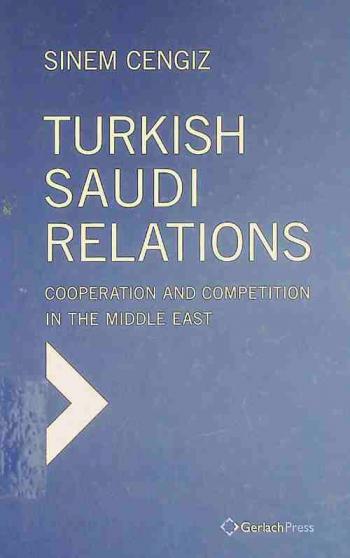
Turkish-Saudi Relations : cooperation and competition in the Middle East
Are the Middle East?s two heavyweights, Turkey and Saudi Arabia, friends or foes? What are the main drivers behind their rivalry or cooperation? The nature of their relationship has region-wide repercussions, affecting the calculations of both regional and global actors. 0This book is the first to offer a comprehensive and nuanced examination of the main drivers in the complex relationship between Turkey and Saudi Arabia, focusing on the role of domestic, regional and international dynamics. 0Three decades are examined: the 1990s, the 2000s and the 2010s. Thus a review of the recent history of the relationship outlining the background dynamics goes on to identify the key turning points in the post- 2011 Middle East, in which the two states have frequently found themselves on a collision course due to their widely differing domestic, regional and international agendas.
Book

Saudi Arabia's rapprochement with Israel: the national security imperatives
The purpose of this article is to examine the evolution of Israel's relations with Saudi Arabia since the establishment of the Jewish state in 1948. The author explains how the major events in the Middle East affected Saudi Arabia's foreign policy orientation. It shows how Saudi Arabia's policy toward Israel was affected by the deterioration in Saudi-Egyptian relations, by its quest for security in the Arabian Gulf region and by its aspiration to hegemony in the Middle East. The author argues that Saudi Arabia's policy toward Israel remained far less hostile than that of the Arab states surrounding Israel. In addition, it argues that it was not until 1973 that Saudi Arabia became seriously involved in the attempt to pressure Israel to withdraw from the territories it occupied in the Six-Day War. The author concludes by showing that neither Saudi Arabia's acquisition of the intelligence-gathering AWACS aircraft, nor Israel's invasion of Lebanon or the massacre of Palestinians in the refugee camps of Sabra and Shatila had a serious impact on the bilateral relations, and that it was not until the emergence of the Iranian nuclear threat that Saudi Arabia's relations with Israel began to improve.
Journal Article

Turkish-Saudi Relations : cooperation and competition in the Middle East
Are the Middle East?s two heavyweights, Turkey and Saudi Arabia, friends or foes? What are the main drivers behind their rivalry or cooperation? The nature of their relationship has region-wide repercussions, affecting the calculations of both regional and global actors. 0This book is the first to offer a comprehensive and nuanced examination of the main drivers in the complex relationship between Turkey and Saudi Arabia, focusing on the role of domestic, regional and international dynamics. 0Three decades are examined: the 1990s, the 2000s and the 2010s. Thus a review of the recent history of the relationship outlining the background dynamics goes on to identify the key turning points in the post- 2011 Middle East, in which the two states have frequently found themselves on a collision course due to their widely differing domestic, regional and international agendas.
Book

Saudi Arabia and the new strategic landscape
Joshua Teitelbaum evaluates Saudi foreign policy in the Persian Gulf and in the Arab-Israeli peace process and provides a shrewd assessment of the Saudi-U.S. relationship. He debunks the traditional view of Saudi foreign policy that emphasizes the Saudi concern with the Israeli-Palestinian conflict and explains how the true concern of Arabia's rulers is the ideological battle that has been opened up by Iran's push into Arab affairs.
eBook

Saudi interventions in Yemen : a historical comparison of ontological insecurity
\"This book explains the Saudi decision to launch a direct military intervention in Yemen in 2015 by comparing it with the monarchy's response to Egyptian intervention into Yemen in 1962. It does so through the lens of domestic politics by tracing the monarchy's response to the opposition in both time periods, and how this was informed by the different regional contexts of the 1960s and the 2011 Arab Spring. The study argues that Saudi Arabia enhanced its own institutions, including a pan-Islamic ideological justification to rule, in response to aggression from Egypt and its revolutionary pan-Arab ideology. This contributed to a relatively cautious Saudi foreign policy in response to regional threats from Arab nationalism, along with a strategy of co-optation within the kingdom. In contrast, the non-ideological threat embodied in the Arab Spring posed a more existential threat to Saudi legitimacy. The new crown prince manipulated the regime's sense of anxiety from this to consolidate power through further scapegoating of the Shi'a minority, exacerbated tensions with foreign rivals, and, most blatantly, the 2015 intervention in Yemen. Comparing Saudi foreign policy changes from the Arab nationalist period to the post-Arab Spring period, this volume is a valuable resource for scholars and students interested in political science, history, international relations and Middle East politics\"-- Provided by publisher.
Book

Desert Diplomat
In the spring of 2001, George W. Bush selected Dallas attorney
Robert W. Jordan as the ambassador to Saudi Arabia. Jordan's
nomination sped through Congress in the wake of the terrorist
attacks on 9/11, and he was at his post by early October, though
with no prior diplomatic experience, as Saudi Arabia mandates that
the U.S. Ambassador be a political appointee with the ear of the
president. Hence Jordan had to learn on the job how to run an
embassy, deal with a foreign culture, and protect U.S. interests,
all following the most significant terrorist attacks on the United
States in history.
From 2001 through 2003, Jordan worked closely with Crown Prince
Abdullah and other Saudi leaders on sensitive issues of terrorism
and human rights, all the while trying to maintain a positive
relationship to ensure their cooperation with the war in
Afghanistan and the invasion of Iraq. At the same time he worked
with top officials in Washington, including President Bush, Dick
Cheney, Colin Powell, Donald Rumsfeld, Condoleezza Rice, George
Tenet, and Tommy Franks. Desert Diplomat discusses these
relationships as well as the historic decisions of Jordan's tenure
and provides a candid and thoughtful assessment of the sometimes
distressing dysfunction in the conduct of American foreign policy,
warfare, and intelligence gathering. Still involved in the Middle
East, Jordan also offers important insights into the political,
economic, and social changes occurring in this critical region,
particularly Saudi Arabia.
eBook