
Catalogue Search | MBRL


Are you sure you want to remove the book from the shelf?

{{itemTitle}}
156
result(s) for
"Scenography"
Sort by:

The role of scenography in enhancing the visual impact of poster design
Scenography, traditionally linked to theatre, has emerged as a powerful tool in poster design. This study examines how scenographic principles—spatial composition, layering, lighting, and depth—enhance visual impact and communication. Using surveys and designer interviews, the research explores scenography’s role in engaging viewers and reinforcing messages. Findings suggest that scenographic techniques create immersive experiences and improve message retention. Case studies highlight their application in storytelling. The study also addresses challenges, such as balancing complexity with clarity. By bridging scenography and graphic design, this research offers valuable insights for designers and educators, fostering innovation in visual communication. L'escenografia, tradicionalment vinculada al teatre, s'ha convertit en una eina poderosa en el disseny de cartells. Aquest estudi explora com els principis escenogràfics—composició espacial, superposició, il·luminació i profunditat—milloren l'impacte visual i la comunicació. A través d'enquestes i entrevistes amb dissenyadors, s'analitza el paper de l'escenografia en l'atracció de l'espectador i el reforç del missatge. Les troballes indiquen que aquestes tècniques creen experiències immersives i milloren la retenció del missatge. Els estudis de cas il·lustren la seva aplicació en la narració visual. Aquesta recerca aporta coneixements valuosos per a dissenyadors i educadors, fomentant la innovació en la comunicació visual. La escenografía, tradicionalmente vinculada al teatro, se ha convertido en una herramienta poderosa en el diseño de carteles. Este estudio explora cómo los principios escenográficos—composición espacial, superposición, iluminación y profundidad—mejoran el impacto visual y la comunicación. A través de encuestas y entrevistas con diseñadores, se analiza el papel de la escenografía en la atracción del espectador y el refuerzo del mensaje. Los hallazgos indican que estas técnicas crean experiencias inmersivas y mejoran la retención del mensaje. Los estudios de caso ilustran su aplicación en la narración visual. Esta investigación aporta conocimientos valiosos para diseñadores y educadores, fomentando la innovación en la comunicación visual. A cenografia, tradicionalmente associada ao teatro, tornou-se uma ferramenta essencial no design de cartazes. Este estudo analisa como os princípios cenográficos—composição espacial, sobreposição, iluminação e profundidade—melhoram o impacto visual e a comunicação. Através de inquéritos e entrevistas com designers, explora-se o papel da cenografia na captação do público e no reforço da mensagem. Os resultados sugerem que estas técnicas criam experiências imersivas e aumentam a retenção da mensagem. Estudos de caso destacam a sua aplicação na narrativa visual. Esta investigação fornece insights valiosos para designers e educadores, promovendo a inovação na comunicação visual.
Journal Article
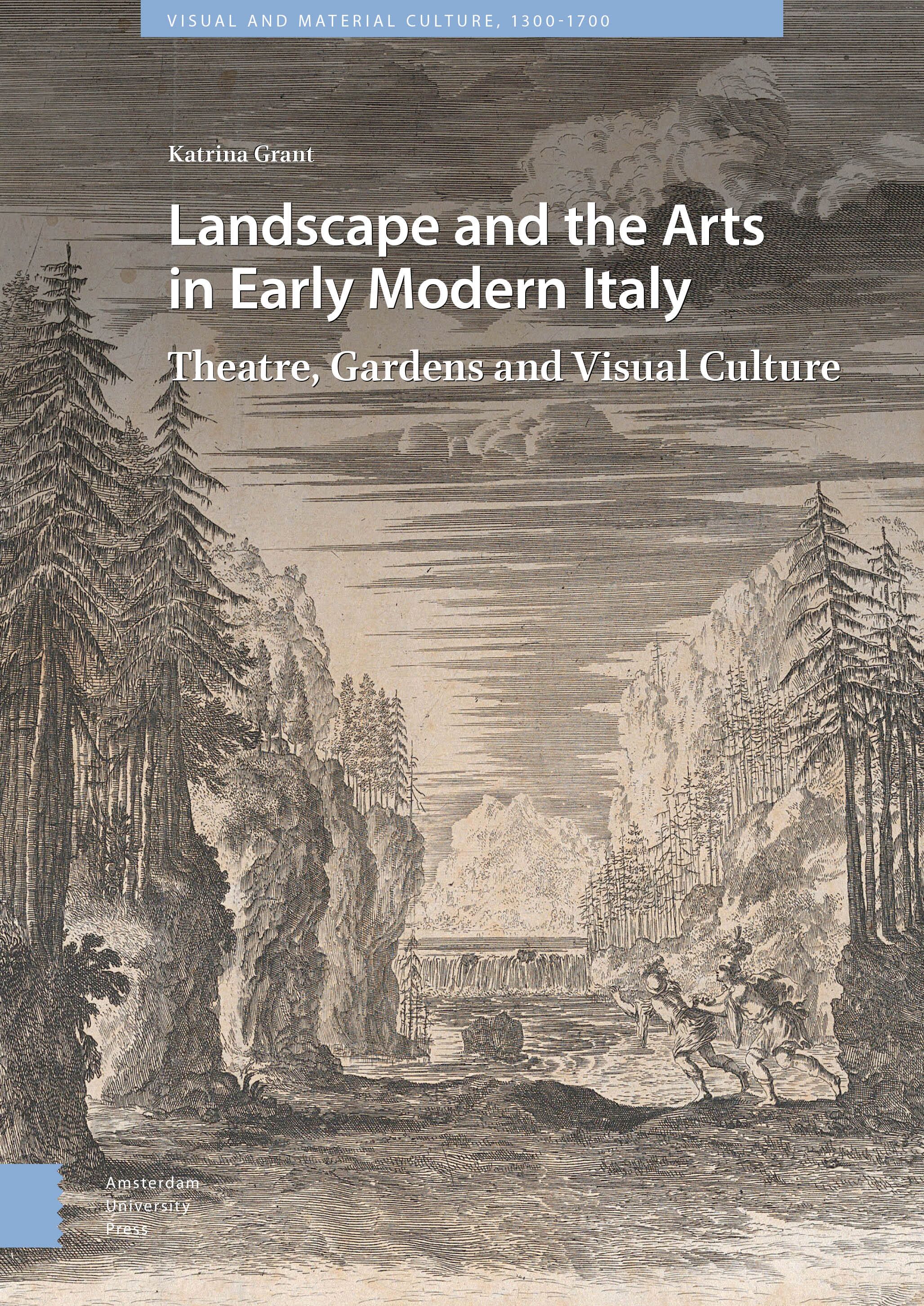
Landscape and the Arts in Early Modern Italy
Landscape and the Arts in Early Modern Italy: Theatre, Gardens and Visual Culture argues that theatre, and the new genre of opera in particular, played a key role in creating a new vision of landscape during the long seventeenth century in Italy. It explores how the idea of gardens as theatres emerged at the same time as opera was developed in Italian courts around the turn of the seventeenth century. During this period landscape painting emerged as a genre and the aesthetic of designed landscapes and gardens was wholly transformed, which resulted in a reconceptualization of the relationship between humans and landscape. The importance of theatre as a key cultural expression in Italy is widely recognised, but the visual culture of theatre and its relationship to the broader artistic culture is still being untangled. This book argues that the combination of narratives playing out in natural settings (Arcadia, Parnassus, Alcina), the emotional responses elicited by sets and special effects (the apparent magical manipulation of the laws of nature), and, the way that garden theatres were used for displays of power and to enact princely virtue and social order, all contributed to this shifting idea of landscape in the seventeenth century.
eBook
Sprawczość scenografii: między sceną teatralną i społeczną
This article discusses the research project Change the Setting: Polish Theatrical and Social Set Design of the 20th and 21st Centuries, carried out by a team led by Dariusz Kosiński, and concluded with a three-volume publication. The author presents the project’s theoretical premises and subject matter. She introduces and analyzes the concepts of theatrical scenography and social scenography, drawing on the example of the publication’s last volume, which re-enacts in book form an exhibition shown at the Zachęta National Gallery of Art in 2019. The exhibition presented the transformations of Polish theater set design in the 20th and 21st centuries, juxtaposing them with records of political and social events. The author of the article focuses on the volume’s value in terms of culture research: she is primarily interested in its approach to the idea of social scenography and the method of translating the reality of the exhibition into a book.
Journal Article

Metaescenografías pintadas = Painted Meta-scenographies
La vista urbana en perspectiva ilusionista es un motivo iconográfico procedente de la cultura visual del Renacimiento italiano, momento en el que fue utilizado tanto en el teatro como en la pintura. Este artículo estudia la influencia y pervivencia de esta iconografía en la pintura occidental y pone en evidencia, particularmente, los casos de metaescenografías. Se plantea una reflexión sobre los usos de dicho motivo, en especial, su empleo como recurso metaartístico, sus variantes, así como su temporalidad. A partir de ahí, se analizan algunos ejemplos de las vanguardias artísticas del siglo XX donde esta iconografía reaparece, bien constatando la supervivencia de la visión euclidiana o adquiriendo el significado de metaescenografías pintadas.AbstractThe urban view in an illusionist perspective is an iconographic motif from the visual culture of the Italian Renaissance, at which time it was used both in theatre and in painting. This article studies the influence and survival of this iconography in Western painting and highlights, in particular, cases of meta-scenographies. A reflection is raised on the uses of this motif, especially its use as a meta-artistic resource, its variants, as well as its temporality. From there, some examples of 20th century artistic avant-gardes where this iconography reappears are analyzed, either confirming the survival of the Euclidean vision or acquiring the meaning of painted meta-scenographies.
Journal Article

Art installations as an idea of interference theatre in the landscape of urban space
According to a common belief from ancient times, theatre is happening all around us while we, the actors, keep playing out our roles in the surrounding existential space. An analysis of the phenomenon of theatricalisation of public space must not disregard the role of art installations as performances which serve as the background and medial tool to evoke the interaction of the viewer and stir his/her imagination, fluctuating between the spatial form and the content – the “spirit of the place”; installations of art are symbols embedded into the contemporary cultural space of cities, which restore the memory of the past.
Journal Article

Artworks Behind the Curtain – Creativity and Copyright Law of Theatre Set Designs
Theatrical productions are often developed through the collaboration of directors, actors, producers, and many contributors, such as the costume and scenery designers. The copyright law protection for scenery designers and costume designers seems clear in many European countries, which means it can be protected by copyright law. On the contrary, in the copyright law of the United States of America, stage sets and costumes are not clearly protected. Even in those countries where protection is clearer, there are problems with the application of the law, especially in relation to the unauthorized use or adaptation of sets and costumes. Thus, the question arises as to which modifications to a set design violate the designer’s copyright. The study pays special attention to the differences for copyrightability of set designs in the United States and in two European countries (Italy and Hungary) where the protection is clearly defined. In the first half of the article, the conceptual approach to the relevant works, the legal background for the copyright protection of set design, the issue of functionality, and the copyrightability of masking and lighting are presented. The following part sheds light on the exploitation of set design, as the boundaries of adaptation and replica and non-replica licences.The study is based on the legal sources, relevant legal literature, and legal practice of the given countries.
Journal Article

Uno scenografo e un impresario: il contratto Madonis-Bellavite al teatro Sant’Angelo di Venezia (1724)
On 24 January 1724, the Veronese set designer Innocente Bellavite signed a contract with the impresario Antonio Madonis to create the sets for the operas at the Teatro Sant’Angelo in the 1724-1725 season. The contract, broken by when he entered the pay of Antonio Denzio’s company in Bohemia, is a rare testimony of the clauses established between a set designer and an impresario in Venetian theatres at that time. By highlighting this unpublished document for the investigation of Baroque scenography, this contribution adds new details to the laconic biographies of two overly neglected protagonists of early 18th-century European theatre.
Journal Article
La festa della Porchetta a Bologna: nuove prospettive di indagine (ii)
The essay reconstructs some episodes of the Feast of the Porchetta. A civic event of long history that, at least from the end of the Sixteenth Century, used different artistic, literary, musical and spectacular typologies to convey the ambitions of the Senatorial aristocracy of Felsina. It was also a highlight of the ephemeral state and allowed Bologna to be assigned its rightful place among the European capitals of the spectacle of the Ancient Regime. An extensive unpublished documentation preserved at the Archivio di Stato di Bologna, including two contracts for the construction of theatres and workshops for the fairs of 1627 and 1702, and an icnography of 1697, testify to an unexpected organizational punctuality.
Journal Article

Redefining performance relationships: Stretching the limits of bodily co-presence in the audiovisual exhibition 'Near Sighted'
This article interrogates the ways in which we understand performance: as a process, an outcome, and a philosophical approach. Drawing on an innovative audiovisual exhibition, Near Sighted (2023) as a case study, the article examines the ways in which performance practices can be used to craft and shape other forms of work that are not live performance, but which nonetheless are performative in their approach, engagement and experience.
Journal Article

Concordance des temps: De la scénographie dans Demain j’aurai vingt ans d’Alain Mabanckou
This article demonstrates that in Demain j’aurai vingt ans (“Tomorrow I will be Twenty”) Alain Mabanckou, while talking about his childhood in Pointe Noire in Congo, also talks about justifying his adhesion to the littérature-monde movement. In the main, fictional works of Alain Mabanckou portray his vision of African literature, Verre Cassé being a perfect example of this. While this earlier novel only highlights this vision, Demain j’aurai vingt ans tries to prove that this vision is the only pertinent one. In this regard, Mabanckou attempts to deconstruct the argument that the upholders of littérature-monde, to which he belongs, are westernized and too remote from African realities. The article further examines and analyses the strategies of the author based on the notions of paratopy and scenography as developed by Dominique Maingueneau in Le discours littéraire. Paratopie et scène d’énonciation (“Literary Discourse. Paratopy and enunciation scene”).
Journal Article