
Catalogue Search | MBRL


Are you sure you want to remove the book from the shelf?

{{itemTitle}}
315
result(s) for
"Schmuck"
Sort by:

Men's rings
Published in conjunction with the exhibition of Yves Gastou's collection at the L'ECOLE, School of Jewelry Arts October 5-November 30, 2018.
Book

Shells
Shells have captivated humans from the dawn of time: the earliest known artwork was made on a shell. As well as containers for food, shells have been used as tools, jewellery and decorations for dwellings, and to bring good luck or to ward off spirits. Many indigenous peoples have used shells as currency, and in a few places they still do. This beautifully illustrated book looks at the scientific and cultural history of shells, showing how their diverse colourful forms take shape. It examines pearls, the only gems of animal origin, as well as how shells have inspired artists throughout history. The book looks at shells used in architecture and ritual, but also how shells are indicators of changing environmental conditions. Also including two essays by shell expert M. G. Harasewych, emeritus curator of gastropods in the Smithsonian's Department of Invertebrate Zoology, Shells is an authoritative exploration of the deep human connection to these molluscan exoskeletons of sea, lake, land, and stream.
eBook

The art of adornment : jewellery of the Islamic lands
The Collection provides an unrivalled resource for the study of Islamic jewellery, with nearly 600 catalogued pieces in gold, silver and copper alloys, of all periods from the 7th to the 20th centuries and from throughout the Islamic world Spain to Malaysia, and Africa to the Eurasian steppes. Various sectors of production and clienteles are represented, from the court to bespoke jewellery to the urban marketplace. The jewellery also illustrates a correspondingly wide range of techniques and materials, including all the main methods of working gold, silver and copper alloys and their decoration especially filigree, niello, enamel and the setting of gems. Inevitably some periods, areas and techniques are better represented than others, but overall the Collection is remarkably comprehensive and in some areas, such as the Fatimid filigree, is among the finest in the world. This two-part volume includes virtually every form of personal adornment head, hair and headdress ornaments; earrings; nose rings; finger rings; pendants; beads; necklaces; bracelets, armlets and anklets; armband elements; amulets and amulet cases; pins and brooches; buttons; belts and belt fittings as well as harness fittings. Separate volumes in the Nasser D. Khalili Collection of Islamic Art series have been devoted to rings (vol. XVI) and the jewellery from Mughal India (vol. XVIII); more of the belt and harness fittings were included in the study of arms and armour (vol. XXI). Outstanding among the Khalili Collection jewellery are the Fatimid pieces, which include a pair of gold pins with extraordinarily fine vegetal designs rendered in the characteristic rope-and-grain filigree of Egypt or Syria; the many bracelets of the 10th early 13th centuries, including exceptional ones of gold sheet set with gems and decorated with inlaid niello and granulation made in Iran; the gold and silver repousse huntsmen s belt fittings from the Golden Horde Central Asia or the Qipchaq steppe, with clear Khitan or Jin influence; a larger number of enamelled and gilded copper-alloy belt and harness fittings from Nasrid Spain than in most other collections; an exquisite two-headed eagle in gold filigree set with emeralds from 18th-century Morocco; and a large group of Iranian enamelled jewellery of the Qajar period, including excellent enamelled pendants with portraits of the Qajar Shahs. In addition to Michael Spink s expertise in Islamic art and jewellery across its full geographical range brought to bear throughout the catalogue, Jack Ogden s comprehensive knowledge of ancient jewellery and jewellery technology is reflected in two important surveys of techniques and materials. Mark G. Kramarovksy contributed an important discussion of the origins of the spiral filigree style. Pedro Moura Carvalho reviewed the evidence for enamelling in Iran under the Safavid and Zand dynasties. J.M. Rogers made numerous additions, most notably his survey of the documentation of Ottoman jewellery, and with Manijeh Bayani have made the text of Nishaburi on medieval enamelling accessible to a wider audience.
BOOK
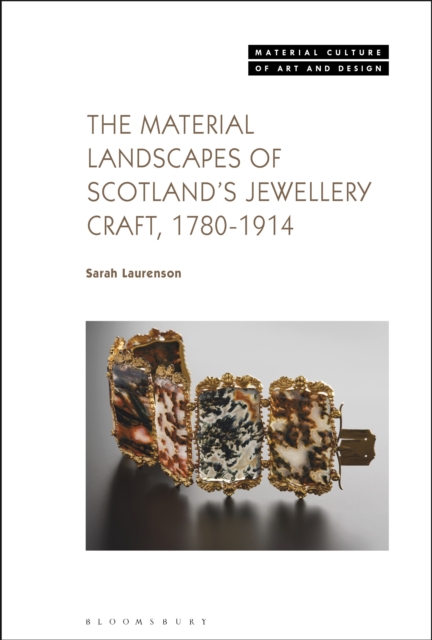
The Material Landscapes of Scotland's Jewellery Craft, 1780-1914
During the long 19th century, Scotland was home to an established body of skilled jewellers who were able to access a range of materials from the country's varied natural landscape: precious gold and silver; sparkling crystals and colourful stones; freshwater pearls, shells and parts of rare animals. Following these materials on their journey from hill and shore, across the jeweller's bench and on to the bodies of wearers, this book challenges the persistent notion that the forces of industrialisation led to the decline of craft. It instead reveals a vivid picture of skilled producers who were driving new and revived areas of hand skill, and who were key to fostering a focused cultural engagement with the natural world - among both producers and consumers - through the things they made. By placing producers and their skill in cultural context, the book reveals how examining the materiality of even the smallest of objects can offer new and multifaceted insights into the wider transformations that marked British history during the long 19th century. The Material Landscapes of Scotland's Jewellery Craft 1780-1914 brings together a vast array of jewellery objects with a range of other sources - including paintings, engravings, newspaper reports, letters, inventories of big houses and small workshops, sketchbooks, novels, works of literary geology and early travel writings - to provide a detailed cultural history of jewellery production. In doing so, it sets out innovative methodologies for writing about the histories of craft production, the natural environment and the material world.
eBook

Understanding jewellery : the twentieth century
\"In this new work, Bennett and Mascetti have taken the original concept of Understanding Jewellery a stage further. Now, with the benefit of 20 years of hindsight, they have concentrated on the 20th century alone by conducting a detailed survey of each decade, identifying the key players, trends and movements. The book is an encyclopaedic history of the various forms, techniques and materials employed by the companies and individuals who defined jewelry in the 20th century\"--Publisher.
Book


Ruby, sapphire & spinel : an archaeological, textual and cultural study
Until about two hundred years ago, no gemological distinction was made between ruby and spinel. Red spinel and red ruby are not infrequently found together and though gem cutters and engravers noticed and commented on the difference in hardness, the assumption was that spinel was simply an \"unripe\" version of ruby. Additionally, ruby and sapphire are both versions of the mineral corundum, distinguished only by color and minute traces of the metal oxides that caused these different colors. Sapphires may be pink, yellow, and green as well as blue, while rubies come in many shades of red which, inevitably causes confusion as one person's pale red ruby is another's pink sapphire--there are no absolutes. Consequently, the nomenclature is confused, both within early texts, and also in later translations of those texts. The ancient authors could only report on the basis of the information available to them at the time, while those writing the later translations were fine textual scholars or epigraphers, but not infrequently poor gemologists, not familiar with the mineralogical distinctions between the gems. It has often been difficult to get an overarching view of the many different factors that all played a part in the spread of precious gems and of the dissemination of knowledge about them. Given the paucity of available information concentrating exclusively on the use of ancient precious gemstones, the author combed the literature for relevant references. A surprising amount of descriptive and factual information was found, mostly scattered throughout early texts. The most interesting passages were selected and wherever possible the original authors' words were quoted rather than paraphrased. The early translations in the languages used by 17th-19th century scholars are given, names of people, places or objects that otherwise might have remained obscure are explained. Gems travel. They follow wealth and because of their natural immutability, the only way they can be identified by culture is by the way man has affected their appearance, deliberately or accidentally. The dating of gems that are still in original period settings is easier because the dated typology of rings and jewelry settings generally, is more secure than the study of gem shapes, while the study and dating of specific faceting styles of unmounted stones is still in its infancy.
Book

The pearl frontier
Border-crossing on the pearl frontier -- The birth of the pearling zone, 1860-1890 -- Maritime mobility in eastern Indonesia -- Master pearlers on both sides of the frontier -- Labor migration to north Australia, 1901-1941 -- Challenging social segregation -- War on the pearl frontier -- Disputed borders on the pearl frontier -- Marriage and Australian citizenship
Book


Understanding informal jewellery apprenticeship in Ghana: nature, processes and challanges
Context: The processes of acquiring education in jewellery in Ghana has been dominated by the informal apprenticeship system and it forms the backbone of the workforce of the jewellery industry in Ghana. However, the patronage of informal jewellery apprenticeship in Ghana in recent times has been on decline even though it has the potential of training human resources to transform Ghana's precious mineral resources sector. This is based on the belief that jewellery trade and its training are shrouded in secrecy, in other words, the jewellery trade is considered to be a sacred profession where information on its operating systems are not allowed to be shared easily. It is believed to be associated with cult and magic, hence the reluctant to admit people who are from outside the family of particular jewellery enterprise. This study is sought to bring to fore the understanding nature, processes and challenges of the informal jewellery apprenticeship in Ghana. Approach: The study adopted the descriptive and phenomenology research designs (qualitative research methods). Jewellers who own a jewellery business and who are training other people through apprenticeships as well as people who are trained are observed and interviewed. A sample size was selected through purposive and convenience sampling techniques from four jewellery enterprises in Accra, Ghana. A thematic analysis plan was adopted to generate findings of the study. Findings: The results show that for a person to train as a jeweller, s/he has to enrol by going through induction, furthermore fees (money and perishable items) are to be paid. The training content is driven by orders received by the master jeweller, thereby making it unstructured and lacking criteria for assessing the performance and progress of apprentice jewellers. Teaching and learning methods are usually on-the-job training that rely on demonstrations and observation. Conclusion: Informal jewellery apprenticeship in Ghana uses a fexible, cost-efective approach for transferring jewellery making skills from masters to apprentice jewellers, and it has substantial potential for improving skills training in the country. Sometimes the reluctant of some jeweller to train others is to keep the trade to family members only. (DIPF/Orig.).
Journal Article