
Catalogue Search | MBRL


Are you sure you want to remove the book from the shelf?

{{itemTitle}}
173,733
result(s) for
"School environment"
Sort by:


Teachers' views of their school climate and its relationship with teacher self-efficacy and job satisfaction
The purpose of this study, in part, was to confirm the factor structure of the School-Level Environment Questionnaire, which assesses six school climate factors that can be considered important for improving schools. The study also
tested a research model of the relationships between the school climate, teachers' self-efficacy and job satisfaction. The participants included 781 Western Australian high- school teachers in 29 schools. When the data were analysed by
means of structural equation modelling, teacher self-efficacy and teacher job satisfaction were both related to school climate dimensions and there was also a relationship between teacher self-efficacy and job satisfaction. These results
provide practical information for improving school climate and suggest that it is worthwhile for school principals to consider factors within the school climate and how they might be enhanced. [Author abstract]
Journal Article

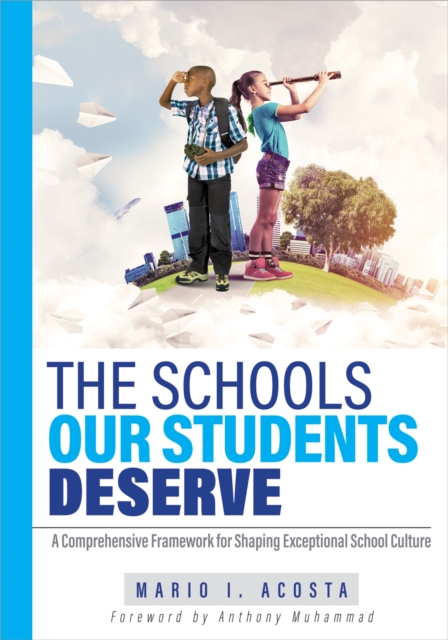
The Schools Our Students Deserve
Author Mario I. Acosta emphasizes the critical importance of school culture in enhancing student learning and optimizing teacher efficacy. In this guide, he defines and examines the foundations of an effective school culture and how it influences the school's vision, values, climate, and community and family involvement. With research-backed strategies, real-world examples, and practitioner-driven insights, he provides actionable steps for implementing meaningful culture change that ensures lasting community impact. K–12 teachers, leaders, and administrators can use this book to: * Establish balanced cultural values of strong academic integrity and mutual respect * Craft common working goals based on a vision of what their school culture should be * Identify and adopt positive behaviors that support culture change * Evaluate and strengthen the school's climate to ensure educators feel safe and supported * Build support with students' families and the community to reinforce school culture values Contents: Introduction: In Pursuit of Excellence—Shaping the Future Through Exceptional School Culture Chapter 1: An Equal Focus on Mutual Respect and a Results Orientation—Defining School Culture Chapter 2: Shared Vision—Aligning School Culture Chapter 3: Behavior Alignment for Change—Refining School Culture Chapter 4: School Climate—Creating a Positive Work Environment Chapter 5: Student Success and Family and Community Engagement—Focusing Reform Efforts Epilogue Appendix References and Resources Index
eBook

Assessing students’ perceptions of school climate in primary schools
Research at the secondary school level provides compelling evidence to suggest that a positive school climate is related to improved health, wellbeing, and cognitive outcomes for students. In response to these findings, school systems around the world are mandating the collection of school climate data in schools. However, reviews of the literature indicate that there are relatively few instruments that provide evidence to support translation and criterion validity and assess the school climate from the perspectives of primary school students; and all of them were considered unsuitable or problematic for our purposes. To overcome this gap in the literature, this article describes the development and validation of a school climate survey designed to assess primary school students’ perceptions of school climate. Evidence to support translation validity is provided through data collected at various stages of the development process. Further, data collected from a sample of 1193 primary school students (years 3 to 6) were analysed to provide evidence to support convergent, discriminant concurrent, and predictive validity. The survey and evidence of its psychometric properties are significant for researchers, schools, and education systems seeking to assess primary school students’ perception of the school climate.
Journal Article


School adjustment in adolescence explained by social support, resilience and positive affect
In order to develop future academic-professional skills and later social and financial independence, an adequate adolescent school adjustment is essential. Therefore, it is necessary to identify the variables that contribute to its improvement in a stage characterised by its decrease. The aim of the present study is to analyse and compare two theoretical models to determine the prediction of teacher and peer support, resilience and positive affect to school adjustment, measured through emotional engagement, school integration problems and perceived academic performance. The design was cross-sectional and participants were 1397 adolescents in high school (
M
= 13.88,
SD
= 1.27). The results reveal that teacher and peer support, resilience and positive affect indirectly predict perceived academic performance through school integration problems and emotional engagement. The negative effect of emotional engagement and support from peers on school integration problems is particularly worth highlighting, along with the prediction of resilience on positive affect and that of support from teachers on emotional engagement. The theoretical and practical implications of these results are discussed.
Journal Article


Collective Impact
In Collective Impact, authors Jenni Donohoo and Glenn Forbes identify barriers that impede collective teacher efficacy and detail effective strategies school leaders can use to overcome these obstacles. With reflective prompts and tools for implementation, this book will help school leaders in developing the capability to lead successful and sustainable improvement and realize more positive outcomes for students.
K12 teachers and leaders can use this book to:
Reframe deficit thinking to recognize opportunities and to embrace challenges
Foster the belief that everyone in an educational setting has the individual and collective capability to impact positive outcomes
Create a collaborative culture that promotes innovation and teamwork
Build strong, supportive teams in which everyone can grow and contribute professionally
Establish mutual goals and visions to guide committed teams toward collective efficacy and collective impact
Contents:
Introduction
Part 1: Persuasion
Chapter 1: Feedback Over Blame
Chapter 2: Perspective Over Magnitude
Chapter 3: Commitment Over Compliance
Part 2: Positive Emotions
Chapter 4: Positivity Over Negativity
Chapter 5: Psychological Safety Over Judgment
Chapter 6: Well-Being Over Uncertainty
Part 3: Mastery Experiences
Chapter 7: Action Over Avoidance
Chapter 8: Criteria Over Comparison
Chapter 9: Empowerment Over Hierarchy
Part 4: Vicarious Experiences
Chapter 10: Interdependence Over Isolation
Chapter 11: Consensus Over Ambiguity
Chapter 12: Focus Over Fragmentation
Epilogue
Appendix: Summaries of the Micro-Moves
References and Resources
Index
eBook