
Catalogue Search | MBRL


Are you sure you want to remove the book from the shelf?

{{itemTitle}}
5,826
result(s) for
"Science -- Latin America -- History"
Sort by:

Writing the new world : the politics of natural history in the early Spanish Empire
\"In this volume, Mauro Caraccioli examines the natural history writings of early Spanish missionaries, using these texts to argue that colonial Latin America was fundamental in the development of modern political thought\"-- Provided by publisher.
BOOK

Experiencing nature : the Spanish American empire and the early scientific revolution
“A very significant contribution. . . . This book tells a story that is usually left out of the master narrative of the history of exploration. . . . Moreover, it tells a story based on real expeditions and experiences, and it quotes liberally and effectively from engaging reports and sixteenth-century treatises, so it should appeal to general readers as well.” -Carla Rahn Phillips, Union Pacific Professor in Comparative Early Modern History, University of Minnesota As Spain colonized the Americas during the sixteenth century, Spanish soldiers, bureaucrats, merchants, adventurers, physicians, ship pilots, and friars explored the natural world, gathered data, drew maps, and sent home specimens of America's vast resources of animals, plants, and minerals. This amassing of empirical knowledge about Spain's American possessions had two far-reaching effects. It overturned the medieval understanding of nature derived from Classical texts and helped initiate the modern scientific revolution. And it allowed Spain to commodify and control the natural resources upon which it built its American empire. In this book, Antonio Barrera-Osorio investigates how Spain's need for accurate information about its American colonies gave rise to empirical scientific practices and their institutionalization, which, he asserts, was Spain's chief contribution to the early scientific revolution. He also conclusively links empiricism to empire-building as he focuses on five areas of Spanish activity in America: the search for commodities in, and the ecological transformation of, the New World; the institutionalization of navigational and information-gathering practices at the Spanish Casa de la Contratación (House of Trade); the development of instruments and technologies for exploiting the natural resources of the Americas; the use of reports and questionnaires for gathering information; and the writing of natural histories about the Americas.
eBook

Daily life in colonial Latin America
\"This book offers an examination of everyday life in the Iberian colonies of Central and South America--the indigenous peoples, their Spanish and Portuguese colonizers, and the Africans brought over as slaves\"-- Provided by publisher.
Book

Science in Latin America : a history
Eleven leading Latin American historians provide the first comprehensive overview of the history of science in Latin America from the sixteenth century to the present.
eBook

Latin American state building in comparative perspective : social foundations of institutional order
\"Provides an account of long-run institutional development in Latin America that emphasizes the social and political foundations of state-building processes\"-- Provided by publisher.
Book
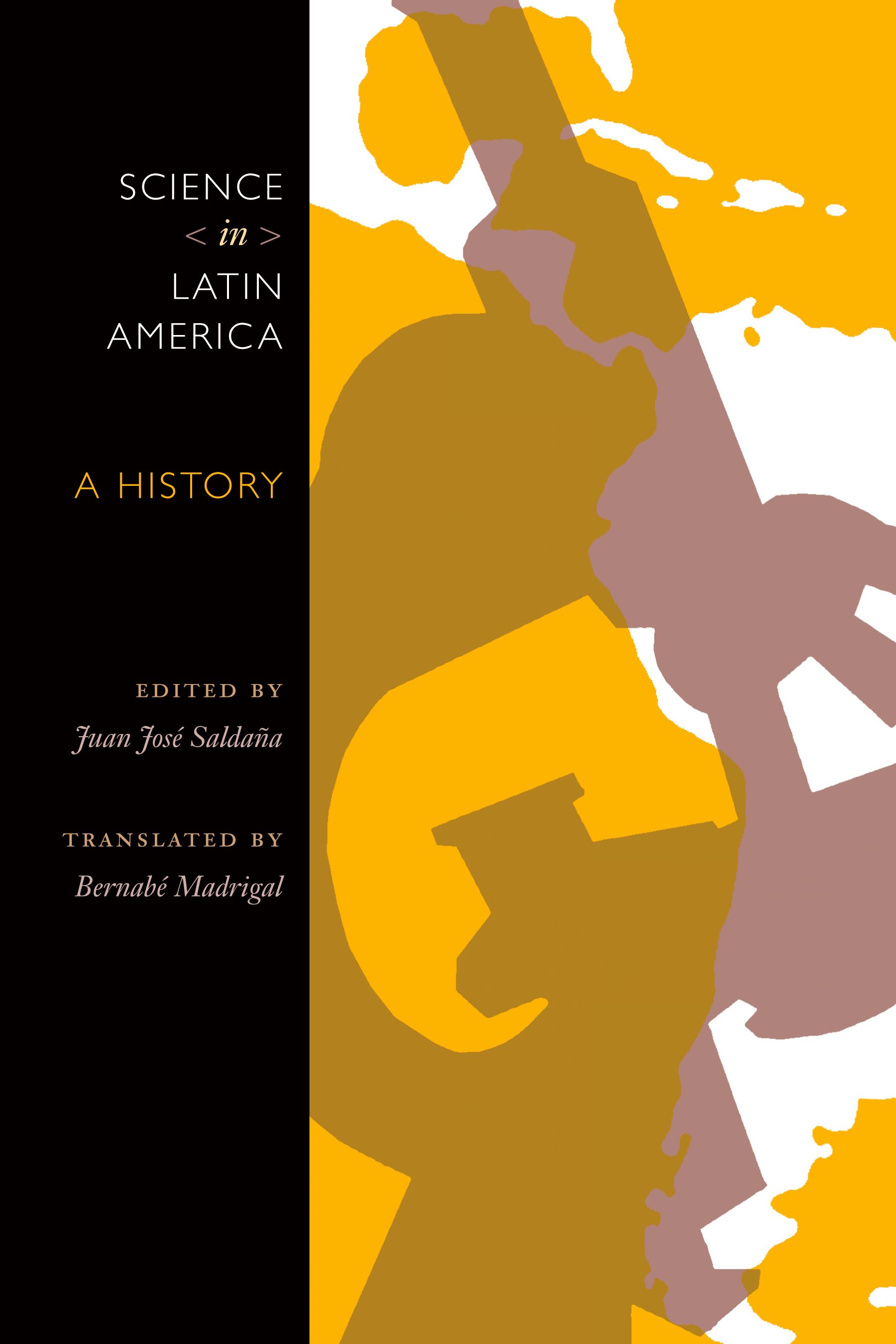
Science in Latin America
Science in Latin America has roots that reach back to the information gathering and recording practices of the Maya, Aztec, and Inca civilizations. Spanish and Portuguese conquerors and colonists introduced European scientific practices to the continent, where they hybridized with local traditions to form the beginnings of a truly Latin American science. As countries achieved their independence in the nineteenth century, they turned to science as a vehicle for modernizing education and forwarding \"progress.\" In the twentieth century, science and technology became as omnipresent in Latin America as in the United States and Europe. Yet despite a history that stretches across five centuries, science in Latin America has traditionally been viewed as derivative of and peripheral to Euro-American science. To correct that mistaken view, this book provides the first comprehensive overview of the history of science in Latin America from the sixteenth century to the present. Eleven leading Latin American historians assess the part that science played in Latin American society during the colonial, independence, national, and modern eras, investigating science's role in such areas as natural history, medicine and public health, the eighteenth-century Enlightenment, politics and nation-building, educational reform, and contemporary academic research. The comparative approach of the essays creates a continent-spanning picture of Latin American science that clearly establishes its autonomous history and its right to be studied within a Latin American context.
eBook

The success of the left in Latin America : untainted parties, market reforms, and voting behavior
\"Why, since the beginning of the twenty-first century, have so many Latin American countries elected governments identifying themselves with the ideological Left? In The Success of the Left in Latin America: Untainted Parties, Market Reforms, and Voting Behavior, Rosario Queirolo argues that the \"pink tide\" that swept across Latin America beginning in the late 1990s--with the election of a growing number of leftist political candidates to public office--was caused by the intent of voters to punish political parties unable to improve the economic well-being of their electorates. She argues that Latin Americans vote based on performance, ousting those whom they perceive as responsible for economic downturns, and ushering into power those in the \"untainted opposition,\" which has been the Left in most Latin American countries. Queirolo argues that the effects of neoliberal economic reforms did not produce more votes for political parties on the Left. Rather, the key variable is unemployment. Left-leaning parties in Latin America increase their electoral chances when unemployment is high. In addition to explaining recent electoral successes of leftist parties, The Success of the Left in Latin America also undermines a dominant scholarly view of Latin Americans as random and unpredictable voters by showing how the electorate at the polls holds politicians accountable. \"Rosario Queirolo's The Success of the Left in Latin America: Untainted Parties, Market Reforms, and Voting Behavior makes a valuable contribution to the study of Latin American politics and of comparative politics more generally. Queirolo makes a compelling argument that the general shift to the Left in Latin America was less a straightforward protest against neoliberal policies but more strongly a reaction to negative economic performance. Enriched with extensive survey data, her book is authoritative and persuasive.\" --Elizabeth J. Zechmeister, Vanderbilt University\"-- Provided by publisher.
Book

Between the National and the Universal: Natural History Networks in Latin America in the Nineteenth and Twentieth Centuries
This essay examines contemporary Latin American historical writing about natural history from the nineteenth through the twentieth centuries. Natural history is a “network science,” woven out of connections and communications between diverse people and centers of scholarship, all against a backdrop of complex political and economic changes. Latin American naturalists navigated a tension between promoting national science and participating in “universal” science. These tensions between the national and the universal have also been reflected in historical writing on Latin America. Since the 1980s, narratives that recognize Latin Americans' active role have become more notable within the renewal of the history of Latin American science. However, the nationalist slant of these approaches has kept Latin American historiography on the margins. The networked nature of natural history and Latin America's active role in it afford an opportunity to end the historiographic isolation of Latin America and situate it within world history.
Journal Article

Silver, sword, and stone
\"Arana tells the stories of three people in contemporary Latin America whose lives emblemize the three powerful historical forces that still shape Latin America: mineral exploitation (silver), violence (sword), and the Church (stone)\"-- Provided by publisher.
Book
Globalizing the History of Disease, Medicine, and Public Health in Latin America
The history of Latin America, the history of disease, medicine, and public health, and global history are deeply intertwined, but the intersection of these three fields has not yet attracted sustained attention from historians. Recent developments in the historiography of disease, medicine, and public health in Latin America suggest, however, that a distinctive, global approach to the topic is beginning to emerge. This essay identifies the distinguishing characteristic of this approach as an attentiveness to transfers of contagions, cures, and medical knowledge from Latin America to the rest of the world and then summarizes a few episodes that demonstrate its promise. While national as well as colonial and neocolonial histories of Latin America have made important contributions to our understanding, works taking the global approach have the potential to contribute more directly to the decentering of the global history of disease, medicine, and public health.
Journal Article