
Catalogue Search | MBRL


Are you sure you want to remove the book from the shelf?

{{itemTitle}}
79
result(s) for
"Science -- Portugal -- Colonies -- History"
Sort by:

Science in the Spanish and Portuguese Empires, 1500–1800
This collection of essays is the first book published in English to provide a thorough survey of the practices of science in the Spanish and Portuguese empires from 1500 to 1800. Authored by an interdisciplinary team of specialists from the United States, Latin America, and Europe, the book consists of fifteen original essays, as well as an introduction and an afterword by renowned scholars in the field. The topics discussed include navigation, exploration, cartography, natural sciences, technology, and medicine. This volume is aimed at both specialists and non-specialists, and is designed to be useful for teaching. It will be a major resource for anyone interested in colonial Latin America.
eBook

A History of Portuguese Overseas Expansion 1400-1668
A History of Portuguese Overseas Expansion 1400-1668 provides an accessible survey of how the Portuguese became so influential during this period and how Portuguese settlements were founded in areas as far flung as Asia, Africa and South America.
Malyn Newitt examines how the ideas and institutions of a late medieval society were deployed to aid expansion into Africa and the Atlantic islands, as well as how, through rivalry with Castile, this grew into a worldwide commercial enterprise. Finally, he considers how resilient the Portuguese overseas communities were, surviving wars and natural disasters, and fending off attacks by the more heavily armed English and Dutch invaders until well into the 1600s.
Including a detailed bibliography and glossary, A History of Portuguese Overseas Expansion 1400-1668 is an invaluable textbook for all those studying this fascinating period of European expansion
List of Maps Glossary Preface 1. The Origins of Portuguese Expansion to 1469 2. Portuguese Expansion 1469-1500 3. Portuguese Expansion in the East and the Atlantic, 1500 to 1515 4. The Great Portuguese Diaspora 1515-1550 5. The Portuguese Empire at its Height 1550-1580 6. Challenge and Response: The Portuguese Empire 1580-1620 7. Defeat and Survival 1620-1668 8. Understanding Portuguese Expansion
Malyn Newitt is Chales Boxer Professor of History at King's College London. His many publications include The First Portuguese Colonial Empire , A History of Mozambique and East Africa .
\"Malyn Newitt’s aim simply has been ‘to give a coherent account of a very complex topic for a new generation of students of European overseas expansion’ and ‘to restore a chronological perspective to the story of the empire.’ To do this in less than three hundred pages is no means a task, but the end product lives up to the promise. Anyone familiar with the history of the Portuguese empire should have it on the shelve.\" --Itinerario
eBook

Imperial Portugal in the Age of Atlantic Revolutions
Portugal made great efforts to tie its territories together, but the Luso-Brazilian empire eventually succumbed to revolution like its British, French and Spanish counterparts. This book reveals the links and relationships between Portugal and Brazil that survived the demise of empire and shaped the trajectories of the two countries.
eBook

A Civilised Savagery
In the two decades before World War One, Great Britain witnessed the largest revival of anti-slavery protest since the legendary age of emancipation in the mid-nineteenth century. Rather than campaigning against the trans-Atlantic slave trade, these latter-day abolitionists focused on the so-called 'new slaveries' of European imperialism in Africa, condemning coercive systems of labor taxation and indentured servitude, as well as evidence of atrocities.
A Civilized Savagery illuminates the multifaceted nature of British humanitarianism by juxtaposing campaigns against different forms of imperial labor exploitation in three separate areas: the Congo Free State, South Africa, and Portuguese West Africa. In doing so, Kevin Grant points out how this new type of humanitarianism influenced the transition from Empire to international government and the advent of universal human rights in subsequent decades.
eBook

Bárbaros
Two centuries after Cortés and Pizarro seized the Aztec and Inca empires, Spain's conquest of America remained unfinished. Indians retained control over most of the lands in Spain's American empire. Mounted on horseback, savvy about European ways, and often possessing firearms, independent Indians continued to find new ways to resist subjugation by Spanish soldiers and conversion by Spanish missionaries.
In this panoramic study, David J. Weber explains how late eighteenthcentury Spanish administrators tried to fashion a more enlightened policy toward the people they calledbárbaros,or \"savages.\" Even Spain's most powerful monarchs failed, however, to enforce a consistent, well-reasoned policy toward Indians. At one extreme, powerful independent Indians forced Spaniards to seek peace, acknowledge autonomous tribal governments, and recognize the existence of tribal lands, fulfilling the Crown's oft-stated wish to use \"gentle\" means in dealing with Indians. At the other extreme the Crown abandoned its principles, authorizing bloody wars on Indians when Spanish officers believed they could defeat them. Power, says Weber, more than the power of ideas, determined how Spaniards treated \"savages\" in the Age of Enlightenment.
eBook
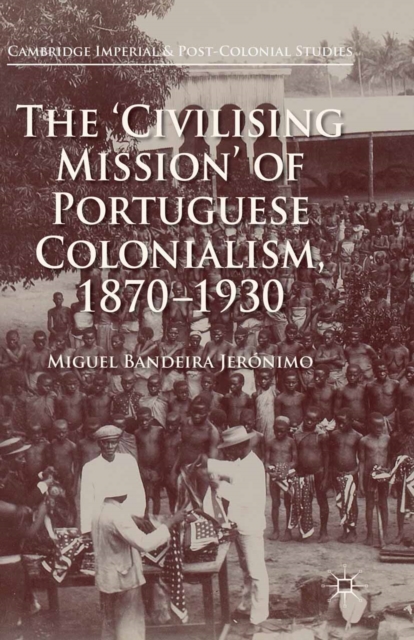
The 'civilising mission' of Portuguese colonialism, 1870-1930
This book provides an historical, critical analysis of the doctrine of 'civilising mission' in Portuguese colonialism in the crucial period from 1870 to 1930. Exploring international contexts and transnational connections, this 'civilising mission' is analysed and assessed by examining the employment and distribution of African manpower.
eBook
Legacies of the Portuguese Colonial Empire
Decolonization represented the end of colonial rule, but did not eradicate imperial and colonial categories and mythologies.Situated in the wider context of European colonial legacies, this book looks at the legacies of the Portuguese empire in today's Portugal.
eBook

American Baroque
Pearls have enthralled global consumers since antiquity, and the Spanish monarchs Ferdinand and Isabella explicitly charged Columbus with finding pearls, as well as gold and silver, when he sailed westward in 1492.American Baroquecharts Spain's exploitation of Caribbean pearl fisheries to trace the genesis of its maritime empire. In the 1500s, licit and illicit trade in the jewel gave rise to global networks, connecting the Caribbean to the Indian Ocean to the pearl-producing regions of the Chesapeake and northern Europe.Pearls-a unique source of wealth because of their renewable, fungible, and portable nature-defied easy categorization. Their value was highly subjective and determined more by the individuals, free and enslaved, who produced, carried, traded, wore, and painted them than by imperial decrees and tax-related assessments. The irregular baroque pearl, often transformed by the imagination of a skilled artisan into a fantastical jewel, embodied this subjective appeal. Warsh blends environmental, social, and cultural history to construct microhistories of peoples' wide-ranging engagement with this deceptively simple jewel. Pearls facilitated imperial fantasy and personal ambition, adorned the wardrobes of monarchs and financed their wars, and played a crucial part in the survival strategies of diverse people of humble means. These stories, taken together, uncover early modern conceptions of wealth, from the hardscrabble shores of Caribbean islands to the lavish rooms of Mediterranean palaces.
eBook

Chocolate islands : cocoa, slavery, and colonial Africa
In Chocolate Islands: Cocoa, Slavery, and Colonial Africa, Catherine Higgs traces the early-twentieth-century journey of the Englishman Joseph Burtt to the Portuguese colony of São Tomé and Príncipe—the chocolate islands—through Angola and Mozambique, and finally to British Southern Africa. Burtt had been hired by the chocolate firm Cadbury Brothers Limited to determine if the cocoa it was buying from the islands had been harvested by slave laborers forcibly recruited from Angola, an allegation that became one of the grand scandals of the early colonial era. Burtt spent six months on São Tomé and Príncipe and a year in Angola. His five-month march across Angola in 1906 took him from innocence and credulity to outrage and activism and ultimately helped change labor recruiting practices in colonial Africa. This beautifully written and engaging travel narrative draws on collections in Portugal, the United Kingdom, and Africa to explore British and Portuguese attitudes toward work, slavery, race, and imperialism. In a story still familiar a century after Burtt's sojourn, Chocolate Islands reveals the idealism, naivety, and racism that shaped attitudes toward Africa, even among those who sought to improve the conditions of its workers.
eBook

Headhunting and colonialism : anthropology and the circulation of human skulls in the Portuguese empire, 1870-1930
An exploration of headhunting and the collection of heads for European museums in the context of colonial wars, from the 1870s to the 1930s. The book offers a new understanding of the mutually dependent interaction between indigenous peoples and colonial powers, and how collected remains became regarded as objects of wider significance.
eBook