
Catalogue Search | MBRL


Are you sure you want to remove the book from the shelf?

{{itemTitle}}
48,386
result(s) for
"Science Biography."
Sort by:


John Theophilus Desaguliers
This is the first comprehensive biography of a major, but neglected, figure of his age. John Theophilus Desaguliers made his mark on the eighteenth century in several diverse ways. He was an assistant to Sir Isaac Newton and later elucidated the difficult concepts of Newtonian physics in private lectures. He was a member of the Royal Society, and was presented with the Society's highest honour, the Copley Medal, no less than three times. He was a pioneering engineer: the water supply of Edinburgh, the ventilation of the Houses of Parliament and the first Westminster Bridge all owed him a debt. In a different sphere, Desaguliers became the third Grand Master of the Grand Lodge of the Freemasons which was founded in 1717. He is remembered worldwide for his seminal influence during those early days of Freemasonry. He also wrote poetry and had an influential circle of patrons, including George I and Frederick, Prince of Wales (whom he initiated as a Mason at a specially convened lodge at Kew). This biography, based on original research, describes a charismatic character who was a major figure of his age.
eBook


From Taxonomy to Phylogenetics Life and Work of Willi Hennig
Willi Hennig (1913-1976), laid the fundaments of a 'scientific revolution' in Biological Systematics by his method called \"Phylogenetic Systematics\". The book describes the historical development of this 'scientific revolution', and highlights the life and the work of a 'cautious revolutioniser' in a Germany of dictatorship, war, and separation.
eBook

Women of invention : life-changing ideas by remarkable women
\"Hypatia was a Greek mathematician, astronomer, and philosopher who invented the hydrometer in about 400 AD. Described as a charismatic teacher, she was seen as an evil symbol of the pagan science of learning and she was eventually murdered by Christian zealots. For many women in years gone by, the invention process was fraught with danger and difficulty. Not only did they face the hardship and obstacles of inventing, they also had to contend with the sexism and gender discrimination of a male world that believed women had nothing to contribute. Scientific women came to the fore with momentous innovations which were impossible for men to ignore. During World War Two, Austrian actress Hedy Lamarr became a pioneer in wireless communications, developing a Secret Communications System. More recently, 20-year-old Ann Makosinski has invented the ingenious Hollow Flashlight which converts radiant body heat into electricity. Meanwhile other women continued inventing in the domestic sphere with Miracle Mops, long-lasting lipsticks, and magic knickers. In every walk of twenty-first century life women have been challenging themselves (and men) to shape the way we live. The 150 remarkable women in this book show all too clearly that not only can invention no longer be described as a male dominated domain but that a woman's inspiration and ingenuity will probably be driving the life-changing ideas of tomorrow's world\"--Publisher's description.
Book
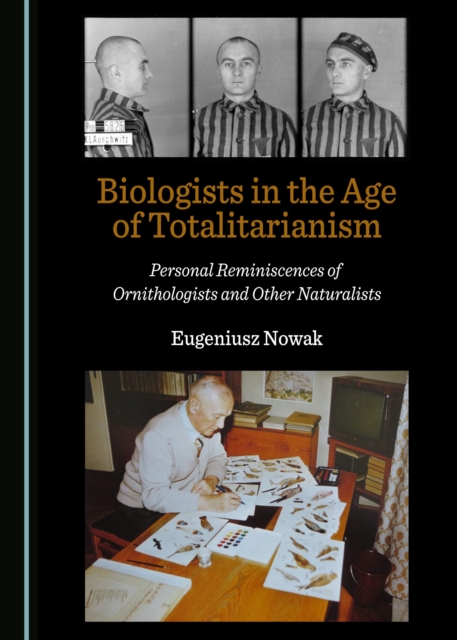
Biologists in the Age of Totalitarianism
This fascinating volume resulted from one man's frustration with the series of whitewashed obituaries and laudations he had to endure in his long career in West Germany. These were often of biologists who had worked in the Third Reich, a period generally skipped over in such eulogies. Dr Eugeniusz Nowak, born in Poland in 1933, therefore decided to do some historical research of his own. His series of controversial 'alternative' biographies of mainly German biologists in various journals soon grew into a successful book, with German, Russian and Polish editions. Now at last translated into English, this revised and updated volume contains over 40 brief lives, illustrated by 113 often dramatic photographs. It uses material gathered from dozens of Central European archives only accessible since the collapse of the Eastern Bloc. What makes this book so gripping is its personal element; Dr Nowak, with his contacts on both sides of the Iron Curtain, either knew these scientists personally or interviewed family members and colleagues. We see here how these victims (and perpetrators) were caught in the ideological nets of Nazism, Stalinism or Maoism, and how their lives were changed utterly by political forces beyond their control. As such, this book represents essential reading for those interested in the personal stories at the interface of totalitarian politics and biological science.
eBook

Einstein and the quantum : the quest of the valiant Swabian
\"Einstein and the Quantum reveals for the first time the full significance of Albert Einstein's contributions to quantum theory. Einstein famously rejected quantum mechanics, observing that God does not play dice. But, in fact, he thought more about the nature of atoms, molecules, and the emission and absorption of light--the core of what we now know as quantum theory--than he did about relativity. A compelling blend of physics, biography, and the history of science, Einstein and the Quantum shares the untold story of how Einstein--not Max Planck or Niels Bohr--was the driving force behind early quantum theory. It paints a vivid portrait of the iconic physicist as he grappled with the apparently contradictory nature of the atomic world, in which its invisible constituents defy the categories of classical physics, behaving simultaneously as both particle and wave. And it demonstrates how Einstein's later work on the emission and absorption of light, and on atomic gases, led directly to Erwin Schrèodinger's breakthrough to the modern form of quantum mechanics. The book sheds light on why Einstein ultimately renounced his own brilliant work on quantum theory, due to his deep belief in science as something objective and eternal.A book unlike any other, Einstein and the Quantum offers a completely new perspective on the scientific achievements of the greatest intellect of the twentieth century, showing how Einstein's contributions to the development of quantum theory are more significant, perhaps, than even his legendary work on relativity\"-- Provided by publisher.
Book

Scotland's Pariah
Scotland's Pariah is the first book to examine the remarkable life of John Pinkerton: antiquarian, poet, forger, cartographer, historian, serial adulterer, bigamist, and religious skeptic. A pugnacious and persistent man of letters who knew and was admired by literary masters such as Edward Gibbon, Horace Walpole, and William Godwin, Pinkerton's life was full of personal and professional misadventures.Patrick O'Flaherty's biography presents an engrossing account of Pinkerton's life and works from his early years in Scotland to his Parisian exile, covering his major editorial, antiquarian, and geographic works. Examining Pinkerton's involvement in the London literary scene, his conflicted relationship with the rise of Celtic nationalism, and his response to early literary romanticism, Scotland's Pariah is a shrewd and compassionate evaluation of an astonishing literary life.
eBook


Moore's law : the life of Gordon Moore, Silicon Valley's quiet revolutionary
Our world todayfrom the phone in your pocket to the car that you drive, the allure of social media to the strategy of the Pentagonhas been shaped irrevocably by the technology of silicon transistors. Year after year, for half a century, these tiny switches have enabled ever-more startling capabilities. Their incredible proliferation has altered the course of human history as dramatically as any political or social revolution. At the heart of it all has been one quiet Californian: Gordon Moore. At Fairchild Semiconductor, his seminal Silicon Valley startup, Moorea young chemist turned electronics entrepreneurhad the defining insight: silicon transistors, and microchips made of them, could make electronics profoundly cheap and immensely powerful. Microchips could double in power, then redouble again in clockwork fashion. History has borne out this insight, which we now call Moore's Law\", and Moore himself, having recognized it, worked endlessly to realize his vision. With Moore's technological leadership at Fairchild and then at his second start-up, the Intel Corporation, the law has held for fifty years. The result is profound: from the days of enormous, clunky computers of limited capability to our new era, in which computers are placed everywhere from inside of our bodies to the surface of Mars. Moore led nothing short of a revolution. In Moore's Law, Arnold Thackray, David C. Brock, and Rachel Jones give the authoritative account of Gordon Moore's life and his role in the development both of Silicon Valley and the transformative technologies developed there. Told by a team of writers with unparalleled access to Moore, his family, and his contemporaries, this is the human story of man and a career that have had almost superhuman effects. The history of twentieth-century technology is littered with overblown revolutions.\" Moore's Law is
essential reading for anyone seeking to learn what a real revolution looks like.
eBook