
Catalogue Search | MBRL


Are you sure you want to remove the book from the shelf?

{{itemTitle}}
3,220
result(s) for
"Science Study and teaching (Preschool)"
Sort by:

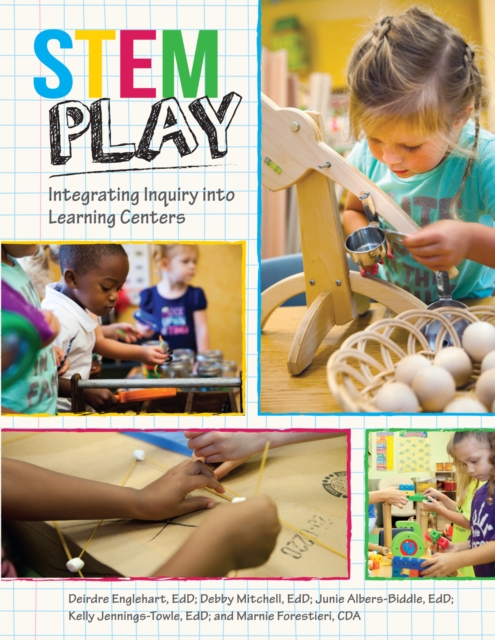
STEM Play
Most early childhood teachers are using learning centers in the classroom, but do not approach them in ways that fully support a variety of learning opportunities. This book approaches learning centers through the STEM (science, technology, engineering, math) lens, and shares how themes can be integrated into centers to promote creativity and highler-level thinking.
eBook


Engaging young children in mathematics
This book consists of conclusions drawn from the expertise shared at the Conference on Standards for Prekindergarten and Kindergarten Mathematics Education. It offers substantive detail regarding young students' understandings of mathematical ideas.
eBook

Preschool Deployment of Evidence-Based Social Communication Intervention: JASPER in the Classroom
Few research-developed early intervention models have been deployed to and tested in real world preschool programs. In this study, teaching staff implemented a social communication modularized intervention, JASPER, in their daily program. Sixty-six preschool children with autism in twelve classrooms (12 teachers) were randomized to receive immediate JASPER training (IT) or were waitlisted (WL) for 3 months with a 1-month follow up. Measures of core deficits (initiations of joint engagement, joint attention gestures and language, play skills) and standardized cognitive measures were improved for IT over WL children. IT teachers achieved and maintained high fidelity. Teachers can implement evidence-based interventions with significant improvements in core deficits of their children with ASD.
Journal Article

Professional Development for Enhancing Autism Spectrum Disorder Awareness in Preschool Professionals
The current study describes the design, implementation, and analysis of a professional development programme using a Lesson Study model to enhance awareness in preschool professionals regarding inclusive education for children with autism spectrum disorder. The mixed method approach included pre- and post-intervention questionnaires, audio-recordings of group seminars, and an interview. The results indicated an increase in autism awareness among the professionals, suggesting that professionals changed their practice as a result of the programme. This was particularly clear regarding making adjustments to the learning environment and taking measures to prevent challenging situations. In addition to describing the implementation of a professional development programme in a preschool, this paper emphasises the importance of appropriate conditions for such initiatives.
Journal Article

SEL Interventions in Early Childhood
Young children who enter school without sufficient social and emotional learning (SEL) skills may have a hard time learning. Yet early childhood educators say they don't get enough training to effectively help children develop such skills. In this article, Megan McClelland, Shauna Tominey, Sara Schmitt, and Robert Duncan examine the theory and science behind early childhood SEL interventions. Reviewing evaluation results, they find that several interventions are promising, though we need to know more about how and why their results vary for different groups of children. Three strategies appear to make interventions more successful, the authors write. First, many effective SEL interventions include training or professional development for early childhood teachers; some also emphasize building teachers' own SEL skills. Second, effective interventions embed direct instruction and practice of targeted skills into daily activities, giving children repeated opportunities to practice SEL skills in different contexts; its best if these activities grow more complex over time. Third, effective interventions engage children's families, so that kids have a chance to work on their SEL skills both at school and at home. Family components may include teaching adults how to help children build SEL skills or teaching adults themselves how to practice and model such skills. Are early childhood SEL interventions cost-effective? The short answer is that it's too soon to be sure. We won't know how the costs and benefits stack up without further research that follows participants into later childhood and adulthood. In this context, we particularly need to understand how the long-term benefits of shorter, less intensive, and less costly programs compare to the benefits of more intensive and costlier ones.
Journal Article