
Catalogue Search | MBRL


Are you sure you want to remove the book from the shelf?

{{itemTitle}}
450
result(s) for
"Science Study and teaching (Secondary) Activity programs."
Sort by:

Secondary science 11 to 16
Are you looking for ideas to make your science teaching come alive? Full of suggestions for exciting and practical activities to engage children, Practical Science 11-16 explains the science behind the experiments and shows you where it links to the national curricula in England, Scotland, Wales and Northern Ireland. The book covers the three sciences: chemistry, biology and physics. It contains detailed subject knowledge to ensure you grasp key concepts, and there are lots of useful diagrams to help illustrate key points.Experiments include:extracting DNA from a kiwi fruitcapturing rainbowsthe chromatography of sweetsremoving iron from cornflakesa plate tectonic jigsaw
eBook


Captivate, activate, and invigorate the student brain in science and math, grades 6-12
John Almarode and Ann Miller provide numerous strategies and a model for developing engaging science and math lessons and units that captivate students, activate prior knowledge, and invigorate student interest by making lessons rigorous and relevant.
eBook

Nanoscale Science
Futurists predict that nanotechnology will be the next major scientific revolutionone with an even greater impact than the Industrial Revolution. Nanoscale Science will help your middle and high school students understand the big implications of tiny technology. Using guided inquiry with open-ended exploration where possible, the books 20 investigations teach students about the unique properties and behavior of materials at the nanoscaleone-billionth of the size of a meter.
eBook
Teaching Secondary Science Through Play
This book provides broad support for using games in middle and high school science classes including Earth science/living environment, biology, chemistry, and physics. The lesson plans and resources support a play-based approach to evolution, ecosystems, cellular organisms, elements and compounds, and vector motion. Though easy to learn, the included games provide detailed scientific accuracy allowing complex simulations and immersive learning experiences. Games: Evolution. Dominic Crapuchettes, Dmitry Knorre, Sergey Machin. North Star Games, 2014. Strain. Avrom Tobias. HungryRobot, 2011. Compounded. Darell Louder. Dice Hate Me Games, 2013. Bolide. Alfredo Genovese. Rio Grande Games, 2005.
eBook
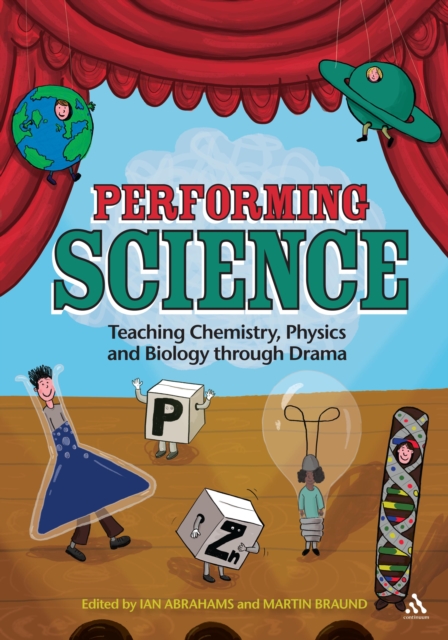
Performing science : teaching chemistry, physics and biology through drama
How to increase students' interest and engagement in science is a challenge shared by teachers around the world.Designing effective science lesson plans using drama and role play requires expertise across two very different subject areas and, as a consequence, many science teachers find it difficult to incorporate this technique into their.
eBook

Teaching Programming Concepts Through Play
Understanding how computer programming works is a critical part of digital literacy for students today. Even students who aren't learning how to code can benefit greatly from knowing how programs work. This book uses highly engaging games to immerse students in the world of logical thinking and problem solving. From programming robots to writing stories that work as interactive fiction games, the lessons in this book provide ways to build digital literacy beyond the computer lab. Games: RoboRally. Richard Garfield. Avalon Hill, 2010. Old Town. Stephan Riedel. Clicker Spiele, 2012. Ricochet Robots. Alex Randolph. Z-Man Games, 2013. Parsley Game System. Memento Mori Theatricks.
eBook
Cooperative problem-solving activities for social studies, grades 6-12
Give your students the opportunity to think, to discover, and to learn together! The second edition of Catch Them Thinking in Social Studies demonstrates how teachers can use cooperative learning strategies to fully engage students in the social studies curriculum. The authors offer engaging activities and a variety of problem-solving lessons in five areas of social studies instruction: geography, politics, economics, culture, and history. This updated edition includes new activities and helps teachers prepare students to: - Rely on themselves and their peers for information - Work closely with others Make suggestions - Use trial-and-error strategies Have fun learning about social studies
eBook
