
Catalogue Search | MBRL


Are you sure you want to remove the book from the shelf?

{{itemTitle}}
968,260
result(s) for
"Science and the humanities"
Sort by:


Disability Studies and the Environmental Humanities
Although scholars in the environmental humanities have been exploring the dichotomy between \"wild\" and \"built\" environments for several years, few have focused on the field of disability studies, a discipline that enlists the contingency between environments and bodies as a foundation of its scholarship. On the other hand, scholars in disability studies have demonstrated the ways in which the built environment privileges some bodies and minds over others, yet they have rarely examined the ways in which toxic environments engender chronic illness and disability or how environmental illnesses disrupt dominant paradigms for scrutinizing \"disability.\"Designed as a reader for undergraduate and graduate courses,Disability Studies and the Environmental Humanitiesemploys interdisciplinary perspectives to examine such issues as slow violence, imperialism, race, toxicity, eco-sickness, the body in environmental justice, ableism, and other topics. With a historical scope spanning the seventeenth century to the present, this collection not only presents the foundational documents informing this intersection of fields but also showcases the most current work, making it an indispensable reference.
eBook


Medieval Textual Cultures
Understanding how medieval textual cultures engaged with the heritage of antiquity (transmission and translation) depends on recognizing that reception is a creative cultural act (transformation). These essays focus on the people, societies and institutions who were doing the transmitting, translating, and transforming -- the \"agents\". The subject matter ranges from medicine to astronomy, literature to magic, while the cultural context encompasses Islamic and Jewish societies, as well as Byzantium and the Latin West. What unites these studies is their attention to the methodological and conceptual challenges of thinking about agency. Not every agent acted with an agenda, and agenda were sometimes driven by immediate needs or religious considerations that while compelling to the actors, are more opaque to us. What does it mean to say that a text becomes \"available\" for transmission or translation? And why do some texts, once transmitted, fail to thrive in their new milieu? This collection thus points toward a more sophisticated \"ecology\" of transmission, where not only individuals and teams of individuals, but also social spaces and local cultures, act as the agents of cultural creativity.
eBook

Writing a new environmental era : moving forward to nature
\"Writing a New Environmental Era first considers and then rejects back-to-nature thinking and its proponents like Henry David Thoreau, arguing that human beings have never lived at peace with nature. Consequently, we need to stop thinking about going back to what never was and instead work at moving forward to forge a more harmonious relationship with nature in the future. Using the rise of the automobile and climate change denial literature to explore how our current environmental era was written into existence, Ken Hiltner argues that the humanities - and not, as might be expected, the sciences - need to lead us there. In one sense, climate change is caused by a rise in atmospheric CO2 and other so-called greenhouse gases. Science can address this cause. However, approached in another way altogether, climate change is caused by a range of troubling human activities that require the release of these gases, such as our obsessions with cars, lavish houses, air travel and endless consumer goods. The natural sciences may be able to tell us how these activities are changing our climate, but not why we are engaging in them. That's a job for the humanities and social sciences. As this book argues, we need to see anthropogenic (i.e. human-caused) climate change for what it is and address it as such: a human problem brought about by human actions. A passionate and personal exploration of why the Environmental Humanities matter and why we should be looking forward, not back to nature, this book will be essential reading for all those interested in the future and sustainability of our planet\"-- Provided by publisher.
Book

The Aesop's Fable Paradigm
The Aesop's Fable Paradigm is a collection of essays
that explore the cutting-edge intersection of Folklore and Science.
From moralizing fables to fantastic folktales, humans have been
telling stories about animals-animals who can talk, feel, think,
and make moral judgments just as we do-for a very long time. In
contrast, scientific studies of the mental lives of animals have
professed to be investigating the nature of animal minds slowly,
cautiously, objectively, with no room for fanciful tales, fables,
or myths. But recently, these folkloric and scientific traditions
have merged in an unexpected and shocking way: scientists have
attempted to prove that at least some animal fables are actually
true.
These interdisciplinary chapters examine how science has
targeted the well-known Aesop's fable \"The Crow and the Pitcher\" as
their starting point. They explore the ever-growing set of
experimental studies which purport to prove that crows possess an
understanding of higher-order concepts like weight, mass, and even
Archimedes' insight about the physics of water displacement.
The Aesop's Fable Paradigm explores how these
scientific studies are doomed to accomplish little more than to
mirror anthropomorphic representations of animals in human folklore
and reveal that the problem of folkloric projection extends far
beyond the \"Aesop's Fable Paradigm\" into every nook and cranny of
research on animal cognition.
eBook

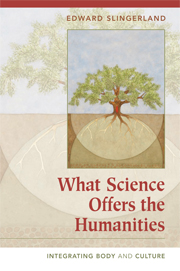
What Science Offers the Humanities
What Science Offers the Humanities examines some of the deep problems facing the study of culture. It focuses on the excesses of postmodernism, but also acknowledges serious problems with postmodernism's harshest critics. In short, Edward Slingerland argues that in order for the humanities to progress, its scholars need to take seriously contributions from the natural sciences - and particular research on human cognition - which demonstrate that any separation of the mind and the body is entirely untenable. The author provides suggestions for how humanists might begin to utilize these scientific discoveries without conceding that science has the last word on morality, religion, art, and literature. Calling into question such deeply entrenched dogmas as the 'blank slate' theory of nature, strong social constructivism, and the ideal of disembodied reason, What Science Offers the Humanities replaces the human-sciences divide with a more integrated approach to the study of culture.
eBook


Fiction: The science in Sherlock Holmes
Maria Konnikova detects the fictional sleuth's inner researcher, 130 years on from his 'birth'.
Journal Article