
Catalogue Search | MBRL


Are you sure you want to remove the book from the shelf?

{{itemTitle}}
19,647
result(s) for
"Science in popular culture"
Sort by:
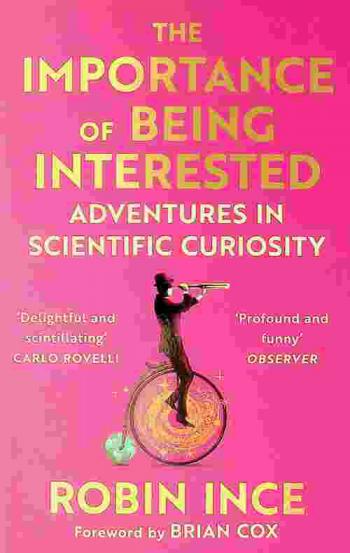
The importance of being interested : adventures in scientific curiosity
Comedian Robin Ince quickly abandoned science at school, bored by a fog of dull lessons and intimidated by the barrage of equations. But, twenty years later, he fell in love and he now presents one of the world's most popular science podcasts. Every year he meets hundreds of the world's greatest thinkers.In this erudite and witty book, Robin reveals why scientific wonder isn't just for the professionals. Filled with interviews featuring astronauts, comedians, teachers, quantum physicists, neuro-scientists and more - as well as charting Robin's own journey with science -The Importance of Being Interested explores why many wrongly think of the discipline as distant and difficult. From the glorious appeal of the stars above to why scientific curiosity can encourage much needed intellectual humility, this optimistic and profound book will leave you filled with a thirst for intellectual adventure.

Formen der Evidenz : populäre Wissenschaftsprosa zwischen Liebig und Haeckel
Die Studie untersucht das Spektrum populärwissenschaftlicher Darstellungsformen in der zweiten Hälfte des 19. Jahrhunderts und unternimmt erstmals den Versuch einer Systematisierung des Textfeldes zwischen Justus von Liebig und Ernst Haeckel.Die populäre Wissenschaftsprosa wird über ihre textuellen Verfahren, ihre gattungs- und medienspezifischen Darbietungsansprüche erschlossen. Leitend ist dabei die These, dass Popularität als eigenständiges Textmerkmal zu verstehen ist und maßgeblich vom rhetorischen Konzept der Evidenz und von Techniken der Veranschaulichung, des Sichtbarmachens und Vor-Augen-Stellens abhängt. Die Arbeit untersucht unter anderem populäre Briefe, Zeitschriften, Lexika, Hand- und Lehrbücher ebenso wie weltanschauliche Streitschriften. An all diesen Quellen lässt sich zeigen, wie sich die Entstehung und Professionalisierung und die Verbreitung und Popularisierung moderner Wissenschaftsdisziplinen wechselseitig bedingen.
eBook


Unscientific America
Climate change, the energy crisis, nuclear proliferationmany of the most urgent problems of the twenty-first century require scientific solutions, yet America is paying less and less attention to scientists. For every five hours of cable news, less than one minute is devoted to science, and the number of newspapers with science sections has shrunk from ninety-five to thirty-three in the last twenty years. In Unscientific America, journalist and best-selling author Chris Mooney and scientist Sheril Kirshenbaum explain this dangerous state of affairs, proposing a broad array of initiatives that could reverse the current trend. An impassioned call to arms, Unscientific America exhorts Americans to reintegrate science into public discoursebefore it is too late.
eBook

The physics of everyday things : the extraordinary science behind an ordinary day
\"Explanations about the extraordinary physics that invisibly guides our daily lives\"-- Provided by publisher.
Book

The Problem is Not Monsters: The FRANKENCON Panel on Science and Ethics
In November of 2019, the University of California Santa Cruz hosted a 3-day interdisciplinary conference to commemorate the 200th anniversary of the publication of Frankenstein, by Mary Shelley. A panel of senior researchers convened to discuss the impact of the novel on modern discussions of scientific ethics. The panel featured Nandini Bhattacharya, George Blumenthal, Michael M. Chemers, David Haussler, and Jenny Reardon. In the process, the panelists acted as the Institutional Review Board for a proposal from Victor Frankenstein himself.
Journal Article

The folkloresque : reframing folklore in a popular culture world
\"This volume introduces a new concept to explore the dynamic relationship between folklore and popular culture: the \"folkloresque.\" With \"folkloresque,\" Foster and Tolbert name the product created when popular culture appropriates or reinvents folkloric themes, characters, and images. Such manufactured tropes are traditionally considered outside the purview of academic folklore study, but the folkloresque offers a frame for understanding them that is grounded in the discourse and theory of the discipline.Fantasy fiction, comic books, anime, video games, literature, professional storytelling and comedy, and even popular science writing all commonly incorporate elements from tradition or draw on basic folklore genres to inform their structure. Through three primary modes--integration, portrayal, and parody--the collection offers a set of heuristic tools for analysis of how folklore is increasingly used in these commercial and mass-market contexts.The Folkloresque challenges disciplinary and genre boundaries; suggests productive new approaches for interpreting folklore, popular culture, literature, film, and contemporary media; and encourages a rethinking of traditional works and older interpretive paradigms. Contributors: Trevor J. Blank, Chad Buterbaugh, Bill Ellis, Tim Evans, Michael Dylan Foster, Carlea Holl-Jensen, Greg Kelley, Paul Manning, Daniel Peretti, Gregory Schrempp, Jeffrey A. Tolbert \"-- Provided by publisher.
Book

A tiny spot on the earth
In this survey of the Dutch political culture of the nineteenth and twentieth centuries, Piet de Rooij reveals that the \"polder model\" often used to describe economic and social policymaking based on consensus is a myth. Instead, modern political culture in the Dutch Low Countries began with a revolution and is rife with rivalries among political and ideological factions. He argues that because of its extremely open economy, the country is vulnerable to external political, cultural, and economic pressures, and Dutch politics is a balancing act between profiting from international developments and maintaining sovereignty. The sudden rise of populism and Euroscepticism at the turn of the millennium, then, indicated a loss of this balance. Shining new light on the political culture of the Netherlands, this book provides insights into the polder model and the principles of pillarization in Dutch society.
eBook


Body Panic
Are you ripped? Do you need to work on your abs? Do you know your ideal body weight? Your body fat index? Increasingly, Americans are being sold on a fitness ideal - not just thin but toned, not just muscular but cut - that is harder and harder to reach. In Body Panic, Shari L. Dworkin and Faye Linda Wachs ask why. How did these particular body types come to be \"fit\"? And how is it that having an unfit, or \"bad,\" body gets conflated with being an unfit, or \"bad,\" citizen?Dworkin and Wachs head to the newsstand for this study, examining ten years worth of men's and women's health and fitness magazines to determine the ways in which bodies are \"made\" in today's culture. They dissect the images, the workouts, and the ideology being sold, as well as the contemporary links among health, morality, citizenship, and identity that can be read on these pages. While women and body image are often studied together, Body Panic considers both women's and men's bodies side-by-side and over time in order to offer a more in-depth understanding of this pervasive cultural trend.
eBook