
Catalogue Search | MBRL


Are you sure you want to remove the book from the shelf?

{{itemTitle}}
38,066
result(s) for
"Science teachers Study and teaching."
Sort by:

Designing and teaching the secondary science methods course : an international perspective
The improvement of science education is a common goal worldwide. Countries not only seek to increase the number of individuals pursuing careers in science, but to improve scientific literacy among the general population. As the teacher is one of the greatest influences on student learning, a focus on the preparation of science teachers is essential in achieving these outcomes. A critical component of science teacher education is the methods course, where pedagogy and content coalesce. It is here that future science teachers begin to focus simultaneously on the knowledge, dispositions and skills for teaching secondary science in meaningful and effective ways. This book provides a comparison of secondary science methods courses from teacher education programs all over the world.
Book
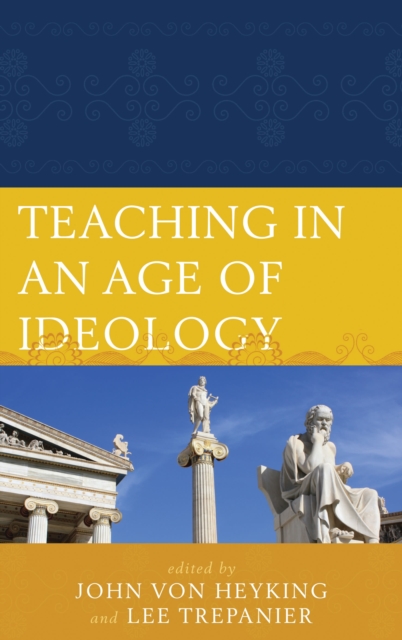
Teaching in an age of ideology
This volume explores the role of some of the most prominent twentieth-century philosophers and political thinkers as teachers. It examines how these teachers conveyed truth to their students against the ideological influences found in the university and society. Philosophers from Edmund Husserl and Hannah Arendt to political thinkers like Eric Voegelin and Leo Strauss, and their students such as Ellis Sandoz, Stanley Rosen, and Harvey Mansfield, are in this volume as teachers who analyze, denounce, and attempt to transcend ideology for a more authentic way of thinking. What the reader will discover is that teaching is not merely a matter of holding concepts together, but a way of existing or living in the world. The thinkers in this volume represent this form of teaching as the philosophical search for truth in a world deformed by ideology.
eBook

Meaning making in secondary science classrooms
This book focuses on the talk of science classrooms and in particular on the ways in which the different kinds of interactions between teachers and students contribute to meaning making and learning. Central to the text is a new analytical framework for characterising the key features of the talk of school science classrooms. This framework is based on sociocultural principles and links the work of theorists such as Vygotsky and Bakhtin to the day-to-day interactions of contemporary science classrooms. *presents a framework, based on sociocultural theory, for analysing the language of teaching and learning interactions in science classrooms*provides detailed examples and illustrations of insights gained from applying the framework to real science lessons in Brazil and the UK.*demonstrates how these ways of thinking about classroom talk can be drawn upon to inform the professional development of science teachers.*offers an innovative research methodology, based on sociocultural theory, for analysing classroom talk.*expands upon the ways in which sociocultural theory has been systematically applied to analysing classroom contexts. This book offers a powerful set of tools for thinking and talking about the day-to-day practices of contemporary science classrooms. It contains messages of fundamental importance and insight for all of those who are interested in reflecting on the interactions of science teaching and learning, whether in the context of teaching, higher degree study, or research.
eBook

Preparing mathematics and science teachers for diverse classrooms
This book provides a theoretical basis and practical strategies to counter resistance to learning to teach for diversity (in culturally and gender-inclusive ways), and resistance to teaching for understanding (using student-centered and inquiry-based pedagogical approaches). Teacher educators from across the United States present rich narratives of their experiences in helping prospective and practicing teachers learn to teach for diversity and for understanding in a variety of mathematics and science contexts.
Mathematics and science education has been slow to respond to issues of diversity and equity. Preparing Mathematics and Science Teachers for Diverse Classrooms: Promising Strategies for Transformative Pedagogy helps to begin a network for support and collaboration among teacher educators in science and mathematics who work for multicultural education and equity.
A unique and much-needed contribution, this book is an essential resource for teacher educators, K-12 teachers who work as student teacher supervisors and cooperating teachers, and graduate students in mathematics and science education, and a compelling text for science and mathematics methods courses.
Contents: Foreword. Preface. A.J. Rodriguez, Teachers' Resistance to Ideological and Pedagogical Change: Definitions, Theoretical Framework, and Significance. A.J. Rodriguez, Using Sociotransformative Constructivism to Respond to Teachers' Resistance to Ideological and Pedagogical Change. R.S. Kitchen, Making Equity and Multiculturalism Explicit to Transform Mathematics Education. M.B. Barnes, L.W. Barnes, Using Inquiry Processes to Investigate Knowledge, Skills, and Perceptions of Diverse Learners: An Approach to Working With Prospective and Current Science Teachers. J. Leonard, S.J. Dantley, Breaking Through the Ice: Dealing With Issues of Diversity in Mathematics and Science Education Courses. A. Luykx, P. Cuevas, J. Lambert, O. Lee, Unpacking Teachers' \"Resistance\" to Integrating Students' Language and Culture Into Elementary Science Instruction. T.K. Dunn, Engaging Prospective Teachers in Critical Reflection: Facilitating a Disposition to Teach Mathematics for Diversity. P.W.U. Chinn, \"Eh, Mus' Be Smart Class\": Race, Social Class, Language, and Access to Academic Resources. J. Moore, Transformative Mathematics Pedagogy: From Theory to Practice, Research, and Beyond. R. Yerrick, Seeing IT in the Lives of Children: Strategies for Promoting Equitable Practices Among Tomorrow's Science Teachers. J. Ensign, Helping Teachers Use Students' Home Cultures in Mathematics Lessons: Developmental Stages of Becoming Effective Teachers of Diverse Students. C. Brandt, Examining the \"Script\" in Science Education: Critical Literacy in the Classroom.
\"Much has been written about teachers’ resistance to change and practices that \"work.\" In contrast to books that describe teachers’ experiences, Preparing Mathematics and Science Teachers for Diverse Classrooms: Promising Strategies for Transformative Pedagogy provides models that can be used by methods and content instructors to elicit conversations about supporting diverse students in the classroom. \"-- Jo Clay Olson, Journal for Research in Mathematics Education , July 2009
eBook


Developing science, mathematics, and ICT education in Sub-Saharan Africa : patterns and promising practices
'Developing Science, Mathematics and ICT in Secondary Education' is based on country studies from ten Sub-Saharan African countries: Botswana, Burkina Faso, Ghana, Namibia, Nigeria, Senegal, South Africa, Uganda, Tanzania and Zimbabwe, and a literature review. It reveals a number of huge challenges in science, mathematics and ICT (SMICT) education in sub-Saharan Africa: poorly-resourced schools; large classes; a curriculum hardly relevant to the daily lives of students; a lack of qualified teachers; and inadequate teacher education programs. Through examining country case studies, this paper discusses the lessons for improvement of SMICT in secondary education in Africa.
eBook


Constructing Representations to Learn in Science
This book builds on recent interest in the role of representations in learning to argue for a pedagogical practice based on students actively generating and exploring representations. The book describes a sustained inquiry in which the authors worked with primary and secondary teachers of science, on key topics identified as problematic in the research literature.
eBook