
Catalogue Search | MBRL


Are you sure you want to remove the book from the shelf?

{{itemTitle}}
37
result(s) for
"Science-fiction américaine -- Histoire et critique"
Sort by:

Bodies of Tomorrow
Anxieties about embodiment and posthumanism have always found an outlet in the science fiction of the day. In Bodies of Tomorrow , Sherryl Vint argues for a new model of an ethical and embodied posthuman subject through close readings of the works of Gwyneth Jones, Octavia Butler, Iain M. Banks, William Gibson, and other science fiction authors. Vint’s discussion is firmly contextualized by discussions of contemporary technoscience, specifically genetics and information technology, and the implications of this technology for the way we consider human subjectivity.
Engaging with theorists such as Michel Foucault, Judith Butler, Anne Balsamo, N. Katherine Hayles, and Douglas Kellner, Bodies of Tomorrow argues for the importance of challenging visions of humanity in the future that overlook our responsibility as embodied beings connected to a material world. If we are to understand the post-human subject, then we must acknowledge our embodied connection to the world around us and the value of our multiple subjective responses to it. Vint’s study thus encourages a move from the common liberal humanist approach to posthuman theory toward what she calls ‘embodied posthumanism.’ This timely work of science fiction criticism will prove fascinating to cultural theorists, philosophers, and literary scholars alike, as well as anyone concerned with the ethics of posthumanism.
eBook

The Cambridge Companion to Science Fiction
Science fiction is at the intersection of numerous fields. It is a literature which draws on popular culture, and which engages in speculation about science, history, and all types of social relations. This volume brings together essays by scholars and practitioners of science fiction, which look at the genre from these different angles. After an introduction to the nature of science fiction, historical chapters trace science fiction from Thomas More to more recent years, including a chapter on film and television. The second section introduces four important critical approaches to science fiction drawing their theoretical inspiration from Marxism, postmodernism, feminism and queer theory. The final and largest section of the book looks at various themes and sub-genres of science fiction. A number of well-known science fiction writers contribute to this volume, including Gwyneth Jones, Ken MacLeod, Brian Stableford Andy Duncan, James Gunn, Joan Slonczewski, and Damien Broderick.
eBook

Ray Bradbury : the life of fiction
This is a textual, bibliographical and cultural study of 60 years of Bradbury's fiction. The authors draw upon correspondence with his publishers, agents and friends, as well as archival manuscripts, to examine the story of Bradbury's authorship over more than half a century.
eBook

The Cambridge Companion to American Science Fiction
The Cambridge Companion to American Science Fiction explores the relationship between the ideas and themes of American science fiction and their roots in the American cultural experience. Science fiction in America has long served to reflect the country's hopes, desires, ambitions, and fears. The ideas and conventions associated with science fiction are pervasive throughout American film and television, comics and visual arts, games and gaming, and fandom, as well as across the culture writ large. Through essays that address not only the history of science fiction in America but also the influence and significance of American science fiction throughout media and fan culture, this companion serves as a key resource for scholars, teachers, students, and fans of science fiction.
eBook

Decoding Gender in Science Fiction
From Frankenstein to futuristic feminist utopias, Decoding Gender in Science Fiction examines the ways science fiction writers have incorporated, explored, and revised conventional notions of sexual difference. Attebery traces a fascinating history of men's and women's writing that covertly or overtly investigates conceptions of gender, suggesting new perspectives on the genre.
eBook

Critical theory and science fiction
Selected by Choice as an Outstanding Academic Book of the Year. This innovative cultural critique offers valuable insights into science fiction, thus enlarging our understanding of critical theory.
eBook

Alien Constructions
Though set in other worlds populated by alien beings, science fiction is a site where humans can critique and re-imagine the paradigms that shape this world, from fundamentals such as the sex and gender of the body to global power relations among sexes, races, and nations. Feminist thinkers and writers are increasingly recognizing science fiction's potential to shatter patriarchal and heterosexual norms, while the creators of science fiction are bringing new depth and complexity to the genre by engaging with feminist theories and politics. This book maps the intersection of feminism and science fiction through close readings of science fiction literature by Octavia E. Butler, Richard Calder, and Melissa Scott and the movies The Matrix and the Alien series. Patricia Melzer analyzes how these authors and films represent debates and concepts in three areas of feminist thought: identity and difference, feminist critiques of science and technology, and the relationship among gender identity, body, and desire, including the new gender politics of queer desires, transgender, and intersexed bodies and identities. She demonstrates that key political elements shape these debates, including global capitalism and exploitative class relations within a growing international system; the impact of computer, industrial, and medical technologies on women's lives and reproductive rights; and posthuman embodiment as expressed through biotechnologies, the body/machine interface, and the commodification of desire. Melzer's investigation makes it clear that feminist writings and readings of science fiction are part of a feminist critique of existing power relations—and that the alien constructions (cyborgs, clones, androids, aliens, and hybrids) that populate postmodern science fiction are as potentially empowering as they are threatening.
eBook

The Cambridge Companion to Fantasy Literature
Fantasy is a creation of the Enlightenment, and the recognition that excitement and wonder can be found in imagining impossible things. From the ghost stories of the Gothic to the zombies and vampires of twenty-first-century popular literature, from Mrs Radcliffe to Ms Rowling, the fantastic has been popular with readers. Since Tolkien and his many imitators, however, it has become a major publishing phenomenon. In this volume, critics and authors of fantasy look at its history since the Enlightenment, introduce readers to some of the different codes for the reading and understanding of fantasy, and examine some of the many varieties and subgenres of fantasy; from magical realism at the more literary end of the genre, to paranormal romance at the more popular end. The book is edited by the same pair who produced The Cambridge Companion to Science Fiction (winner of a Hugo Award in 2005).
eBook
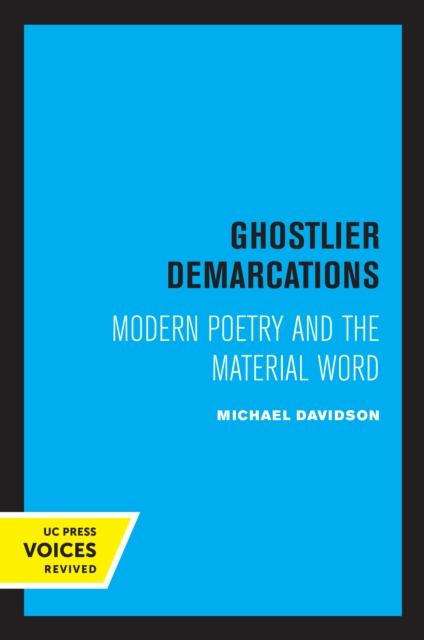
Ghostlier Demarcations
Why do modern poets quote from dictionaries in their poems? How has the tape recorder changed the poet's voice? What has shopping to do with Gertrude Stein's aesthetics? These and other questions form the core of Ghostlier Demarcations, a study of modern poetry as a material medium. One of today's most respected critics of twentieth-century poetry and poetics, Michael Davidson argues that literary materiality has been dominated by an ideology of modernism, based on the ideal of the autonomous work of art, which has hindered our ability to read poetry as a socially critical medium. By focusing on writing as a palimpsest involving numerous layers of materiality--from the holograph manuscript to the printed book--Davidson exposes modern poetry's engagement with larger historical forces. The palimpsest that results is less a poem than an arrested stage of writing in whose layers can be discerned ghostly traces of other texts. This title is part of UC Press's Voices Revived program, which commemorates University of California Press's mission to seek out and cultivate the brightest minds and give them voice, reach, and impact. Drawing on a backlist dating to 1893, Voices Revived makes high-quality, peer-reviewed scholarship accessible once again using print-on-demand technology. This title was originally published in 1997. Many titles in the Voices Revived program are also newly available as ebooks, offered at a discounted price to support wider access to scholarly work.
eBook

Black and Brown Planets
Black and Brown Planetsembarks on a timely exploration of the American obsession with color in its look at the sometimes contrary intersections of politics and race in science fiction. The contributors, including De Witt D. Kilgore, Edward James, Lisa Yaszek, and Marleen S. Barr, among others, explore science fiction worlds of possibility (literature, television, and film), lifting blacks, Latin Americans, and indigenous peoples out from the background of this historically white genre.
This collection considers the role of race and ethnicity in our visions of the future. The first section emphasizes the political elements of black identity portrayed in science fiction from black America to the vast reaches of interstellar space framed by racial history. In the next section, analysis of indigenous science fiction addresses the effects of colonization, helps discard the emotional and psychological baggage carried from its impact, and recovers ancestral traditions in order to adapt in a post-Native-apocalyptic world. Likewise, this section explores the affinity between science fiction and subjectivity in Latin American cultures from the role of science and industrialization to the effects of being in and moving between two cultures. By infusing more color in this otherwise monochrome genre,Black and Brown Planetsimagines alternate racial galaxies with viable political futures in which people of color determine human destiny.
eBook