
Catalogue Search | MBRL


Are you sure you want to remove the book from the shelf?

{{itemTitle}}
29
result(s) for
"Scientists Italy Biography."
Sort by:

Galileo
\"In 1610, Galileo published the Siderius nuncius, or Starry Messenger, a \"hurried little masterpiece\" in John Heilbron's words. Presenting to the world his remarkable observations using the recently invented telescope--the craters of the moon, the satellites of Jupiter--Galileo dramatically challenged our idea of the perfection of the heavens and the centrality of the Earth in the universe. Indeed, the appearance of the little book is regarded as one of the great moments in the history of science\"-- Publisher's description.
Book

Ulisse Aldrovandi
The Bolognese naturalist Ulisse Aldrovandi was a prolific writer, polymath and prodigious collector who amassed the largest collection of naturalia in sixteenth-century Europe, as well as hundreds of coloured drawings detailing them. Many of these drawings found their way into his illustrated publications, most of which were published posthumously. This book provides a concise yet comprehensive portrait of Aldrovandi, paying particular attention to two aspects: the role that the newly discovered continent of America played in his research interests, and his study of abnormalities of physiological development in organisms. Peter Mason gives insight into Aldrovandi's fascinating life, his early work on antiquities, his natural history and other collecting activities, his network of correspondents and patrons, and the influence and legacy of his collection and publications.
eBook


Setting Aside All Authority
Setting Aside All Authority is an important account and analysis of seventeenth-century scientific arguments against the Copernican system. Christopher M. Graney challenges the long-standing ideas that opponents of the heliocentric ideas of Copernicus and Galileo were primarily motivated by religion or devotion to an outdated intellectual tradition, and that they were in continual retreat in the face of telescopic discoveries. Graney calls on newly translated works by anti-Copernican writers of the time to demonstrate that science, not religion, played an important, and arguably predominant, role in the opposition to the Copernican system. Anti-Copernicans, building on the work of the Danish astronomer Tycho Brahe, were in fact able to build an increasingly strong scientific case against the heliocentric system at least through the middle of the seventeenth century, several decades after the advent of the telescope. The scientific case reached its apogee, Graney argues, in the 1651 New Almagest of the Italian Jesuit astronomer Giovanni Battista Riccioli, who used detailed telescopic observations of stars to construct a powerful scientific argument against Copernicus. Setting Aside All Authority includes the first English translation of Monsignor Francesco Ingoli's essay to Galileo (disputing the Copernican system on the eve of the Inquisition's condemnation of it in 1616) and excerpts from Riccioli's reports regarding his experiments with falling bodies.
eBook

Leonardo da Vinci : the greatest inventor
Leonardo da Vinci is remembered as a painter, an inventor, a scientist, an engineer, and an architect. This book examines his many contributions to the intellectual climate of the Renaissance in Italy while also tracing his legacy in inventions of the modern era, including the helicopter and military tank.
Book


Leonardo da Vinci in his own words
\"This comprehensive volume presents the biography of [Leonardo da Vinci]... using his own words and works. Readers will come to appreciate the genius of the inventor who devised early airplanes and helicopters more than 300 years before flying machines would be successfully developed! His paintings, sculptures, blueprints, notebooks, and other reminders of his legacy are well represented throughout this beautifully designed and well-researched book.\"--Amazon.com.
Book
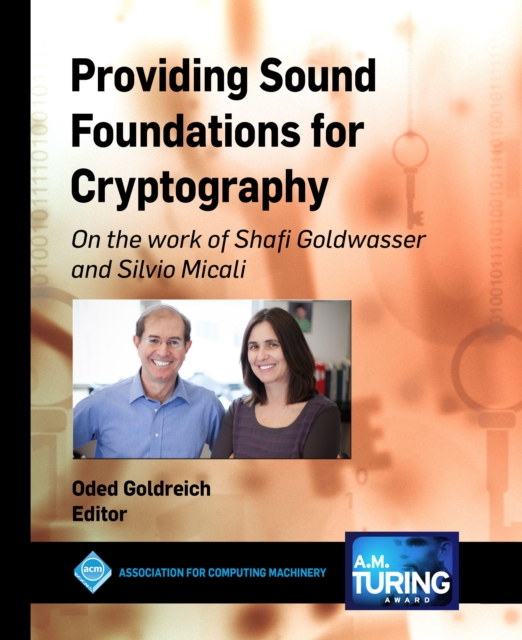
Providing Sound Foundations for Cryptography
Cryptography is concerned with the construction of schemes that withstand any abuse. A cryptographic scheme is constructed so as to maintain a desired functionality, even under malicious attempts aimed at making it deviate from its prescribed behavior. The design of cryptographic systems must be based on firm foundations, whereas ad hoc approaches and heuristics are a very dangerous way to go. These foundations were developed mostly in the 1980s, in works that are all co-authored by Shafi Goldwasser and/or Silvio Micali. These works have transformed cryptography from an engineering discipline, lacking sound theoretical foundations, into a scientific field possessing a well-founded theory, which influences practice as well as contributes to other areas of theoretical computer science. This book celebrates these works, which were the basis for bestowing the 2012 A.M. Turing Award upon Shafi Goldwasser and Silvio Micali. A significant portion of this book reproduces some of these works, and another portion consists of scientific perspectives by some of their former students. The highlight of the book is provided by a few chapters that allow the readers to meet Shafi and Silvio in person. These include interviews with them, their biographies and their Turing Award lectures.
eBook


In the Land of Marvels
In 1749, the celebrated French physicist Jean-Antoine Nollet set out on a journey through Italy to solve an international controversy over the medical uses of electricity. At the end of his nine-month tour, he published a highly influential account of his philosophical battle with his Italian counterparts, discrediting them as misguided devotees of the marvelous. Paola Bertucci's In the Land of Marvels brilliantly reveals the mysteries of Nollet's journey, uncovering a subterranean world of secretive and ambitious intelligence gathering masked as scientific inquiry. The advent of electricity was a pivotal phenomenon not only in the history of physical experimentation, but also in the cultivation of popular scientific interest. Nollet's journey was supposedly inspired by the need to investigate, and subsequently report on, claims of the use of electrified \"medicated tubes\" by their Italian inventor Gianfrancesco Pivati. Motivated by economic interests in the silk industry, Nollet's journey was in fact an undercover mission commissioned by the French state to discover the secrets of Italian silk manufacture and possibly supplant its international success. The event that sparked the medical controversy-the unusual cure of a bishop-was a complete fabrication. Bertucci insightfully contrasts published accounts of the event with private documents and discusses how eighteenth-century scientists published fictional events and results to bolster their careers, ultimately leading to long-lasting misrepresentations of scientific practice and enduring stereotypes. In the Land of Marvels reveals the constellation of historical actors, from reputed physicists to travel writers and electrical amateurs, who manipulated information to gain authority and prestige. (HRK / Abstract übernommen).
eBook