
Catalogue Search | MBRL


Are you sure you want to remove the book from the shelf?

{{itemTitle}}
2,523
result(s) for
"Scottish Studies"
Sort by:

The Victorian novel and masculinity
\"'The old ideal of Manhood has grown obsolete,' wrote Thomas Carlyle in 1831, 'and the new is still invisible to us.' The essays in this volume explore the way Victorian novelists tried to answer the question of what it meant to 'be a man': how manhood was learned, sustained, broken, or restored, and how the idea of the manly was shaped by class, schooling, region and religion, and by scientific and medical debate. Topics covered include the playful subversion of gender roles in the early writings of Charlotte Brontèe; changing patterns of working class masculinity in London and Manchester; Dickens and the nurturing male; boyhood and girlhood in Eliot's The Mill on the Floss; the challenge to patriarchy in sensation fiction; manhood, imperialism and the adventure novel; masculinity and aestheticism; Hardy's reluctant, failed, or damaged men; and Conrad's studies of men isolated or divided against themselves\"-- Provided by publisher.
Book

Remembering the Past in Nineteenth-Century Scotland
At a time when the Union between Scotland and England is once again under the spotlight, Remembering the Past in Nineteenth-Century Scotland examines the way in which Scotland's national heroes were once remembered as champions of both Scottish and British patriotism. Whereas 19th-century Scotland is popularly depicted as a mire of sentimental Jacobitism and kow-towing unionism, this book shows how Scotland's national heroes were once the embodiment of a consistent, expressive and robust view of Scottish nationality. Whether celebrating the legacy of William Wallace and Robert Bruce, the reformer John Knox, the Covenanters, 19th-century Scots rooted their national heroes in a Presbyterian and unionist view of Scotland's past. Examined through the prism of commemoration, this book uncovers collective memories of Scotland's past entirely opposed to 21st-century assumptions of medieval proto-nationalism and Calvinist misery.
Key Features
* Detailed studies of 19th-century commemoration of Scotland's national heroes
* Uncovers an all but forgotten interpretation of these 'great Scots'
* Shines a new light on the mindset of nineteenth-century Scottish national identity as being comfortably Scottish and British
* Overturns the prevailing view of Victorian Scottishness as parochial, sentimental tartanry
eBook

Words like daggers : violent female speech in early modern England
\"Dramatic and documentary narratives about aggressive and garrulous women often cast such women as reckless and ultimately unsuccessful usurpers of cultural authority. Contending narratives, however, sometimes within the same texts, point to the effective subversion and undoing of the normative restrictions of social and gender hierarchies. Words Like Daggers explores the scolding invectives, malevolent curses, and ecstatic prophesies of early modern women as attested to in legal documents, letters, self-narratives, popular pamphlets, ballads, and dramas of the era. Examining the framing and performance of violent female speech between the 1590s and the 1660s, Kirilka Stavreva dismantles the myth of the silent and obedient women who allegedly populated early modern England. Blending gender theory with detailed historical analysis, Words Like Daggers asserts the power of women's language--the power to subvert binaries and destabilize social hierarchies, particularly those of gender, in the early modern era. In the process Stavreva reconstructs the speech acts of individual contentious women, such as the scold Janet Dalton, the witch Alice Samuel, and the Quaker Elizabeth Stirredge. Because the dramatic potential of women's powerful rhetorical performances was recognized not only by victims and witnesses of individual violent speech acts but also by theater professionals, Stavreva also focuses on how the stage, arguably the most influential cultural institution of the Renaissance era, orchestrated and aestheticized women's fighting words and, in so doing, showcased and augmented their cultural significance. \"-- Provided by publisher.
Book

The Scottish Town in the Age of the Enlightenment 1740-1820
A pioneering study of 18th century Scottish urbanism: dynamic but different This heavily illustrated and innovative study is founded upon personal documents, town council minutes, legal cases, inventories, travellers' tales, plans and drawings relating to some 30 Scots burghs of the Georgian period. It establishes a distinctive history for the development of Scots burghs, their living patterns and legislative controls, and shows that the Scottish urban experience was quite different from other parts of Britain. With population expansion, and economic and social improvement, Scots of the time experienced immense change both in terms of urban behaviour and the decay of ancient privileges and restrictions. This volume shows how the Scots Georgian burgh developed to become a powerfully controlled urban community, with disturbance deliberately designed out. This is a collaborative history, melding together political, social, economic, urban and architectural histories, to achieve a comprehensive perspective on the nature of the Scottish Georgian town. Not so much a history by growth and numbers, this pioneering study of Scottish urbanization explores the type of change and the quality of result. Key Features A pioneering study of how Scottish urban life changed during the 18th century, to be matched against the well-covered English town. Combines social, economic, architectural and urban history in a systematic, comparative manner. The product of an extensive 3-year AHRC-funded research project into extensive, yet untapped primary sources. This research significantly revises current historiography about the Scots urban evolution and the nature of 'British' towns. Heavily illustrated, the pictures being as much of the message as the text.
eBook

Modernism, periodicals, and cultural poetics
\"Modernism, Periodicals, and Cultural Poetics addresses how late modernist poetry in Britain tended toward a culturalist expression and importantly how this occurred within the pages of literary periodicals. 'Periodical formations' describe networks of exchange within and between different literary periodicals that condition the types of poetry published and the kinds of poetic discourse that come to predominate. A re-emphasis on periodical production following the publication of Eliot's The Waste Land and culminating with the pre-Movement magazines of the 1940's illustrates a complex and diverse series of debates and negotiations about not only the tradition of English poetry and its role in contemporaneous form, but also how poetry of the period related to the avant-garde trends prominent on the European continent and in America. By focusing on periodical formations, the development of what are now accepted understandings of the period can be better addressed, and certain lasting assumptions can be demythologized\"-- Provided by publisher.
Book
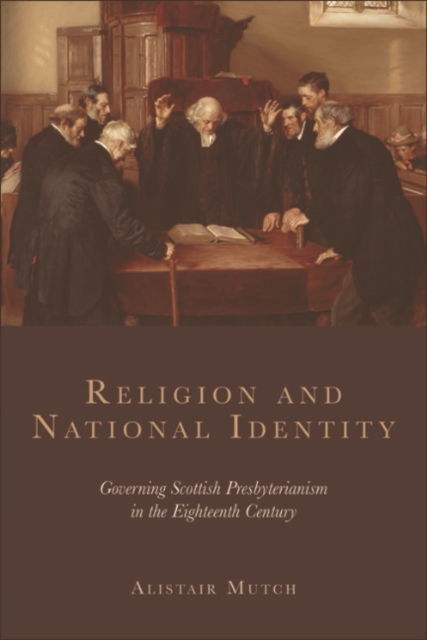
Religion and National Identity
Presbyterianism has shaped Scotland and its impact on the world. Behind its beliefs lie some distinctive practices of governance which endure even when belief fades. These practices place a particular emphasis on the detailed recording of decisions and what we can term a ‘systemic’ form of accountability.This book examines the emergence and consolidation of such practices in the 18th-century Church of Scotland. Using extensive archival research and detailed local case studies, it contrasts them to what is termed a ‘personal’ form of accountability in England in the same period. The wider impact of the systemic approach to governance and accountability, especially in the United States of America, is explored, as is the enduring impact on Scottish identity.This book offers a fresh perspective on the Presbyterian legacy in contemporary Scottish historiography, at the same time as informing current debates on national identity.
eBook
The Modern Scottish Diaspora
Brings together well-established and emerging scholars from a variety of disciplines to present a contemporary ‘diasporic’ perspective on national affairs for Scotland. The book reflects a growing interest in the subject from academics, policy makers and politicians and the Scottish Government's new diaspora strategy.
eBook

A Global Force
This book explores the many ways in which a military Scottish identity was reinvented and forged overseas amongst Scotland's diaspora from the late nineteenth century to the present day. It provides case studies from North America, South Africa, Australia and New Zealand.
eBook

The cinema and cinema-going in Scotland, 1896-1950
Scottish cinema is explored as a cultural industry and as an experience using a range of research methods. Documentation kept by cinema managers and diaries of cinema-goers are examined and patterns and conclusions are drawn from the results.
eBook

Liberty, Property and Popular Politics
This collection (in honour of an internationally-renowned scholar who had shaped both scholarly and popular understandings of the period) comprises fourteen chapters written by specialists in the period and provides an appealing and illuminating cross-section of current research.
eBook