
Catalogue Search | MBRL


Are you sure you want to remove the book from the shelf?

{{itemTitle}}
88
result(s) for
"Scottish drama 20th century History and criticism."
Sort by:


Strategies of Political Theatre
This volume provides a theoretical framework for some of the most important play-writing in Britain in the second half of the twentieth century. Examining representative plays by Arnold Wesker, John Arden, Trevor Griffith, Howard Barker, Howard Brenton, Edward Bond, David Hare, John McGrath and Caryl Churchill, the author analyses their respective strategies for persuading audiences of the need for a radical restructuring of society. The book begins with a discussion of the way that theatre has been used to convey a political message. Each chapter is then devoted to an exploration of the engagement of individual playwrights with left-wing political theatre, including a detailed analysis of one of their major plays. Despite political change since the 1980s, political play-writing continues to be a significant element in contemporary play-writing, but in a very changed form.
eBook

Dramas of the Past on the Twentieth-Century Stage
This book defines and exemplifies a major genre of modern dramatic writing, termed historiographic metatheatre, in which self-reflexive engagements with the traditions and forms of dramatic art illuminate historical themes and aid in the representation of historical events and, in doing so, formulates a genre. Historiographic metatheatre has been, and remains, a seminal mode of political engagement and ideological critique in the contemporary dramatic canon. Locating its key texts within the traditions of historical drama, self-reflexivity in European theatre, debates in the politics and aesthetics of postmodernism, and currents in contemporary historiography, this book provides a new critical idiom for discussing the major works of the genre and others that utilize its techniques. Feldman studies landmarks in the theatre history of postwar Britain by Weiss, Stoppard, Brenton, Wertenbaker and others, focusing on European revolutionary politics, the historiography of the World Wars and the effects of British colonialism. The playwrights under consideration all use the device of the play-within-the-play to explore constructions of nationhood and of Britishness, in particular. Those plays performed within the framing works are produced in places of exile where, Feldman argues, the marginalized negotiate the terms of national identity through performance.
eBook

Contemporary british drama
This book offers an extended analysis of writers and theatre companies in Britain since 1995, and explores them alongside recent cultural, social and political developments. Referencing well-known practitioners from modern theatre, this book is an excellent introduction to how contemporary drama is made and analysed.
eBook
Modern British Playwriting: The 1970s
Essential for students of Theatre Studies, this series of six decadal volumes provides a critical survey and reassessment of the theatre produced in each decade from the 1950s to the present. Each volume equips readers with an understanding of the context from which work emerged, a detailed overview of the range of theatrical activity and a close study of the work of four of the major playwrights by a team of leading scholars. Chris Megson's comprehensive survey of the theatre of the 1970s examines the work of four playwrights who came to promience in the decade and whose work remains undiminished today: Caryl Churchill (by Paola Botham), David Hare (Chris Megson), Howard Brenton (Richard Boon) and David Edgar (Janelle Reinelt). It analyses their work then, its legacy today and provides a fresh assessment of their contribution to British theatre. Interviews with the playwrights, with directors and with actors provides an invaluable collection of documents offering new perspectives on the work. Revisiting the decade from the perspective of the twenty-first century, Chris Megson provides an authoritative and stimulating reassessment of British playwriting in the 1970s.
eBook

A Companion to Modern British and Irish Drama, 1880 - 2005
This wide-ranging Companion to Modern British and Irish Drama offers challenging analyses of a range of plays in their political contexts.It explores the cultural, social, economic and institutional agendas that readers need to engage with in order to appreciate modern theatre in all its complexity.
eBook

The Performance of Nationalism
Imagine the patriotic camaraderie of national day parades. How crucial is performance for the sustenance of the nation? The Performance of Nationalism considers the formation of the Indian and Pakistani nation, in the wake of the most violent chapter of its history: the partition of the subcontinent. In the process, Jisha Menon offers a fresh analysis of nationalism from the perspective of performance. Menon recuperates the manifold valences of 'mimesis' as aesthetic representation, as the constitution of a community of witnesses, and as the mimetic relationality that underlies the encounter between India and Pakistan. The particular performances considered here range from Wagah border ceremonies, to the partition theatre of Asghar Wajahat, Kirti Jain, M. K. Raina, and the cinema of Ritwik Ghatak and M. S. Sathyu. By pointing to the tropes of twins, doubles, and doppelgangers that suffuse these performances, this study troubles the idea of two insular, autonomous nation-states of India and Pakistan. In the process, Menon recovers mimetic modes of thinking that unsettle the reified categories of identity politics.
eBook
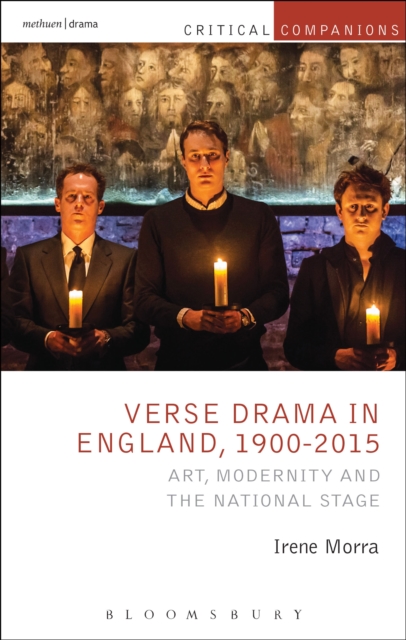
Verse Drama in England, 1900–2015
Modern Verse Drama explores the emergence of the form at the turn of the century and its development into the twenty-first, offering key case studies of well-known verse dramatists alongside explorations of less-discussed but equally influential writers within the form. Dramatists discussed include T. S. Eliot, Gordon Bottomley, Charles Williams, W. H. Auden, Christopher Isherwood, Ronald Duncan, Christopher Fry, John Arden, Anne Ridler, Tony Harrison, Ted Hughes, and Caryl Churchill. The book explores the negotiation of these dramatists with the changing position of verse drama in relation to constructions of national and communal audience, aesthetic challenge, and dramatic heritage. Key to the study is the self-conscious positioning of many of these dramatists in relation to an assumed mainstream tradition – and the various critical responses that that positioning has provoked.
eBook
Sublime Drama
British drama of the 1990s is most commonly associated with the term in-yer-face theatre, which was coined by Aleks Sierz to describe the shocking and provocative work of emerging playwrights such as Mark Ravenhill or Sarah Kane. Taking a cue from Sierz's own suggestion that what still remains to be researched more thoroughly in this field is the particular relationship between the stage and the audience, this monograph undertakes precisely that task. Rather than use the term offered by Sierz, however, the study proposes a different concept to account for the dynamics of communication within the particular theatre of the 1990s, namely the aesthetic category of the sublime. Coupled with elements of Reader Response Theory, the sublime proves to be a more fruitful term, as it provides more precise tools for the analysis of the audience's aesthetic response than does in-yer-face theatre. With the help of four representative plays by four key playwrights of that time, Closer by Patrick Marber, Normal by Anthony Neilson, Faust is Dead by Mark Ravenhill and 4.48 Psychosis by Sarah Kane, the book details the consecutive stages in the process of the plays' reception that the members of the audience go through while forming their aesthetic response to them. Looking through the prism of the sublime, the study not only offers a detailed analysis of each play but also suggests an entirely new approach to British drama of the 1990s.
eBook
Theatre on terror : subject positions in British drama
CDE STUDIES (GENERAL EDITOR: ANETTE PANKRATZ) The book series is dedicated to contemporary anglophone playwrights and the analysis of the historical, political and aesthetic contexts of their work, thus seeking to advance the theoretical and methodological discourse on theatre and drama today.
eBook