
Catalogue Search | MBRL


Are you sure you want to remove the book from the shelf?

{{itemTitle}}
9,194
result(s) for
"Scribes"
Sort by:
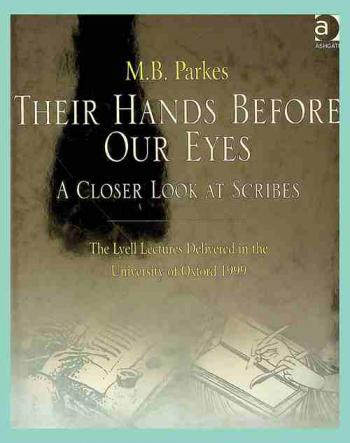
Their hands before our eyes : a closer look at scribes : the Lyell lectures delivered in the University of Oxford, 1999
\"This new book by Malcolm Parkes makes a fundamental contribution to the history of handwriting. Handwriting is a versatile medium that has always allowed individual scribes the opportunity for self-expression, despite the limitations of the pen and the finite number of possible movements. The purpose of this study is to focus on the handwriting of scribes from late antiquity to the beginning of the sixteenth century, and to identify those features which are a scribe's personal contribution to the techniques and art of handwriting.\"--Jacket.
Book

Accuracy and Safety of AI-Enabled Scribe Technology: Instrument Validation Study
Artificial intelligence-enabled ambient digital scribes may have many potential benefits, yet results from our study indicate that there are errors that must be evaluated to mitigate safety risks.Artificial intelligence-enabled ambient digital scribes may have many potential benefits, yet results from our study indicate that there are errors that must be evaluated to mitigate safety risks.
Journal Article


Luigi Marchionni traduttore, adattatore, dramaturg
The essay examines the work of Luigi Marchionni (1792-1864) as a translator and adapter of foreign theatrical plays. Marchionni, brother of the better-known Carlotta, combined throughout his long career the roles of actor, playwright, translator, and adapter, becoming one of the most sought-after actor-translators in early 19th-century Italy. This study, based on an analysis of manuscript scripts and a comparison with numerous 19th-century printed editions, sheds light on his working methods, which reflect the common practice of adapting plays ‘for Italian stages’. At the same time, the analysis reveals previously overlooked qualities that position him as a cultural mediator, closely resembling the figure of the German and European dramaturg, of which he may be considered one of the earliest Italian examples.
Journal Article


AI Scribes in Health Care: Balancing Transformative Potential With Responsible Integration
The administrative burden of clinical documentation contributes to health care practitioner burnout and diverts valuable time away from direct patient care. Ambient artificial intelligence (AI) scribes—also called “digital scribes” or “AI scribes”—are emerging as a promising solution, given their potential to automate clinical note generation and reduce clinician workload, and those specifically built on a large language model (LLM) are emerging as technologies for facilitating real-time clinical documentation tasks. This potentially transformative development has a foundation on longer-standing, AI-based transcription software, which uses automated speech recognition and/or natural language processing. Recent studies have highlighted the potential impact of ambient AI scribes on clinician well-being, workflow efficiency, documentation quality, user experience, and patient interaction. So far, limited evidence indicates that ambient AI scribes are associated with reduced clinician burnout, lower cognitive task load, and significant time savings in documentation, particularly in after-hours electronic health record (EHR) work. One consistently reported benefit is the improvement in the patient-physician interaction, as physicians feel more present during a clinical encounter. However, these benefits are counterbalanced by persisting concerns regarding the accuracy, consistency, language use, and style of AI-generated notes. Studies noting errors, omissions, or hallucinations caution that diligent clinician oversight is necessary. The user experience is also heterogeneous, with benefits varying by specialty and individual workflow. Further, there are concerns about ethical and legal issues, algorithmic bias, the potential for long-term “cognitive debt” from overreliance on AI, and even the potential loss of physician autonomy. Additional pragmatic concerns include security, privacy, integration, interoperability, user acceptance and training, and the cost-effectiveness of adoption at scale. Finally, limited studies describe adoption or evaluation of these technologies by nonphysician clinicians and health professionals. Although ambient AI scribes and AI-driven documentation technologies are promising as potentially practice-changing tools, there are many questions remaining. Key issues persist, including responsible deployment with the goal of ensuring that ambient AI scribes produce clinical documentation that supports more efficient, equitable, and patient-centered care. To advance our collective understanding and address key issues, JMIR Medical Informatics is launching a call for papers for a new section on “Ambient AI Scribes and AI-Driven Documentation Technologies.” As editors, we look forward to the opportunity to advance the science and understanding of these fields through publishing high-quality and rigorous scholarly work in this new section of JMIR Medical Informatics .
Journal Article

Alphabet scribes in the land of cuneiform : sهepiru professionals in Mesopotamia in the neo-Babylonian and Achaemenid periods
This book discusses the alphabetic scribes (sهepiru) mentioned in Mesopotamian documents of the Neo-Babylonian and Achaemenid periods - specifically, of the 6th-5th centuries BCE. The period in question saw a wide diffusion of writing in the Northwest Semitic alphabetic script - mostly in Aramaic - in Mesopotamia; yet, alphabetic texts were normally written in ink on perishable materials and did not survive to be discovered by modern archaeologists. In contrast, cuneiform tablets written on clay have been found in large numbers, and they document different aspects of the alphabetic scribes' activities. This book presents evidence for understanding the Akkadian term sهepiru as a designation for an alphabetic scribe and discusses the functions of these professionals in different administrative and economic spheres. It further considers the question of the ethnic origins of the alphabetic scribes in Mesopotamia, with special attention to the participation of Judeans in Babylonia in this profession. Bloch also provides translations of over 100 cuneiform documents of economic, legal and administrative content.
Book
AI Scribes: Are We Measuring What Matters?
Artificial intelligence (AI) scribes, software that can convert speech into concise clinical documents, have achieved remarkable clinical adoption at a pace rarely seen for digital technologies in health care. The reasons for this are understandable: the technology works well enough, it addresses a genuine pain point for clinicians, and it has largely sidestepped regulatory requirements. In many ways, clinical adoption of AI scribes has also occurred well ahead of robust evidence of their safety and efficacy. The papers in this theme issue demonstrate real progress in the technology and evidence of its benefit: documentation times are reported to decrease when using scribes, clinicians report feeling less burdened, and the notes produced are often of reasonable quality. Yet as we survey the emerging evidence base, there remains one outstanding and urgent unanswered question: Are AI scribes safe? We need to know the clinical outcomes achievable when scribes are used compared to other forms of note taking.
Journal Article

The lost puzzler
More than a hundred years have passed since the Catastrophe brought humanity to the brink of extinction. Those who survived are changed. The Wildeners have reverted to the old ways--but with new Gods--while others place their faith in the technology that once powered their lost civilization. In the mysterious City of Towers, the center of the destroyed Tarakan empire, a lowly scribe of the Guild of Historians is charged with a dangerous assignment. He must venture into the wilds beyond the glass and steel towers to discover the fate of a child who mysteriously disappeared more than a decade before. Born of a rare breed of marked people, the child, Rafik--known as \"The Key\"--was one of a special few with the power to restore this lost civilization to glory once again. In a world riven by fear and violence, where tattooed mutants, manic truckers, warring guilds and greedy mercenaries battle for survival, this one boy may have singlehandedly destroyed humanity's only chance for salvation--unless the scribe can figure out what happened to him.
Book

Artificial intelligence based writer identification generates new evidence for the unknown scribes of the Dead Sea Scrolls exemplified by the Great Isaiah Scroll (1QIsaa)
The Dead Sea Scrolls are tangible evidence of the Bible’s ancient scribal culture. This study takes an innovative approach to palaeography—the study of ancient handwriting—as a new entry point to access this scribal culture. One of the problems of palaeography is to determine writer identity or difference when the writing style is near uniform. This is exemplified by the Great Isaiah Scroll (1QIsa a ). To this end, we use pattern recognition and artificial intelligence techniques to innovate the palaeography of the scrolls and to pioneer the microlevel of individual scribes to open access to the Bible’s ancient scribal culture. We report new evidence for a breaking point in the series of columns in this scroll. Without prior assumption of writer identity, based on point clouds of the reduced-dimensionality feature-space, we found that columns from the first and second halves of the manuscript ended up in two distinct zones of such scatter plots, notably for a range of digital palaeography tools, each addressing very different featural aspects of the script samples. In a secondary, independent, analysis, now assuming writer difference and using yet another independent feature method and several different types of statistical testing, a switching point was found in the column series. A clear phase transition is apparent in columns 27–29. We also demonstrated a difference in distance variances such that the variance is higher in the second part of the manuscript. Given the statistically significant differences between the two halves, a tertiary, post-hoc analysis was performed using visual inspection of character heatmaps and of the most discriminative Fraglet sets in the script. Demonstrating that two main scribes, each showing different writing patterns, were responsible for the Great Isaiah Scroll, this study sheds new light on the Bible’s ancient scribal culture by providing new, tangible evidence that ancient biblical texts were not copied by a single scribe only but that multiple scribes, while carefully mirroring another scribe’s writing style, could closely collaborate on one particular manuscript.
Journal Article