
Catalogue Search | MBRL


Are you sure you want to remove the book from the shelf?

{{itemTitle}}
1,568
result(s) for
"Scribes History"
Sort by:
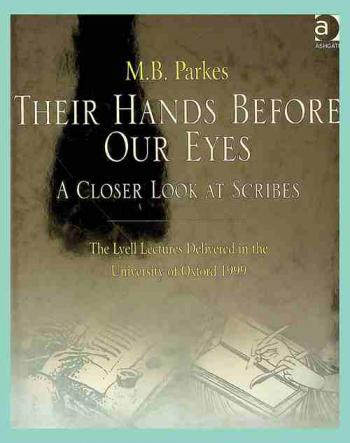
Their hands before our eyes : a closer look at scribes : the Lyell lectures delivered in the University of Oxford, 1999
\"This new book by Malcolm Parkes makes a fundamental contribution to the history of handwriting. Handwriting is a versatile medium that has always allowed individual scribes the opportunity for self-expression, despite the limitations of the pen and the finite number of possible movements. The purpose of this study is to focus on the handwriting of scribes from late antiquity to the beginning of the sixteenth century, and to identify those features which are a scribe's personal contribution to the techniques and art of handwriting.\"--Jacket.
Book
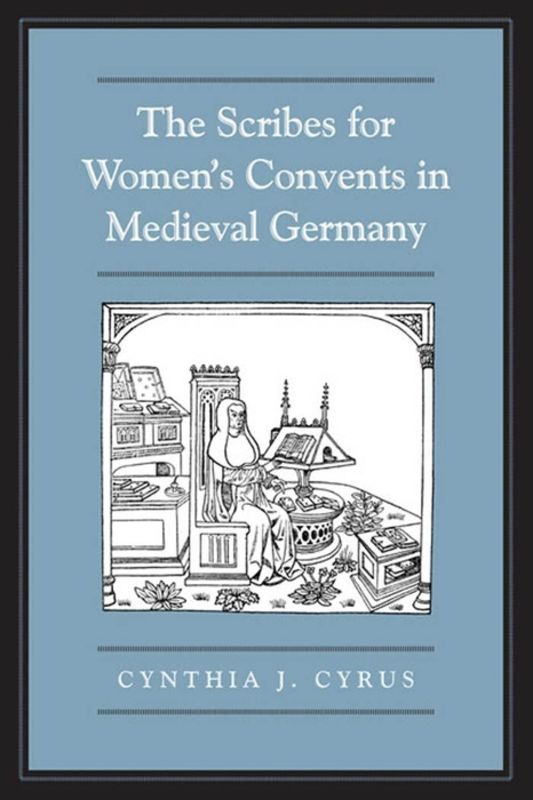
The Scribes For Women's Convents in Late Medieval Germany
Demonstrates the prevalence of manuscript production by women monastics and challenges assumptions of how manuscripts circulated in the late medieval period. Drawing on research into the manuscripts of over 450 women's convents, this book assesses the genres common to women's convent libraries.
eBook


The Culture of Letter-Writing in Pre-Modern Islamic Society
This book presents a unique analysis of letter writing in the Middle Islamic period. This was an important aspect of intellectual life among the ruling classes in that period and it can tell us a great deal about the cultural history of the time. The author sets epistolography within a wider context, drawing on similarities between Islamic modes of letter writing and those of Western cultures. He ties in the crucial notion of the power of the pen in Islamic society with epistemological trends and relationships of dependency among the bureaucracy.
eBook


Empowering Collaborations
This study examines partnerships between medieval women and scribes. Kimberly Benedict argues that medieval female visionaries often play prominent roles in collaboration while their male amanuenses serves as supports and foils.
Kimberley Benedict received her Ph.D. in English from Stanford University in 2001.
eBook
The book in Mamluk Egypt and Syria (1250-1517) : scribes, libraries and market
This book is the first to date to be dedicated to the circulation of the book as a commodity in the Mamluk sultanate. It discusses the impact of princely patronage on the production of books, the formation and management of libraries in religious institutions, their size and their physical setting. It documents the significance of private collections and their interaction with institutional libraries and the role of charitable endowments (waqf) in the life of libraries. The market as a venue of intellectual and commercial exchanges and a production centre is explored with references to prices and fees. The social and professional background of scribes and calligraphers occupies a major place in this study, which also documents the chain of master-calligraphers over the entire Mamluk period. For her study the author relies on biographical dictionaries, chronicles, waqf documents and manuscripts.
Book

Jewish scribes in the Second Temple Period
Journal for the Study of the Old Testament Supplement series, 291.
eBook

Egyptian diary : the journal of Nakht, young scribe
In ancient Egypt, Nakht records his experiences as his family moves from small town Esna to the big, exciting city of Memphis, where he studies to be a scribe like his father and helps discover who has been robbing graves. Includes nonfiction information about Egyptian culture.
Book

Scribal Revelations in Ancient Judaism
Revelations, visions and their interpretations create in themselves authority. In early Jewish Aramaic tradition, however, this is increased by the role of writing. Enoch receives revelations of the secrets of heaven from heavenly tablets by the Holy Watchers. The Fallen Watchers teach the earthly women magic and sorcery from tablets stolen from the heaven. Scribalism in Second Temple period Judaism and Enoch is becoming more and more researched. As is known, Enoch has a Mesopotamian scholarly tradition behind it, which saw the movement of the celestial bodies as a heavenly writing, the transmission of the will of the gods. Enochic scribes had a good familiarity with the Mesopotamian scribal tradition that took place in the sanctuaries from the Persian period onwards and whose purpose was to record astronomical observations, write diaries, prepare astronomical tables and produce almanacs recording events. Scholarly texts were considered as “secret” or “exclusive” knowledge. The omen list Enūma Anu Enlil, based on a 360-day calendar, was the pinnacle of the scribal tradition and the basis of Mesopotamian astral magic. The Mesopotamian revelatory form in Enoch serves to assert the authority of a calendrical system of its own, the 364-day year and the Holy Watchers and other angelic beings who govern it. The scribal form of revelation is known in Daniel 7 (also in Aramaic), in which the books opened in heaven contain a revelation about the fate of the fourth empire. The book-revelation of cyclic and linear time is present together in the book of Jubilees, whose chronology is based on the 364-day year, and in which Enoch keeps a record of earthly events on heavenly tablets.
Journal Article