
Catalogue Search | MBRL


Are you sure you want to remove the book from the shelf?

{{itemTitle}}
398
result(s) for
"Seafood industry Safety measures."
Sort by:

Food Safety in the Seafood Industry
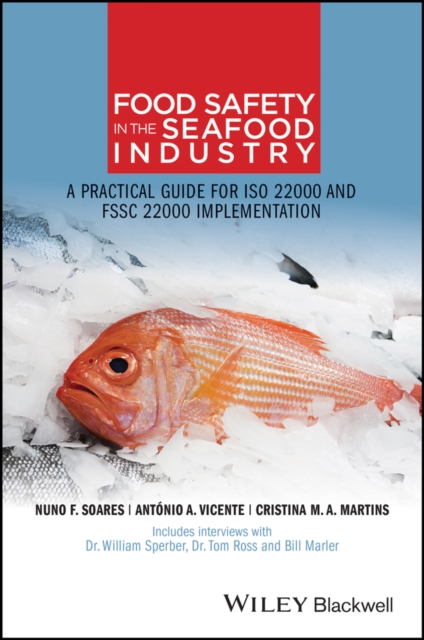
Seafood is one of the most traded commodities worldwide. It is thus imperative that all companies and official control agencies ensure seafood safety and quality throughout the supply chain. Written in an accessible and succinct style, Food Safety in Seafood Industry: A practical guide for ISO 22000 and FSSC 22000 implementation brings together in one volume key information for those wanting to implement ISO 22000 or FSSC 22000 in the seafood manufacturing industry. Concise and highly practical, this book comprises: * a presentation of seafood industry and its future perspectives * the description of the main hazards associated to seafood (including an annexe featuring the analysis of notifications related with such hazards published by Rapid Alert System for Food and Feed - RASFF) * interpretation of ISO 22000 clauses together with practical examples adapted to the seafood manufacturing industry * the presentation of the most recent food safety scheme FSSC 22000 and the interpretation of the additional clauses that this scheme introduces when compared to ISO 22000 This practical guide is a valuable resource for seafood industry quality managers, food technologists, managers, consultants, professors and students. This book is a tool and a vehicle for further cooperation and information interchange around seafood safety and food safety systems. QR codes can be found throughout the book; when scanned they will allow the reader to contact the authors directly, know their personal views on each chapter and even access or request more details on the book content. We encourage the readers to use the QR codes or contact the editors via e-mail (foodsatefybooks@gmail.com) or Twitter (@foodsafetybooks) to make comments, suggestions or questions and to know how to access the Extended Book Content.
eBook

Analysis of the development trend of Chinese seafood imports from Southeast Asia after the Fukushima-Daiichi radioactive treated water discharge from Japan
Japan’s decision to discharge the Fukushima-Daiichi radioactive treated water into the Pacific Ocean has drawn widespread international concern regarding radioactive contamination of seafood and its impact on the marine ecosystem and human health. China’s seafood import trade is confronted with a potentially significant threat. In the favorable circumstances created by China’s suspension of seafood imports from Japan, This article analyzes the impact of Japan’s radioactive treated water discharge on seafood safety and human health, as well as the importance of the Chinese market in the international trade of seafood, and analyzes the seafood export data from Southeast Asian countries to China from 2018 to 2024. A significant increase in seafood exports from countries such as Indonesia, Myanmar, and the Philippines to China was observed. Conversely, there has been a notable decline in the export volumes from Vietnam and Thailand. This paper proposes some proactive strategies for Southeast Asian seafood exports to China, including actively familiarizing with China’s import regulations and standards, optimizing export strategies, cultivating a positive and favorable product image, aligning with the needs of Chinese enterprises, and ensuring food safety.
Journal Article

Potentials of Natural Preservatives to Enhance Food Safety and Shelf Life: A Review
Food-borne illnesses are a significant concern for consumers, the food industry, and food safety authorities. Natural preservatives are very crucial for enhancing food safety and shelf life. Therefore, this review aimed to assess the literature regarding the potential of natural preservatives to enhance food safety and extend the shelf life of food products. The review paper indicated that natural antimicrobial agents that inhibit bacterial and fungal growth for better quality and shelf life have been of considerable interest in recent years. Natural antimicrobials are mainly extracted and isolated as secondary metabolites of plants, animals, and microorganisms. Plants, especially herbs and spices, are given more attention as a source of natural antimicrobials. Microorganisms used in food fermentation also produce different antimicrobial metabolites, including organic acids, hydrogen peroxide, and diacetyl, in addition to bacteriocins. Products of animal origin, such as tissues and milk, contain different antimicrobial agents. Natural antimicrobials are primarily extracted and purified before utilization for food product development. The extraction condition and purification of natural preservatives may change their structure and affect their functionality. Selecting the best extraction method coupled with minimal processing such as direct mechanical extraction seems to preserve active ingredients. The activity of natural antimicrobials could also be influenced by the source, time of harvesting, and stage of development. The effectiveness of natural antimicrobial compounds in food applications is affected by different factors, including food composition, processing method, and storage conditions. Natural antimicrobials are safe because they can limit microbial resistance and meet consumers’ demands for healthier foods.
Journal Article

A Comprehensive Investigation of Microplastic Contamination and Polymer Toxicity in Farmed Shrimps; L. vannamei and P. monodon
Microplastic (MP) pollution poses a significant threat to marine ecosystems, seafood safety, and human health. This study investigates the accumulation of microplastics in two commercially important shrimp species,
Litopenaeus vannamei
(
L. vannamei
) and
Penaeus monodon
(
P. monodon
), sourced from cluster farming sites in Puttalam, Sri Lanka. Shrimp exoskeletons and edible soft tissues underwent rigorous microplastic analysis, including density separation, alkali digestion, stereo microscopy, and Raman spectroscopy. The results revealed high microplastic contamination, with
L. vannamei
containing an average of 4.99 ± 1.81 MP particles/g and
P. monodon
containing 1.87 ± 0.55 MP particles/g. Microplastic sizes varied, with
L. vannamei
predominantly contaminated with 100–250 µm particles and
P. monodon
with 500 µm—1000 µm particles. Fiber morphotypes were prevalent in
L. vannamei
, while blue-colored microplastics were dominant in
P. monodon
. These comprised polystyrene (PS), nylon 6,6, and polyethylene (PE) which were identified by Raman spectroscopy. Additionally, the study investigated the acute toxicity effects of microplastic polymer combinations using a zebrafish embryo model (FET236 assay). Zebrafish embryos exposed to polyethylene-nylon 6,6 combinations exhibited significant adverse effects on hatching, survival, and heart function at lower concentrations, while polyethylene terephthalate-polystyrene combinations showed no considerable effects. These findings underscore the urgent need for monitoring and managing microplastic contamination in shrimp farming areas. Future research should focus on elucidating the ecological impacts and human health risks associated with microplastic exposure.
Graphical Abstract
Journal Article
SwinFishNet: A Swin Transformer-based approach for automatic fish species classification using transfer learning
The fish market is a crucial industry for both domestic economies and the global seafood trade. Accurate fish species classification (FSC) plays a significant role in ensuring sustainability, improving food safety, and optimizing market efficiency. This study introduces automatic FSC using Swin Transformer (ST) through transfer learning (SwinFishNet), which proposes an innovative approach to FSC by leveraging the ST model, a cutting-edge architecture known for its exceptional performance in computer vision tasks. The ST’s unique ability to capture both local and global features through its hierarchical structure enhances its effectiveness in complex image classification tasks. The model utilizes three distinct datasets: the 12-class BD-Freshwater-Fish dataset, the 10-class SmallFishBD dataset, and the 20-class FishSpecies dataset, focusing on image processing-based classification. Images were preprocessed by resizing to 224 × 224 pixels, normalizing, and converting to tensor format for compatibility with deep learning models. Transfer learning was applied using the ST, which was fine-tuned on these datasets and optimized with the AdamW algorithm. The model’s performance was evaluated using classification accuracy (CA), F1-score, recall, precision, Matthews correlation coefficient, Cohen’s kappa and confusion matrix metrics. The results yielded promising CAs: 0.9847 for BD-Freshwater-Fish, 0.9964 for SmallFishBD, and 0.9932 for the FishSpecies dataset. These results underscore the potential of the SwinFishNet in automating FSC and demonstrate its significant contributions to improving sustainability, market efficiency, and food safety in the seafood industry. This work offers a novel methodology with broad applications in both commercial and research settings, advancing the role of artificial intelligence in the fish market.
Journal Article

Cultured Meat Safety Research Priorities: Regulatory and Governmental Perspectives
As with every new technology, safety demonstration is a critical component of bringing products to market and gaining public acceptance for cultured meat and seafood. This manuscript develops research priorities from the findings of a series of interviews and workshops with governmental scientists and regulators from food safety agencies in fifteen jurisdictions globally. The interviews and workshops aimed to identify the key safety questions and priority areas of research. Participants raised questions about which aspects of cultured meat and seafood production are novel, and the implications of the paucity of public information on the topic. Novel parameters and targets may require the development of new analytical methods or adaptation and validation of existing ones, including for a diversity of product types and processes. Participants emphasized that data sharing of these efforts would be valuable, similar to those already developed and used in the food and pharmaceutical fields. Contributions to such databases from the private and public sectors would speed general understanding as well as efforts to make evaluations more efficient. In turn, these resources, combined with transparent risk assessment, will be critical elements of building consumer trust in cultured meat and seafood products.
Journal Article
Occupational health safety in aquaculture: A case study on semi-intensive shrimp farmers of Bangladesh
The study examined health safety issues among semi-intensive shrimp farmers in southwestern Bangladesh. The study assessed semi-intensive shrimp farmers’ knowledge, attitudes, and practices (KAP) on health and safety during their farm activities. The KAP model examined working circumstances, exposures, health complaints, diseases, current health status, and job satisfaction. Face-to-face interviews were conducted with 158 semi-intensive shrimp farmers from Bangladesh’s Khulna, Satkhira, and Bagerhat districts. Type-based data analysis was done. We used Spearman’s rank correlation and multiple linear regression. Only 35% of respondents said that they knew the health safety of chemicals and pesticides used in semi-intensive shrimp farms and that safety training is needed, and all farmers wanted to attend when available. At least 74% of farmers used masks when handling pesticides, fertilizers, and chemicals. 40.50% of farmers used protective clothing, 91% cleansed their hands, legs, and face after each day’s work, and 94% felt that sanitization reduces pesticide, fertilizer, and chemical pollution. A significant positive correlation coefficient was established in KAP. Education significantly increased knowledge. Practices varied with health and safety training. Results suggest that attitudes determine practices, where knowledge is significantly associated with attitudes. A comprehensive health safety and hygiene training program for all shrimp farmers should be developed to raise awareness, reduce illness outbreaks, and preserve healthy living.
Journal Article

Prevalence, virulence factors, and antibiotic resistance of Staphylococcus aureus in seafood products
Introduction
Seafood contamination by bacteria is a pervasive issue, contributing to foodborne illnesses. This study investigates the prevalence, virulence factors, and antibiotic resistance in
Staphylococcus aureus
(
S. aureus
) isolated from various seafood products.
Methods
A total of 460 samples, including fresh, smoked, salted, and dried fish, as well as oysters, crab, lobster, and shrimp, were collected in Shahrekord, Iran.
S. aureus
isolation followed ISO standards, with confirmation via PCR for
16S rRNA
and
nuc
genes. Antibiotic susceptibility was determined via Kirby-Bauer disc diffusion, while PCR detected enterotoxin and antibiotic resistance genes.
Findings
S. aureus
was prevalent in all seafood types, with 27.83% positivity. Methicillin-resistant
S. aureus
(MRSA) was found in most samples, except oysters and crabs. Virulence genes were common, with
Sea
,
Seb
,
Sed
,
Sec
, and
See
being the most prevalent. High resistance to penicillin G and ampicillin (70%- 100%) was observed. Resistance varied for other antibiotics, with linezolid showing 100% susceptibility. The
mecA
gene was present in over 50% of isolates, with
blaZ
being the most detected resistance gene.
Conclusion
The study underscores the need for Good Hygiene Practices (GHP) in seafood processing to mitigate
S. aureus
transmission. While specific comparisons between sample types were limited, the findings emphasize the prevalence of virulence factors and antibiotic resistance in seafood-associated S. aureus, highlighting the importance of vigilant food safety measures.
Journal Article

A Systematic Review of the Applications of Electronic Nose and Electronic Tongue in Food Quality Assessment and Safety
Food quality assessment is a critical aspect of food production and safety, ensuring that products meet both regulatory and consumer standards. Traditional methods such as sensory evaluation, chromatography, and spectrophotometry are widely used but often suffer from limitations, including subjectivity, high costs, and time-consuming procedures. In recent years, the development of electronic nose (e-nose) and electronic tongue (e-tongue) technologies has provided rapid, objective, and reliable alternatives for food quality monitoring. These bio-inspired sensing systems mimic human olfactory and gustatory functions through sensor arrays and advanced data processing techniques, including artificial intelligence and pattern recognition algorithms. The e-nose is primarily used for detecting volatile organic compounds (VOCs) in food, making it effective for freshness evaluation, spoilage detection, aroma profiling, and adulteration identification. Meanwhile, the e-tongue analyzes liquid-phase components and is widely applied in taste assessment, beverage authentication, fermentation monitoring, and contaminant detection. Both technologies are extensively used in the quality control of dairy products, meat, seafood, fruits, beverages, and processed foods. Their ability to provide real-time, non-destructive, and high-throughput analysis makes them valuable tools in the food industry. This review explores the principles, advantages, and applications of e-nose and e-tongue systems in food quality assessment. Additionally, it discusses emerging trends, including IoT-based smart sensing, advances in nanotechnology, and AI-driven data analysis, which are expected to further enhance their efficiency and accuracy. With continuous innovation, these technologies are poised to revolutionize food safety and quality control, ensuring consumer satisfaction and compliance with global standards.
Journal Article