
Catalogue Search | MBRL


Are you sure you want to remove the book from the shelf?

{{itemTitle}}
7
result(s) for
"Search and rescue operations Atlantic Ocean."
Sort by:

Into the storm : two ships, a deadly hurricane, and an epic battle for survival
\"In late September 2015, Hurricane Joaquin swept past the Bahamas and swallowed a pair of cargo vessels in its destructive path: El Faro, a 790-foot American behemoth with a crew of thirty-three, and the Minouche, a 230-foot freighter with a dozen sailors aboard. From the parallel stories of these ships and their final journeys, Tristram Korten weaves a remarkable tale of two veteran sea captains from very different worlds, the harrowing ordeals of their desperate crews, and the Coast Guard's extraordinary battle against a storm that defied prediction. When the Coast Guard received word from Captain Renelo Gelera that the Minouche was taking on water on the night of October 1, the servicemen on duty helicoptered through Joaquin to the sinking ship. Rescue swimmer Ben Cournia dropped into the sea--in the middle of a raging tropical cyclone, in the dark--and churned through the monstrous swells, loading survivors into a rescue basket dangling from the helicopter as its pilot struggled against the tempest. With pulsating narrative skill in the tradition of Sebastian Junger and Jon Krakauer, Korten recounts the heroic efforts by Cournia and his fellow guardsmen to haul the Minouche's crew to safety. Tragically, things would not go as well for Captain Michael Davidson and El Faro. Despite exhaustive searching by her would-be rescuers, the loss of the vessel became the largest U.S. maritime disaster in decades. As Korten narrates the ships' fates, with insights drawn from insider access to crew members, Coast Guard teams, and their families, he delivers a moving and propulsive story of men in peril, the international brotherhood of mariners, and the breathtaking power of nature.\" -- Publisher description
Book

Long-Term Monitoring of the Atlantic Jet through the Strait of Gibraltar with HF Radar Observations
The present work focuses on the long-term coastal monitoring of the Atlantic surface inflow into the Mediterranean basin through the Strait of Gibraltar. Hourly current maps provided during 2016–2017 by a High Frequency radar (HFR) system were used to characterize the Atlantic Jet (AJ) since changes in its speed and direction modulate the upper-layer circulation of the Western Alboran Gyre (WAG). The AJ pattern was observed to follow a marked seasonal cycle. A stronger AJ flowed north-eastwards during autumn and winter, while a weaker AJ was directed more southwardly during the middle of the year, reaching a minimum of intensity during summertime. A strong relationship between AJ speeds and angles was evidenced: the AJ appeared to be frequently locked at an angle around 63°, measured clockwise from the North. The AJ speed usually fluctuated between 50 cm·s−1 and 170 cm·s−1, with occasional drops below 50 cm·s−1 which were coincident with abrupt modifications in AJ orientation. Peaks of current speed clearly reached values up to 250 cm·s−1, regardless of the season. A number of persistent full reversal episodes of the surface inflow were analyzed in terms of triggering synoptic conditions and the related wind-driven circulation patterns. High sea level pressures and intense (above 10 m·s−1), permanent and spatially-uniform easterlies prevailed over the study domain during the AJ collapse events analyzed. By contrast, tides seemed to play a secondary role by partially speeding up or slowing down the westward currents, depending on the phase of the tide. A detailed characterization of this unusual phenomenon in the Strait of Gibraltar is relevant from diverse aspects, encompassing search and rescue operations, the management of accidental marine pollution episodes or efficient ship routing.
Journal Article
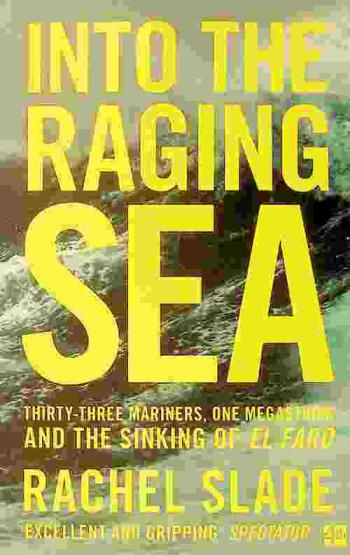
Into the raging sea : thirty-three mariners, one megastorm and the sinking of the El Faro
In the tradition of The Perfect Storm and Into Thin Air, Rachel Slade's Into the Raging Sea is a nail-biting account of the sinking of the American container ship El Faro, the crew of 33 who perished onboard, and the destructive forces of globalization that put the ship in harm's way.


Into the raging sea : thirty-three mariners, one megastorm, and the sinking of El Faro
\"In the tradition of The Perfect Storm and Into Thin Air, Rachel Slade's Into the Raging Sea is a nail-biting account of the sinking of the American container ship El Faro, the crew of 33 who perished onboard, and the destructive forces of globalization that put the ship in harm's way\"-- Provided by publisher.
Book

LOST IN THE DEPTHS: The Atlantic Ocean claims Swissair Flight 111 just off the coast of Nova Scotia
In the wake of the tragedy, about 800 relatives of the victims travelled to Halifax--many of them on Swissair charter flights from New York and Switzerland. As the A310 Airbus from Zurich landed in fog and drizzle at Halifax International Airport on Friday, several passengers pulled the plane's blinds down to avoid the media throng. Most of the relatives made the trip to Peggys Cove, where officials had set up a special isolated seaside area to allow them to look out towards the crash site.
Magazine Article

Abandon ship! : the true World War II story about the sinking of the Laconia
\"A remarkable true WWII account of the maritime attack on the RMS Laconia off the West African coast\"-- Provided by publisher.
BOOK