
Catalogue Search | MBRL


Are you sure you want to remove the book from the shelf?

{{itemTitle}}
141
result(s) for
"Seattle (Wash.) History."
Sort by:


Emerald City
At the foot of the snow-capped Cascade Mountains on the forested shores of Puget Sound, Seattle is set in a location of spectacular natural beauty. Boosters of the city have long capitalized on this splendor, recently likening it to the fairytale capital of L. Frank Baum'sThe Wizard of Oz, the Emerald City. But just as Dorothy, Toto, and their traveling companions discover a darker reality upon entering the green gates of the imaginary Emerald City, those who look more closely at Seattle's landscape will find that it reveals a history marked by environmental degradation and urban inequality.
This book explores the role of nature in the development of the city of Seattle from the earliest days of its settlement to the present. Combining environmental history, urban history, and human geography, Matthew Klingle shows how attempts to reshape nature in and around Seattle have often ended not only in ecological disaster but also social inequality. The price of Seattle's centuries of growth and progress has been paid by its wildlife, including the famous Pacific salmon, and its poorest residents. Klingle proposes a bold new way of understanding the interdependence between nature and culture, and he argues for what he calls an \"ethic of place.\" Using Seattle as a compelling case study, he offers important insights for every city seeking to live in harmony with its natural landscape.
eBook


Pan-tribal activism in the Pacific Northwest
On September 27, 1975, activist Bernie Whitebear (Sin Aikst) and Seattle Mayor Wes Uhlman broke ground on former Fort Lawton lands, just outside Seattle Washington, for the construction of the Daybreak Star Indian Cultural Center. The groundbreaking was the culmination of years of negotiations and legal wrangling between several government entities and the United Indians of All Tribes, the group that occupied the Fort lands in 1970. The peaceful event and sense of co-operation stood in marked contrast to the turbulent and sometimes violent occupation of the lands years before. Native Americans who joined the UIAT came from all parts of the Pacific Northwest and beyond. Inspired by the Civil Rights and protest era of the 1960s and 1970s, they squared off with local and federal government to demand the protection of civil and political rights and better social services. Both the scope and the purpose of this book are manifold. The first purpose is to challenge the predominant narrative of Anglo American colonization in the region and re-assert self-determination by re-defining the relationship between Pacific Northwest Native Americans, the larger population of Washington State, and government itself. The second purpose is to illustrate the growth in Pan-Indian/Pan-Tribal activism in the second half of the twentieth century in an attempt to place the Pacific Northwest Native American protests into a broader context and to amend the scholarly and popular trope which characterizes the Red Power movement of the 1960s as the creation of the American Indian Movement (AIM). In this book, casual students of history as well as academics will find that Fort Lawton represents the zone of conflict and compromise occupied by Indigenous people of the Pacific Northwest in their ongoing struggle with colonial society.
eBook


Heartbreak City
To cities, sports have never been just entertainment.
Progressive urbanites across the United States have used athletics
to address persistent problems in city life: the fights for racial
justice, workers' rights, equality for women and LGBTQ+ city
dwellers, and environmental conservation. In Seattle, sports
initiatives have powered meaningful reforms, such as popular
stadium projects that promoted investments in public housing and
mass transit. At the same time, conservative forces also used
sports to consolidate their power and mobilize against the civic
good. In Heartbreak City Shaun Scott takes the reader
through 170 years of Seattle history, chronicling both well-known
and long-forgotten events, like the establishment of racially
segregated golf courses and neighborhoods in the regressive 1920s
and the 1987 Seahawks players' strike that galvanized organized
labor. At every step of the journey, he uncovers how sports have
both united Seattle in pursuit of triumph and revealed its most
profound political divides. Deep archival research and analysis
combine in this people's history of a great American city's quest
to become even greater-if only it could get out of its own way.
Heartbreak City was made possible in part by a grant from
4Culture's Heritage Program. A Michael J. Repass Book
eBook

The game of love and death
In Seattle in 1937 two seventeen-year-olds, Henry, who is white, and Flora, who is African-American, become the unwitting pawns in a game played by two immortal figures, Love and Death, where they must choose each other at the end, or one of them will die.
Book

Seattle, Past to Present
Roger Sale's Seattle, Past to Present has become a beloved reflection of Seattle's history and its possible futures as imagined in 1976, when the book was first published. Drawing on demographic analysis, residential surveys, portraiture, and personal observation and reflection, Sale provides his take on what was most important in each of Seattle's main periods, from the city's founding, when settlers built a city great enough that the railroads eventually had to come; down to the post-Boeing Seattle of the 1970s, when the city was coming to terms with itself based on lessons from its past.
Along the way, Sale touches on the economic diversity of late nineteenth-century Seattle that allowed it to grow; describes the major achievements of the first boom years in parks, boulevards, and neighborhoods of quiet elegance; and draws portraits of people like Vernon Parrington, Nellie Cornish, and Mark Tobey, who came to Seattle and flourished. The result is a powerful assessment of Seattle's vitality, the result of old-timers and newcomers mixing both in harmony and in antagonism.
With a new introduction by Seattle journalist Knute Berger, this edition invites today's readers to revisit Sale's time capsule of Seattle-and perhaps learn something unexpected about this ever-changing city.
eBook

No-no boy
\"\"No-No Boy\" tells the story of Ichiro Yamada, a fictional version of the real-life \"no-no boys\". Yamada answered \"no\" twice in a compulsory government questionnaire as to whether he would serve in the armed forces and swear loyalty to the United States. Unwilling to pledge himself to the country that interned him and his family, Ichiro earns two years in prison and the hostility of his family and community when he returns home to Seattle\"-- Provided by publisher.
Book
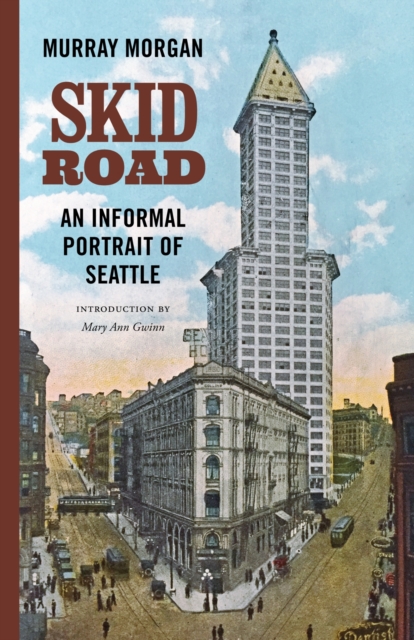
Skid Road
Skid Road tells the story of Seattle “from the bottom up,” offering an informal and engaging portrait of the Emerald City’s first century, as seen through the lives of some of its most colorful citizens. With his trademark combination of deep local knowledge, precision, and wit, Murray Morgan traces the city’s history from its earliest days as a hacked-from-the-wilderness timber town, touching on local tribes, settlers, the lumber and railroad industries, the great fire of 1889, the Alaska gold rush, flourishing dens of vice, the 1919 general strike, the 1962 World’s Fair, and the stuttering growth of the 1970s and ’80s. Through it all, Morgan shows us that Seattle’s one constant is change and that its penchant for reinvention has always been fueled by creative, if sometimes unorthodox, residents.With a new introduction by Pulitzer Prize-winning book critic Mary Ann Gwinn, this redesigned edition of Murray Morgan’s classic work is a must for those interested in how Seattle got to where it is today.
eBook