
Catalogue Search | MBRL


Are you sure you want to remove the book from the shelf?

{{itemTitle}}
19
result(s) for
"Seattle Biography"
Sort by:

Normal : a mother and her beautiful son
\"A moving memoir from the mother of a child with Treacher Collins Syndrome, with a foreword by R.J. Palacio, author of Wonder\"-- Provided by publisher.
Book
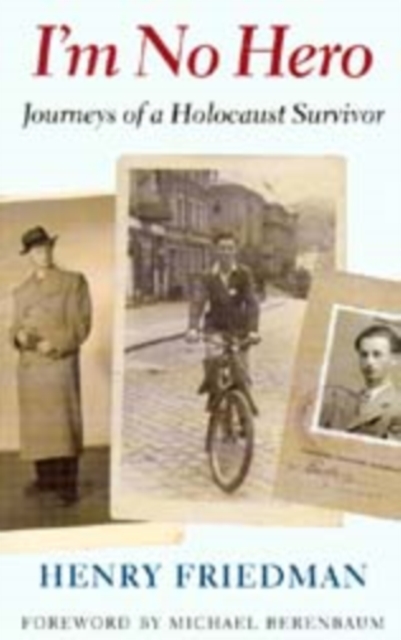
I'm No Hero
Henry Friedman was robbed of his adolescence by the monstrous evil that annihilated millions of European Jews and changed forever the lives of those who survived. When the Nazis overran their home town near the Polish-Ukrainian border, the Friedman family was saved by Ukrainian Christians who had worked at their farm. Henry, his mother, his younger brother, and a young schoolteacher who had been hired by his father when Jews were forbidden to attend school were hidden in a loft over the animal stalls at a neighbor s farm; his father hid in another hayloft half a mile away.
When the family was liberated by the Russians after eighteen months in hiding, Henry, at age fifteen, was emaciated and too weak to walk. The Friedmans eventually made their way to a displaced persons camp in Austria where Henry learned quickly to wheel and deal, seducing women of various ages and nationalities and mastering the intricacies of dealing in the black market. In I m No Hero, he confronts with unblinking honesty the pain, the shame, and the bizarre comedy of his passage to adulthood.
The family came to Seattle in 1949, where Henry Friedman has made his home ever since. In 1988 he returned with his wife to Brody and Suchowola, where he succeeded in finding Julia Symchuk, who, as a young girl, had warned his father that the Gestapo was looking for him, and whose family had hidden the Friedmans in their loft. The following year he was able to bring Julia to Seattle for a triumphal visit, where she was honored in many ways, although, as Friedman writes, in her own country she had never been honored with anything except hard work.
Like many other survivors, Henry Friedman has found it difficult to confront his past. Like others, too, he has felt the obligation to bear witness. Now retired, he devotes much of his time to telling his story, which he believes is a message of hope, to thousands of schoolchildren throughout the Pacific Northwest. He has received national recognition for his role in establishing the United States Holocaust Museum in Washington, DC, and as a founder of the Washington State Holocaust Education Resource Center.
eBook

Midnight in broad daylight : a Japanese American family caught between two worlds
The true story of a Japanese American family that found itself on opposite sides during World War II.
Book

Before Seattle Rocked
Seattle is a music town with rich, deep roots that have influenced the culture and identity of its civic life for decades. In a society that appreciates music but is ambivalent toward the profession of making it, the importance and contribution of Seattle's musicians have been routinely overlooked in historical accounts of the city. Kurt Armbruster fills that gap in this far-reaching and entertaining panorama of Seattle music from the 1890s to the 1960s, \"before Seattle rocked.\"
For this once-remote city, music forged links as real as those created by railroads and steamships. Classical music embodied the middle-class aspirations for gentility and cosmopolitan stature; jazz and blues gave Seattle's small African American community a vehicle for affirmation and economic advancement; ethnic music helped immigrants adjust to a new home; songs and drumming kept the memories of the Duwamish alive in a changing world. Before Seattle Rocked is enlivened by personal anecdotes and memories from many of Seattle's most beloved musicians and is enriched by historic photos of the changing music scene.
Watch the trailer: http://www.youtube.com/watch?v=tyo22tC6PkQ&feature=channel_video_title
eBook

Fieldwork Connections
Fieldwork Connections tells the story of the intertwined research histories of three anthropologists working in Liangshan Yi Autonomous Prefecture, Sichuan, China in the late twentieth century. Chapters are written alternately by a male American anthropologist, a male researcher raised in a village in Liangshan, and a highly educated woman from an elite Nuosu/Chinese family. As decades of mutual ethnographic research unfold, the authors enter one another's narratives and challenge the reader to ponder the nature of ethnographic truth.
The book begins with short accounts of the process by which each of the authors became involved in anthropological field research. It then proceeds to describe the research itself, and the stories begin to connect as they become active collaborators. The scene shifts in the course of the narrative from China to America, and the relationship between the authors shifts from distant, wary, and somewhat hierarchical to close, egalitarian, and reciprocal.
The authors share their histories through personal stories, not technical analyses; their aim is to entertain while addressing the process of ethnography and the dynamics of international and intercultural communication.
eBook
Walking Distance
In the summer of 2000, David Hlavsa and his wife Lisa Holtby embarked on a pilgrimage. After trying for three years to conceive a child and suffering through the monthly cycle of hope and disappointment, they decided to walk the Camino de Santiago, a joint enterprise-and an act of faith-they hoped would strengthen their marriage and prepare them for parenthood.Though walking more than 400 miles across the north of Spain turned out to be more difficult than they had anticipated, after a series of misadventures, including a brief stay in a Spanish hospital, they arrived in Santiago. Shortly after their return to Seattle, Lisa became pregnant, and the hardships of the Camino were no comparison to what followed: the stillbirth of their first son and Lisa's harrowing second pregnancy.Walking Distanceis a moving and disarmingly funny book, a good story with a happy ending-the safe arrival of David and Lisa's second son, Benjamin. David and Lisa get more than they bargained for, but they also get exactly what they wanted: a child, a solid marriage, and a richer life.
eBook


Shaping Seattle Architecture
The first edition ofShaping Seattle Architecture, published in 1994, introduced readers to Seattle's architects by showcasing the work of those who were instrumental in creating the region's built environment. Twenty years later, the second edition updates and expands the original with new information and illustrations that provide an even richer exploration of Seattle architecture.
The book begins with a revised introduction that brings the story of Seattle architecture into the twenty-first century and situates developments in Seattle building design within local and global contexts. The book's fifty-four essays present richly illustrated profiles that describe the architects' careers, provide an overview of their major works, and explore their significance.
Shaping Seattle Architecturecelebrates a wide range of people who helped form the region's built environment. It provides updated information about many of the architects and firms profiled in the first edition. Four individuals newly included in this second edition are Edwin J. Ivey, a leading residential designer; Fred Bassetti, an important contributor to Northwest regional modernism; L. Jane Hastings, one of the region's foremost women in architecture; and Richard Haag, founder of the landscape architecture program at the University of Washington and designer of Gas Works Park and the Bloedel Reserve.
The book also includes essays on the buildings of the Coast Salish people, who inhabited Puget Sound prior to Euro-American settlement; the role that architects played in speculative housing developments before and after World War II; and the vernacular architecture built by nonprofessionals that makes up a portion of the fabric of the city.
Shaping Seattle Architectureconcludes with a substantial reference section, updated to reflect the last twenty years of research and publications. A locations appendix offers a geographic guide to surviving works. The research section directs interested readers to further resources, and the appendix \"Additional Significant Seattle Architects\" provides thumbnail sketches of nearly 250 important figures not included in the main text.
eBook
Classical Seattle
The past 50 years have seen a tremendous arts boom in Seattle, which has given the city not only internationally recognized classical music institutions but also great performance halls to showcase their work and that of visiting artists. From Igor Stravinsky's presence as guest conductor at the World's Fair in 1962, to Speight Jenkins's masterly production of Wagner'sRingcycle, to the work of benefactors such as Jack and Becky Benaroya, Seattle is deservingly well known as a city of the musical arts.
InClassical Seattle, Melinda Bargreen documents the lives of prominent figures in the local classical music world. Informed by Bargreen's experience as a music critic and drawing on interviews she conducted over several decades, the 35 biographical profiles presented here illuminate the conductors, performing artists, composers, arts organizers, and arts leaders who have shaped Seattle's classical music community and made world-class performances possible. Among the individuals featured are University of Washington virtuosi, Seattle Symphony maestros and musicians, and Seattle Opera directors.
eBook
