
Catalogue Search | MBRL


Are you sure you want to remove the book from the shelf?

{{itemTitle}}
406
result(s) for
"Secularism Islamic countries."
Sort by:


Islam, secularism, and liberal democracy : toward a democratic theory for Muslim societies
This book analyzes the relationship between religion, secularism, and liberal democracy—historically, theoretically, and in the context of the contemporary Muslim world. The central issue is: liberal democracy requires a form of secularism, yet simultaneously the main cultural and intellectual resources that Muslim democrats can draw upon are religious. A paradox, therefore, confronts the democratic theorist. Challenging the popular belief that religious politics and democratic development are structurally incompatible, three arguments are advanced: In societies where religion is a key marker of identity, the road to liberal democracy must traverse the gates of religious politics. The primary theoretical implication that emerges from this claim is that the process of democratization cannot be de-linked from debates about the normative role of religion in government. While liberal democracy requires secularism, religious traditions are not born with an inherent secular conception of politics. These ideas must be socially constructed. In the context of an emerging democracy, how secularism becomes indigenized as political value is topic that this work explores. An intimate relationship exists between religious reformation and political development. While the first often precedes the second, the processes are interlinked. Democratization does not require a privatization of religion but it does require a reinterpretation of religious ideas that are conducive to liberal democracy. By engaging in this reinterpretation, religious groups can play an important role in the development and consolidation of democracy. Overall, this book argues for a rethinking of democratic theory so that it incorporates the variable of religion in the development and social construction of liberal democracy.
eBook


Islam without extremes : a Muslim case for liberty
Islam without Extremes presents a provocative manifesto for an interpretation of Islam that synthesises liberal ideas and respect for the Islamic tradition. With an eye sympathetic to Western liberalism and Islamic theology, Mustafa Akyol traces the roots of political Islam. The years following the death of Muhammad saw an intellectual \"war of ideas\" rage between rationalist, flexible schools of Islam and the more dogmatic, rigid ones. The traditionalists won, fostering perceptions of Islam as antithetical to modernity. However, Akyol traces a flourishing of liberalism in the nineteenth-century Ottoman Empire and explores the unique \"Islamo-liberal synthesis\" of present-day Turkey. Only by accepting a secular state, he asserts, can Islamic societies thrive. Persuasive and inspiring, Islam without Extremes offers an intellectual basis for the reconcilability of Islam and religious, political, economic and social freedoms.
Book
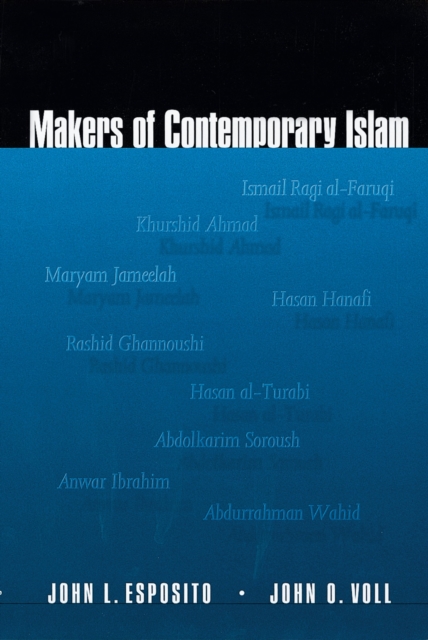
Makers of contemporary Islam
In this timely and important work, John Esposito and John Voll explore the development of contemporary Islamic movements and thought through the biographies of nine major activist intellectuals who represent a wide range of Muslim societies. Many Muslims have combined revivalist activism with intellectual efforts, but only a few have achieved significant international visibility and influence. By examining the lives and work of nine such internationally recognized figures, Esposito and Voll provide a new understanding of the intellectual foundations of contemporary Islamic awareness and politics. Included are profiles of: Ismail Ragi al-Faruqi (U.S./Palestine), Khurshid Ahmad (India/Pakistan), Maryam Jameelah (U.S./Pakistan), Hasan Hanafi (Sudan), Rashid Ghannoushi (Tunisia), Hasan al-Turabi (Sudan), Abdolkarim Soroush (Iran), Anwar Ibrahim (Malaysia), and Abdurrahman Wahid (Indonesia).
These thinkers contributed to some of the most significant intellectual and activist developments in the Muslim world during the 1980s and 1990s--the period during which Islamic movements became a major force in Muslim societies and international affairs. They helped to organize and lead the movements of Islamic renewal and provided the conceptual foundations for the programs those movements advocate. Together, they represent a distinctive phase in the evolution of Islamic thinking: the ongoing effort to create an effective synthesis of modernity and Islamic tradition. Their work supplies the core of the Islamic resurgence of the1990s and the foundation for what it can become in the twenty-first century.
eBook


Remaking Muslim Politics
There is a struggle for the hearts and minds of Muslims unfolding across the Islamic world. The conflict pits Muslims who support pluralism and democracy against others who insist such institutions are antithetical to Islam. With some 1.3 billion people worldwide professing Islam, the outcome of this contest is sure to be one of the defining political events of the twenty-first century.
Bringing together twelve engaging essays by leading specialists focusing on individual countries, this pioneering book examines the social origins of civil-democratic Islam, its long-term prospects, its implications for the West, and its lessons for our understanding of religion and politics in modern times.
Although depicted by its opponents as the product of political ideas \"made in the West\" civil-democratic Islam represents an indigenous politics that seeks to build a distinctive Islamic modernity. In countries like Turkey, Iran, Malaysia, and Indonesia, it has become a major political force. Elsewhere its influence is apparent in efforts to devise Islamic grounds for women's rights, religious tolerance, and democratic citizenship. Everywhere it has generated fierce resistance from religious conservatives. Examining this high-stakes clash,Remaking Muslim Politicsbreaks new ground in the comparative study of Islam and democracy. The contributors are Bahman Baktiari, Thomas Barfield, John R. Bowen, Dale F. Eickelman, Robert W. Hefner, Peter Mandaville, Augustus Richard Norton, Gwenn Okruhlik, Michael G. Peletz, Diane Singerman, Jenny B. White, and Muhammad Qasim Zaman.
eBook


Political Islam, Iran, and the Enlightenment
Ali Mirsepassi's book presents a powerful challenge to the dominant media and scholarly construction of radical Islamist politics, and their anti-Western ideology, as a purely Islamic phenomenon derived from insular, traditional and monolithic religious 'foundations'. It argues that the discourse of political Islam has strong connections to important and disturbing currents in Western philosophy and modern Western intellectual trends. The work demonstrates this by establishing links between important contemporary Iranian intellectuals and the central influence of Martin Heidegger's philosophy. We are also introduced to new democratic narratives of modernity linked to diverse intellectual trends in the West and in non-Western societies, notably in India, where the ideas of John Dewey have influenced important democratic social movements. As the first book to make such connections, it promises to be an important contribution to the field and will do much to overturn some pervasive assumptions about the dichotomy between East and West.
eBook