
Catalogue Search | MBRL


Are you sure you want to remove the book from the shelf?

{{itemTitle}}
19
result(s) for
"Selbstmanagement"
Sort by:

HBR guide to getting the right work done
\"In the HBR Guide to Getting the Right Work Done, you'll discover how to focus your time and energy where they will yield the greatest reward. Not only will you end each day knowing you made progress-your improved productivity will also set you apart from the pack. Whether you're a new professional or an experienced one, this guide will help you: Prioritize and stay focused; Work less but accomplish more; Stop bad habits and develop good ones; Break overwhelming projects into manageable pieces; Conquer e-mail overload; Write to-do lists that really work.
Book

The self-regulation-view in writing-to-learn
[The authors] propose the self-regulation view in writing-to-learn as a promising theoretical perspective that draws on models of self-regulated learning theory and cognitive load theory. According to this theoretical perspective, writing has the potential to scaffold self-regulated learning due to the cognitive offloading written text generally offers as an external representation and memory aid, and due to the offloading, that specifically results from the genre-free principle in journal writing. However, to enable learners to optimally exploit this learning opportunity, the journal writing needs to be instructionally supported. Accordingly, [the authors] have set up a research program - the Freiburg Self-Regulated-Journal-Writing Approach - in which [the authors] developed and tested different instructional support methods to foster learning outcomes by optimizing cognitive load during self-regulated learning by journal writing. [The authors] will highlight the main insights of [their] research program which are synthesized from 16 experimental and 4 correlative studies published in 16 original papers. Accordingly, [the authors] present results on (1) the effects of prompting germane processing in journal writing, (2) the effects of providing worked examples and metacognitive information to support students in effectively exploiting prompted journal writing for self-regulated learning, (3) the effects of adapting and fading guidance in line with learners' expertise in self-regulated learning, and (4) the effects of journal writing on learning motivation and motivation to write. The article closes with a discussion of several avenues of how the Freiburg Self-Regulated-Journal-Writing Approach can be developed further to advance research that integrates self-regulated learning with cognitive load theory. (Orig.).
Journal Article
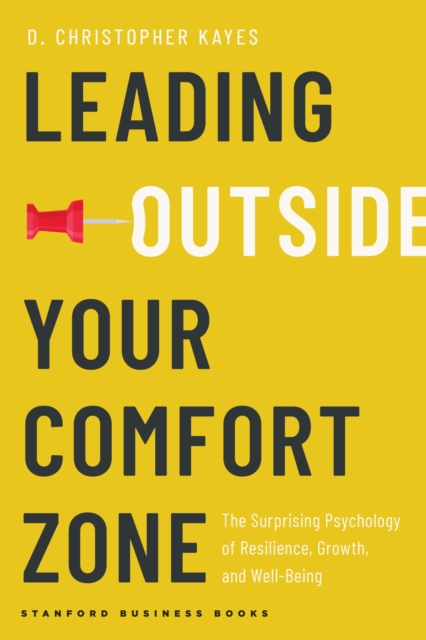
Leading Outside Your Comfort Zone
\"Leading is inevitably frustrating and emotionally demanding, yet leaders get little training in how to deal with painful emotions. Since the global pandemic, stresses on leaders have only grown. To remain effective in an age of anxiety, leaders must build the capacity to act in spite of unpleasant emotions, and bring a learning mindset to novel challenges. Leading Outside Your Comfort Zone draws on a wide body of research to show how well-being and resilience emerges from this struggle -- from continuing to learn in the face of unpleasant emotions. The book offers leaders tools for building everyday resilience and learning how to: Face new challenges Improve progress toward goals; Improve productivity during discouraging, apparently \"unfruitful\" periods; Overcome frustration; Build confidence and a mindset of stress-less productivity; Build resilience throughout the organization. The book integrates insights from diverse disciplines, including management and organization studies, psychology, sports and military psychology, neuroscience, and education, and presents original research involving over 1,000 leaders. The book focuses on five tools that help leaders develop positive emotional engagement, creative problem-solving, learning identity, flexibility, and social support.\"
eBook

Critical Library Leadership
Critical Library Leadership: Managing Self and Others in Today's Academic Library provides practical, library-specific, hands-on tools that help us shape our approach to leadership and ourselves as leaders. It gives practical strategies for dealing with stress and addressing feelings of insecurity alongside managing the organization from an equity perspective that places people at the forefront. Each section offers a mixture of theory and research, lived experience, and practice that captures many different techniques you can apply to your own journey and organizational context in both formal and informal ways.
eBook

Toward Inclusive Academic Librarian Hiring Practices
Toward Inclusive Academic Librarian Hiring Practices, rather than focusing just on how to diversify applicant pools, breaks down the many considerations involved in hiring and the intentional, thoughtful preparation and self-examination that leads to successful recruitment and retention in three parts. * Training for Search Committees and Stakeholders* Removing Barriers for Candidates* Transforming the Process for All.
eBook
Keeping found things found : the study and practice of personal information management
Keeping Found Things Found: The Study and Practice of Personal Information Management is the first comprehensive book on new 'favorite child' of R&D at Microsoft and elsewhere, personal information management (PIM). It provides a comprehensive overview of PIM as both a study and a practice of the activities people do, and need to be doing, so that information can work for them in their daily lives. It explores what good and better PIM looks like, and how to measure improvements. It presents key questions to consider when evaluating any new PIM informational tools or systems. This book is designed for R&D professionals in HCI, data mining and data management, information retrieval, and related areas, plus developers of tools and software that include PIM solutions. Focuses exclusively on one of the most interesting and challenging problems in today's world Explores what good and better PIM looks like, and how to measure improvements Presents key questions to consider when evaluating any new PIM informational tools or systems
eBook

Stress Am Arbeitsplatz
Immer mehr psychisch erkrankte Menschen klagen über berufliche Überlastungsreaktionen oder Erschöpfungszustände bis hin zum Burnout.PeBaS bietet hierfür einen & auch im akuten stationären Sektor bewährten & sinnvollen Baustein in der transdiagnostischen modularen Psychotherapie im Gruppensetting.
eBook

Personal Information Management
In an ideal world, everyone would always have the right information, in the right form, with the right context, right when they needed it. Unfortunately, we do not live in an ideal world. This book looks at how people in the real world currently manage to store and process the massive amounts of information that overload their senses and their systems, and discusses how tools can help bring these real information interactions closer to the ideal.
Personal information management(PIM) is the study and practice of the activities people perform to acquire, organize, maintain, and retrieve information for everyday use. PIM is a growing area of interest as we all strive for better use of our limited personal resources of time, money, and energy, as well as greater workplace efficiency and productivity.
Personal information is currently fragmented across electronic documents, email messages, paper documents, digital photographs, music, videos, instant messages, and so on. Each form of information is organized and used to complete different tasks and to fulfill disparate roles and responsibilities in an individual's life. Existing PIM tools are partly responsible for this fragmentation. They can also be part of the solution that brings information together again. A major contribution of this book is its integrative treatment of PIM-related research.
The book grows out of a workshop on PIM sponsored by the National Science Foundation, held in Seattle, Washington, in 2006. Scholars from major universities and researchers from companies such as Microsoft Research, Google, and IBM offer approaches to conceptual problems of information management. In doing so, they provide a framework for thinking about PIM as an area for future research and innovation.
eBook
Von Kunst Leben
Kenntnisse und Inspirationen über den Kunstmarkt für bildende Künstler*innen und die erfolgreiche Vermarktung des eigenen Werkes.
eBook

Using Action Research and Peer Perspectives to Develop Technology That Facilitates Behavioral Change and Self-Management in COPD
Background. Behavioural change and self-management in patients with chronic illness may help to control symptoms, avoid rehospitalization, enhance quality of life, and decrease mortality and morbidity. Objective. Guided by action research principles and using mixed methods, the aim of this project was to develop peer based educational, motivational, and health-promoting peer based videos, using behavioural change principles, to support self-management in patients with COPD. Methods. Individuals (n=32) living with COPD at home and involved in two community based COPD support groups were invited to participate in this project. Focus group/individual interviews and a demographic questionnaire were used to collect data. Results. Analysis revealed 6 categories relevant to behavioural change which included self-management, support, symptoms, knowledge, rehabilitation, and technology. Participants commented that content needed to be specific, and videos needed to be shorter, to be tailored to severity of condition, to demonstrate “normal” activities, to be positive, and to ensure that content is culturally relevant. Conclusions. This study demonstrated that detailed analysis of patient perspectives and needs for self-management is essential and should underpin the development of any framework, materials, and technology. The action research design principles provided an effective framework for eliciting the data and applying it to technology and testing its relevance to the user.
Journal Article