
Catalogue Search | MBRL


Are you sure you want to remove the book from the shelf?

{{itemTitle}}
18
result(s) for
"Seldes, Gilbert"
Sort by:
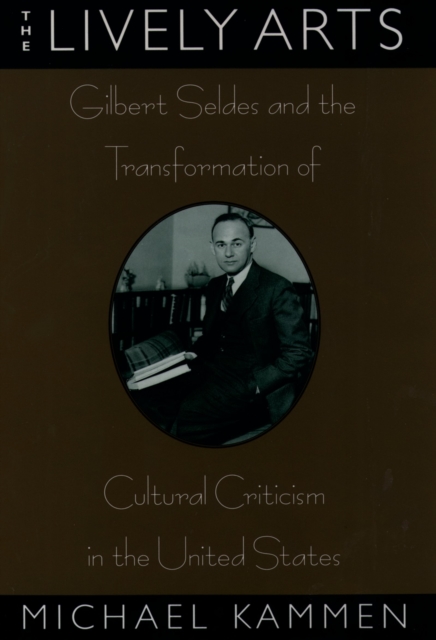
The lively arts : Gilbert Seldes and the transformation of cultural criticism in the United States
He was a friend of James Joyce, Pablo Picasso, e.e. cummings, John Dos Passos, Irving Berlin, and F. Scott Fitzgerald--and the enemy of Ezra Pound, H.L. Mencken, and Ernest Hemingway. He was so influential a critic that Edmund Wilson declared that he had played a leading role in the “liquidation of genteel culture in America.” Yet today many students of American culture would not recognize his name. He was Gilbert Seldes, and in this brilliant biographical study, Pulitzer Prize-winning historian Michael Kammen recreates a singularly American life of letters. Equally important, Kammen uses Seldes’s life as a lens through which to bring into sharp focus the dramatic shifts in American culture that occurred in the half-century after World War I. Born in 1893, Seldes saw in his lifetime an astonishing series of innovations in popular and mass culture: silent films and talkies, the phonograph and the radio, the coming of television, and the proliferation of journalism aimed at mainstream America in such venues as Vanity Fair, The Saturday Evening Post, and Esquire. (His monthly column in Esquire was called “The Lively Arts.”) Seldes was more than a witness to these changes, however; he was the leading champion of popular culture in his time, and a skilled practitioner as well. Kammen, the first scholar to enjoy access to Seldes’s unpublished papers, illuminates his immense influence as the earliest cultural critic to insist that the lively arts--vaudeville, musical revues, film, jazz, and the comics--should be taken just as seriously as grand opera, the legitimate theatre, and other manifestations of high culture. As he traces Seldes’s remarkable evolution from an acknowledged aesthete and highbrow to a cultural democrat with a passion for the popular arts, Kammen recaptures the critic’s prescience, wit, and generosity for a newly expanded audience. We witness Seldes’s triumphs and travails as managing editor of The Dial, the most influential literary magazine of its time, and read of New York’s endlessly feuding publications and literary rivalries. Kammen offers wonderfully detailed accounts of The Dial’s introduction of “The Wasteland” in its November 1922 issue; Seldes’s review of Ulysses for The Nation, one of the first (if not the very first) to appear in the U.S.; and the complete story of the writing, publication, and critical reception of The Seven Lively Arts, Seldes’s most influential book. And Kammen also covers Seldes’s astonishingly versatile later career as a freelance writer (on every conceivable subject), historian, novelist, playwright, filmmaker, radio scriptwriter, the first program director for CBS Television, and the founding dean of the Annenberg School of Communications at the University of Pennsylvania. One of popular culture’s earliest and most eloquent champions, Seldes was nonetheless publicly worried as early as 1937 that the popularity of radio, film, and television would mean the demise of the “private art of reading.” By 1957 he was warning that “with the shift of all entertainment into the area of big business, we are being engulfed into a mass-produced mediocrity.” At a time when many thoughtful Americans despair of popular culture, The Lively Arts revisits the opening salvos in the ongoing debate over “democratization” versus “dumbing down” of the arts. It offers a penetrating and timely analysis of Gilbert Seldes’s pioneering conviction that the popular and the great arts must not only co-exist but enrich one another if we are to realize the innovation and intensity of American culture at its best.
eBook

A Bedpan of Poop: The Influence of Silent Screen Comedy on Dos Passos's Manhattan Transfer
The influence of film technique on John Dos Passos's Manhattan
Transfer is well established. However, there is another aspect of
silent era cinema that is highly present in the novel yet largely overlooked:
slapstick. As much as any other contemporaneous film genre, slapstick shared
with Dos Passos a skepticism about the controlling nature of modern urban
society. A close comparison of the novel and the films of Harold Lloyd and
Charlie Chaplin, the era's two most popular film stars, furthers our
understanding of how Dos Passos sought inspiration in popular entertainment to
make his critique of modernity, while also revealing a comic sensibility at work
in a novel more frequently viewed through the lens of tragedy.
Journal Article

The Lively Arts: Gilbert Seldes and the Transformation of Cultural Criticism in the United States
Wilford reviews \"The Lively Arts: Gilbert Seldes and the Transformation of Cultural Criticism in the United States\" by Michael Kammen.
Book Review


The Lively Arts: Gilbert Seldes and the Transformation of Cultural Criticism in the United States
\"The Lively Arts: Gilbert Seldes and the Transformation of Cultural Criticism in the United States\" by Michael Kammen is reviewed.
Book Review

The Lively Arts: Gilbert Seldes and the Transformation of Cultural Criticism in the United States
\"The Lively Arts: Gilbert Seldes and the Transformation of Cultural Criticism in the United States\" by Michael Kammen is reviewed.
Book Review

The Lively Arts: Gilbert Seldes and the Transformation of Cultural Criticism in the United States
Creighton reviews \"The Lively Arts: Gilbert Seldes and the Transformation of Cultural Criticism in the United States\" by Michael Kammen.
Book Review

The reporter turns editor
The world of art is poorly covered by journalism. The best art writer was Gilbert Seldes, who died in 1970. The legacy of Seldes is examined, along with the recent cultural examinations by Prof Wendy Steiner.
Journal Article
Writing about art
The world of art is poorly covered by journalism. The best art writer was Gilbert Seldes, who died in 1970. The legacy of Seldes is examined, along with the recent cultural examinations by Prof Wendy Steiner.
Journal Article