
Catalogue Search | MBRL


Are you sure you want to remove the book from the shelf?

{{itemTitle}}
770
result(s) for
"Self Help Resources"
Sort by:


College Mindfulness Training
College Mindfulness Training is a ground-breaking book that carefully combines selected meditation exercises with guidance explaining the background, scientific context, and practical applications of mindfulness practice. More than just a meditation manual, this book details how and why personal mindfulness practice is essential for the college-aged student. In addition to extensive practical exercises for both beginner and intermediate-level meditation students, the author explores the kinds of institutions and organizations that have arisen out of the popular mindfulness movement and what career options in the field may be available in the future.
Throughout the manual, the author provides readers with insights into basic meditation techniques; active and passive meditation techniques; Focused Attention Meditation in both guided and self-guided forms; Open Monitoring Meditation; informal meditation exercises; a brief history of the MBSR program and Koru meditation; a survey of current apps and meditation-supportive technology platforms; and detailed instructions for self-driven practice, and a semester-long outline for teachers.
A captivating read, this book covers many of the essentials of mindfulness meditation and self-care of interest to college students, making it an essential tool for those of college age seeking to practice mindfulness meditation as well as college educators seeking a guided system to enhance their students’ emotional well-being and academic performance.
eBook

The miracle morning for network marketers : grow yourself first to grow your business fast
The Miracle Morning for Network Marketers uses Hal Elrod's global phenomenon to show you habits you can adopt from the best performers in your field. By changing your strategies, mindsets, and rituals to match the top 1% of network marketers, you'll grow yourself and your business faster than you ever thought possible.
Book
The Clinician's Guide to Alcohol Moderation
The Clinician's Guide to Alcohol Moderation examines alcohol use around the world and teaches a range of behavioral health care providers how to help clients practice alcohol moderation.
Excavating the current treatments available for alcohol moderation, the book offers step-by-step processes of engaging clients and their families, self-assessments, and alcohol moderation tools. In addition to using it in conjunction with Practicing Alcohol Moderation: A Comprehensive Workbook, readers would benefit from the Alcohol Moderation Assessment which predicts who may be able to successfully drink in moderation as well as developing and monitoring an Alcohol Moderation Plan. The text uses recognized alcohol moderation resources throughout the world and real-life case studies to address typical clinician, client, and family member questions. It challenges the traditional recommendation that drinkers experiencing problems are \"alcoholics.\"
This guide is a resource for all who overdrink or know people who struggle with their alcohol use. Through its medium, a broad range of health care providers receive a step-by-step process on how to practice alcohol moderation, how to put tools into practice, case examples, and answers to the most commonly asked questions.
eBook

Can I have your attention? : inspiring better work habits, focusing your team, and getting stuff done in the constantly connected workplace
\"\"A must read for anyone in the business of leading others.\" Ken May, CEO of Top Golf; former CEO of Fedex \"If you want your team to stay focused, you will want to read Can I Have Your Attention?\" Chester Elton, New York Times Best-Selling author of All In, The Carrot Principle and What Motivates Me Inspire better work habits. Focus your team. Get stuff done in the constantly connected workplace. As our workloads expand, attention has never been more valuable. Or more difficult to keep. In Can I Have your Attention?, Curt Steinhorst shows business leaders how to cut through the noise and get their employees back to work. Curt has spent years helping Fortune 500 companies overcome distraction and achieve focus. With technology creating endless opportunites to \"improve productivity\", people spend so much time responding to the interruptions that they've lost the ability to focus and do their jobs. Yet, the potential for harnessing the power of your team's attention has never been greater--if you can capture it. You'll learn how to: Implement a comprehensive organizational strategy to increase focus and overcome digital distraction. Take back control of the technology in your organization and life. Establish a Communication Compact, defining how, when, and why your team will communicate with each other. Create a \"vault\" to increase productivity, decrease stress, and boost your creativity. Free yourself and your employees from the never-ending flood of emails and messages. Achieve unmatched focus in the age of distraction. The smartphone isn't going away. Learn the simple rules and guidelines that will improve focus and create the mental space needed for your people to work to their full potential\"-- Provided by publisher.
Book
Asian Art Therapists
This book explores Asian art therapist experiences in a predominantly White professional field, challenging readers with visceral, racial, and personalized stories that may push them far beyond their comfort zone.
Drawing from the expertise and practices of Asian art therapists from around the world, this unique text navigates how minority status can affect training and clinical practice in relation to clients, co-workers, and peers. It describes how Asian pioneers have broken therapeutic and racial rules to accommodate patient needs and improve clinical skills and illustrates how the reader can examine and disseminate their own biases. Authors share how they make their own path-by becoming aware of the connection between their lives and circumstances-and how they liberate themselves and those who seek their services.
This informative resource for art therapy students and professionals offers non-Asian readers a glimpse at personal and clinical experiences in a White-dominanted profession while detailing how Asian art therapists can lead race-based discussions with empathy to become more competent therapists and educators in an increasingly diversifying world.
eBook
Women and Problem Gambling
Addiction is much misunderstood. Women and addictive gambling even more so, and for many years women have suffered in silence. This book explores how lonely, troubled lives and damaging relationships lead to the trap of problem gambling, the anxiety and chaos whilst locked inside, and then offers realistic hope of a way out.
With the significant increase in women gambling problematically, Women and Problem Gambling aims to answer the often asked question 'who is to blame?' the text covers:
the role of the gambling industry
the role of society
women's relationships with others and themselves
what ' hitting rock bottom ' truly is
Case studies illustrate how gambling begins as harmless escapism and how stressful and sometimes painful lives, combined with spiralling debts, lead to desperation to avoid thoughts, feelings and the reality of life in chaos. Women can, and do, stop gambling, and the author shares anecdotes from patients, and discusses therapeutic models and practical strategies to demonstrate how this is possible.
Women and Problem Gambling is based on the author's research and theories developed throughout her extensive practice. The insights will be of value to anyone wanting to understand or work with problem gambling in women; from a woman with a problem herself, thorough to family, friends and any healthcare professionals or therapists involved in her care and treatment.
eBook
Life After Self-Harm
In many countries there has been an alarming increase in rates of suicide and self-harm, yet the stigma attached to these difficulties often leads to sub-optimal care.
Life After Self-Harm: A Guide to the Future is written for individuals who have deliberately harmed themselves. Developed through a major research project the contents of the manual have been informed and shaped by many users and expert professionals. Illustrated with multiple case-histories, it teaches users important skills:
for understanding and evaluating self-harm
for keeping safe in crisis
for dealing with seemingly insolvable problems
for developing coping strategies
for re-connecting with life.
Health workers who regularly come into contact with individuals who have self-harmed will find the wealth of practical advice in this book extremely valuable for recommendation to patients either as a self-help book, or in the context of brief therapy.
eBook
Decoding Anorexia
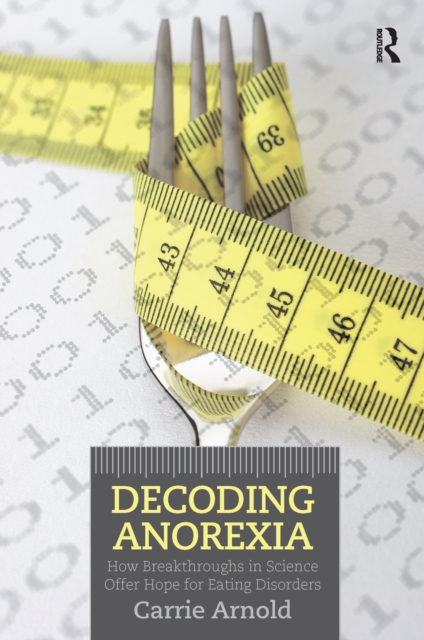
Decoding Anorexia is the first and only book to explain anorexia nervosa from a biological point of view. Its clear, user-friendly descriptions of the genetics and neuroscience behind the disorder is paired with first person descriptions and personal narratives of what biological differences mean to sufferers. Author Carrie Arnold, a trained scientist, science writer, and past sufferer of anorexia, speaks with clinicians, researchers, parents, other family members, and sufferers about the factors that make one vulnerable to anorexia, the neurochemistry behind the call of starvation, and why it's so hard to leave anorexia behind. She also addresses:* How environment is still important and influences behaviors* The characteristics of people at high risk for developing anorexia nervosa* Why anorexics find starvation \"rewarding\"* Why denial is such a salient feature, and how sufferers can overcome itCarrie also includes interviews with key figures in the field who explain their work and how it contributes to our understanding of anorexia. Long thought to be a psychosocial disease of fickle teens, this book alters the way anorexia is understood and treated and gives patients, their doctors, and their family members hope.
eBook

Changepower!
In Changepower! 37 Secrets to Habit Change Success , author Meg Selig guides readers through a step-by-step process that will help them achieve any habit change goal. Whether the reader wants to break a hurtful habit like smoking or overeating, or build a healthy habit like exercising or speaking up, Changepower! provides a springboard for change.
Selig helps habit-changers move beyond willpower and succeed with changepower - the synergy that comes from combining willpower with other resources, useful outside supports, and wise strategies. In Changepower!, she shows habit-changers how to beef up both their willpower and their changepower to achieve habit change success. The key is revving up motivation. Selig reveals the most powerful motivators for change - pain motivators, the Eight Great Motivators, and even not-so-noble motivators.
Research has shown that most changes take place in stages rather than overnight. Selig provides a step-by-step plan for each stage, leaving plenty of room for flexibility depending on each person’s needs. First-person stories, pithy quotes, and how-to exercises provide inspiration, humor, and encouragement as readers embark on their habit change journeys.
Introduction. Part I: Springboard: Change by Choice. Secret 1: Discover Your Place on the Wheel of Change. Secret 2: Try the Quick-change Path. Secret 3: Detect Your Success Pattern. Secret 4: Respect the Power of Habit and Addiction. Secret 5: Know the Key Factor in Habit Change Success. Part II: The Precontemplation Stage: Open the Door. Secret 1: View Your Habit with a Compassionate Eye. Secret 2: Know When True Self-care has Morphed into False Self-care. Secret 3: Reduce Harm. Secret 4: Define Your \"Change Point.\" Secret 5: When Your Habit is Stronger Than You Are, Seek Help. Secret 6: Open the Door. Part III: The Contemplation Stage: Discover Your Motivators. Secret 1: Wake Up from Your Habit Trance. Secret 2: Keep Score. Secret 3: Welcome the Pain. Secret 4: Think Big: Spark Your Change with these Eight Great Motivators. Secret 5: Pump Up Your Motivation. Secret 6: Create an Encouraging Inner Friend. Secret 7: Dare to Decide. Part IV: The Preparation Stage: Use Plan Power. Secret 1: Think Small: Glide into Change with a Gentle Mini-goal. Secret 2: Build Your Plan with These 12 Super-tools of Change. Secret 3: Back Up Wimpy Willpower. Secret 4: Recruit Your Support Team. Secret 5: Vaccinate Yourself Against Lapses and Relapses. Secret 6: Make Your Plan — and Tweak it as You Go. Part V: The Action Stage: Do It! Secret 1: Use the Action Super-tools on Change Day — and Every Day. Secret 2: Ride Out the Cravings with these Proven Techniques. Secret 3: Speak Up. Secret 4: Brace Yourself for the Change-back Squad. Secret 5: Shape Up a Flabby Plan with These Easy Fixes. Part VI: Relapse: Turn Setbacks into Success. Secret 1: Prevent Lapses and Relapses. Secret 2: Deal with the Dreadful \"D Feelings\" of Relapse. Secret 3: Try Again. Part VII: The Maintenance Stage: Keep On Keeping On. Secret 1: Keep On Keeping On with Maintenance Super-tools. Secret 2: Keep Your Life in Balance. Secret 3: Climb a Few Rungs on the Happiness Ladder. Part VIII: The Termination Stage: Move On. Secret 1: Know Your Final Destination. Secret 2: Build a Better Life with Habit Change Skills.
\"This book grabs your attention and doesn’t let go. The secrets revealed in Changepower! will help you change your life, as well as your habit.\" - Bill O’Hanlon, author of Change 101 and Do One Thing Different
\"Given how much I have read and written about change, it is a pleasure to find something so engaging with the potential to enhance my personal changepower!\" - James O. Prochaska, author of Changing for Good
\"Finally, a unique habit change book that will appeal to counselors and students as well as clients. Meg Selig's Changepower! synthesizes the wisdom of the greatest minds in psychology so we can apply their techniques to our daily lives. Read this book. Each chapter is a life-changing experience.\" - Howard Rosenthal, Professor and Coordinator of the Human Services Program at St. Louis Community College at Florissant Valley, USA
eBook