
Catalogue Search | MBRL


Are you sure you want to remove the book from the shelf?

{{itemTitle}}
810
result(s) for
"Self-deception."
Sort by:


Self‐deception: Distorted metacognitive process in ambiguous contexts
As one of the commonly used folk psychological concepts, self‐deception has been intensively discussed yet is short of solid ground from cognitive neuroscience. Self‐deception is a biased cognitive process of information to obtain or maintain a false belief that could be both self‐enhancing or self‐diminishing. Study 1 (N = 152) captured self‐deception by adopting a modified numerical discrimination task that provided cheating opportunities, quantifying errors in predicting future performance (via item‐response theory model), and measuring the belief of how good they are at solving the task (i.e., self‐efficacy belief). By examining whether self‐efficacy belief is based upon actual ability (true belief) or prediction errors (false belief), Study 1 showed that self‐deception occurred in the effortless (easier access to answer cues) rather than effortful (harder access to answer cues) cheating opportunity conditions, suggesting high ambiguity in attributions facilitates self‐deception. Studies 2 and 3 probed the neural source of self‐deception, linking self‐deception with the metacognitive process. Both studies replicated behavioral results from Study 1. Study 2 (ERP study; N = 55) found that the amplitude of frontal slow wave significantly differed between participants with positive/self‐enhancing and negative/self‐diminishing self‐deceiving tendencies in incorrect predictions while remaining similar in correct predictions. Study 3 (functional magnetic resonance imaging study; N = 33) identified self‐deceiving associated activity in the anterior medial prefrontal cortex and showed that effortless cheating context increased cheating behaviors that further facilitated self‐deception. Our findings suggest self‐deception is a false belief associated with a distorted metacognitive mental process that requires ambiguity in attributions of behaviors. Self‐deception occurs in the effortless cheating opportunity context. The amplitude of the frontal slow wave reflects self‐deceiving tendencies. Self‐deception displays alterations in the amPFC activity patterns.
Journal Article
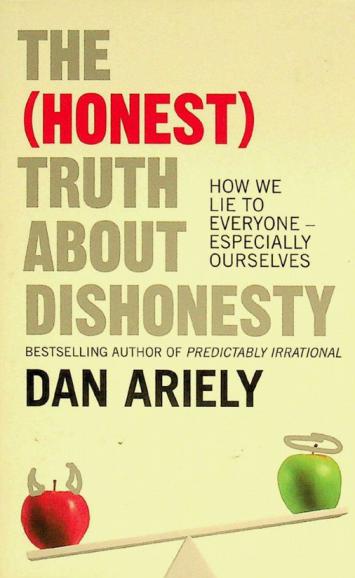
The (honest) truth about dishonesty : how we lie to everyone-especially ourselves
Dan Ariely delves deeper into the dark and murky recesses of contemporary psychology, daring to ask the big questions: What makes us cheat? How and why do we rationalise deception of ourselves and other people, and make ourselves 'wishfully blind' to the blindingly obvious? What affects our infuriatingly intangible willpower and how can we 'catch' the cheating bug from other bad apples? If you've ever wondered how a whole company can turn a blind eye to evident misdemeanours within their ranks, whether people are born dishonest and whether you can really be successful by being totally, brutally honest, then Dan has the answers, and many more.
Book

Mindful Economics: The Production, Consumption, and Value of Beliefs
In this paper, we provide a perspective into the main ideas and findings emerging from the growing literature on motivated beliefs and reasoning. This perspective emphasizes that beliefs often fulfill important psychological and functional needs of the individual. Economically relevant examples include confidence in ones' abilities, moral self-esteem, hope and anxiety reduction, social identity, political ideology, and religious faith. People thus hold certain beliefs in part because they attach value to them, as a result of some (usually implicit) tradeoff between accuracy and desirability. In a sense, we propose to treat beliefs as regular economic goods and assets—which people consume, invest in, reap returns from, and produce, using the informational inputs they receive or have access to. Such beliefs will be resistant to many forms of evidence, with individuals displaying non-Bayesian behaviors such as not wanting to know, wishful thinking, and reality denial.
Journal Article


Our Grandmothers’ Legacy: Challenges Faced by Female Ancestors Leave Traces in Modern Women’s Same-Sex Relationships
Investigations of women’s same-sex relationships present a paradoxical pattern, with women generally disliking competition, yet also exhibiting signs of intrasexual rivalry. The current article leverages the historical challenges faced by female ancestors to understand modern women’s same-sex relationships. Across history, women were largely denied independent access to resources, often depending on male partners’ provisioning to support themselves and their children. Same-sex peers thus became women’s primary romantic rivals in competing to attract and retain relationships with the limited partners able and willing to invest. Modern women show signs of this competition, disliking and aggressing against those who threaten their romantic prospects, targeting especially physically attractive and sexually uninhibited peers. However, women also rely on one another for aid, information, and support. As most social groups were patrilocal across history, upon marriage, women left their families to reside with their husbands. Female ancestors likely used reciprocal altruism or mutualism to facilitate cooperative relationships with nearby unrelated women. To sustain these mutually beneficial cooperative exchange relationships, women may avoid competitive and status-striving peers, instead preferring kind, humble, and loyal allies. Ancestral women who managed to simultaneously compete for romantic partners while forming cooperative female friendships would have been especially successful. Women may therefore have developed strategies to achieve both competitive and cooperative goals, such as guising their intrasexual competition as prosociality or vulnerability. These historical challenges make sense of the seemingly paradoxical pattern of female aversion to competition, relational aggression, and valuation of loyal friends, offering insight into possible opportunities for intervention.
Journal Article
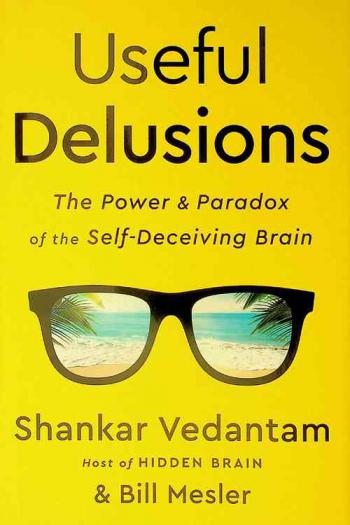
Useful delusions : the power and paradox of the self-deceiving brain
\"From the New York Times-bestselling author and host of NPR's Hidden Brain comes a thought-provoking exploration of deception's role in human success. Everyone agrees that lies and self-deception can do terrible harm to our lives, to our communities, and to the planet. But in Useful Delusions, host of NPR's Hidden Brain Shankar Vedantam argues that, paradoxically, deceiving ourselves and others can also play a vital role in human success and well-being. The lies we tell each other and the lies that we tell ourselves sustain our daily interactions with friends, lovers, and coworkers. They explain why some people live longer than others, why some couples remain in love and others don't, why some nations and tribes hold together while others splinter. Filled with powerful personal stories and drawing on new insights in psychology, neuroscience, and philosophy, Useful Delusions offers a fascinating tour of an upside-down world\"-- Provided by publisher.

The evolution and psychology of self-deception
In this article we argue that self-deception evolved to facilitate interpersonal deception by allowing people to avoid the cues to conscious deception that might reveal deceptive intent. Self-deception has two additional advantages: It eliminates the costly cognitive load that is typically associated with deceiving, and it can minimize retribution if the deception is discovered. Beyond its role in specific acts of deception, self-deceptive self-enhancement also allows people to display more confidence than is warranted, which has a host of social advantages. The question then arises of how the self can be both deceiver and deceived. We propose that this is achieved through dissociations of mental processes, including conscious versus unconscious memories, conscious versus unconscious attitudes, and automatic versus controlled processes. Given the variety of methods for deceiving others, it should come as no surprise that self-deception manifests itself in a number of different psychological processes, and we discuss various types of self-deception. We then discuss the interpersonal versus intrapersonal nature of self-deception before considering the levels of consciousness at which the self can be deceived. Finally, we contrast our evolutionary approach to self-deception with current theories and debates in psychology and consider some of the costs associated with self-deception.
Journal Article

Reply all : stories
\"Reply All, the third collection of award-winning and widely anthologized short stories by Robin Hemley, takes a humorous, edgy, and frank look at the human art of deception and self-deception. A father accepts, without question, the many duplicate saint relics that appear in front of his cave everyday; a translator tricks Magellan by falsely translating a local chief's words of welcome; an apple salesman a long way from home thinks he's fallen in love; a search committee believes in its own nobility by hiring a minority writer; a cheating couple broadcast their affair to an entire listserv; a talk show host interviews the dead and hopes to learn their secrets. The ways in which humans fool themselves are infinite, and while these stories illustrate this sad fact in sometimes excruciating detail, the aim is not to skewer the misdirected, but to commiserate with them and blush in recognition.\"--P. [4] of cover.
Book

Conveniently Upset: Avoiding Altruism by Distorting Beliefs about Others' Altruism
We present results from a \"corruption game\" (a dictator game modified so that recipients can take a side payment in exchange for accepting a reduction in the overall size of the pie). Dictators (silently) treated to be able to take more of the recipient's tokens, took more of them. They were also more likely to believe that recipients had accepted side payments, even if there was a prize for accuracy. The results favor the hypothesis that people avoid altruistic actions by distorting beliefs about others' altruism.
Journal Article