
Catalogue Search | MBRL


Are you sure you want to remove the book from the shelf?

{{itemTitle}}
2,155
result(s) for
"Self-portraits."
Sort by:

The self-portrait : a cultural history
In this broad cultural survey, art historian and critic James Hall brilliantly maps the history of self-portraiture, from the earliest myths of Narcissus to the prolific self-image-making of contemporary artists. His intelligent and vivid account shows how artists' depictions of themselves have been part of a continuing tradition that reaches back for centuries. Along the way he reveals the importance of the medieval 'mirror craze'; the explosion of the genre during the Renaissance; the confessional self-portraits of Titian and Michelangelo; the role of biography for serial self-portraitists such as Courbet and van Gogh; themes of sex and genius in works by Munch, Bonnard and Modersohn-Becker; and the latest developments of the genre in the era of globalization. The full range of self-portraits is covered here, from comic and caricature self-portraits to 'invented' or imaginary ones, as well as key collections of self-portraiture such as that of the Medici in Florence. Throughout, Hall asks why - and when - artists have chosen to make self-portraits, and looks deeply into the worlds and mindsets of the artists who have created them. Comprehensive and beautifully illustrated, the book features the work of a wide range of artists including Alberti, Caravaggio, Courbet, Dèurer, Emin, Gauguin, Giotto, Goya, Kahlo, Koons, Magritte, Mantegna, Picasso, Raphael, Rembrandt and Warhol. Offering a rich and lively history, The Self-Portrait is an essential read for all those interested in this most enduringly popular and humane of art forms.--Publisher.
Book
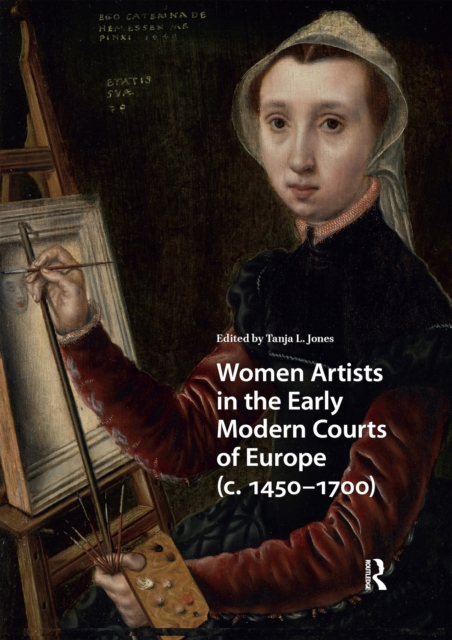
Women Artists in the Early Modern Courts of Europe
Women Artists in the Early Modern Courts of Europe, c. 1450.1700 presents the first collection of essays dedicated to women as producers of visual and material culture in the Early Modern European courts, offering fresh insights into the careers of, among others, Caterina van Hemessen, Sofonisba Anguissola, Luisa Roldán, and Diana Mantuana. Also considered are groups of female makers, such as ladies-in-waiting at the seventeenth-century Medici court. Chapters address works by women who occupied a range of social and economic positions within and around the courts and across media, including paintings, sculpture, prints, and textiles. Both individually and collectively, the texts deepen understanding of the individual artists and courts highlighted and, more broadly, consider the variety of experiences of female makers across traditional geographic and chronological distinctions. The book is also accompanied by the Global Makers: Women Artists in the Early Modern Courts digital humanities project (www.globalmakers.ua.edu), extending and expanding the work begun here.
eBook

In the picture : self-portraits, 1958-2011
Lee Friedlander (b. 1934) has been tackling the challenge of self-portraiture throughout his prolific career. What began as an unorthodox investigation of the genre has become a masterful engagement spanning five decades. In this compilation, which includes hundreds of previously unpublished pictures, we follow the famous photographer through the years as his personal and creative lives unfold and intertwine -- Source other Library of Congress.
BOOK


Using selfies to challenge public stereotypes of scientists
In an online Qualtrics panel survey experiment (N = 1620), we found that scientists posting self-portraits (\"selfies\") to Instagram from the science lab/field were perceived as significantly warmer and more trustworthy, and no less competent, than scientists posting photos of only their work. Participants who viewed scientist selfies, especially posts containing the face of a female scientist, perceived scientists as significantly warmer than did participants who saw science-only images or control images. Participants who viewed selfies also perceived less symbolic threat from scientists. Most encouragingly, participants viewing selfies, either of male or female scientists, did not perceive scientists as any less competent than did participants viewing science-only or control images. Subjects who viewed female scientist selfies also perceived science as less exclusively male. Our findings suggest that self-portraiture by STEM professionals on social media can mitigate negative attitudes toward scientists.
Journal Article

Seeing ourselves : women's self-portraits
This richly diverse exploration of female artists and self-portraits is a brilliant and poignant demonstration of originality in works of haunting variety. The two earliest self-portraits come from 12th-century illuminated manuscripts in which nuns gaze at us across eight centuries. In 16th-century Italy, Sofonisba Anguissola paints one of the longest series of self-portraits, spanning adolescence to old age. In 17th-century Holland, Judith Leyster shows herself at the easel as a relaxed, self-assured professional. In the 18th century, artists from Elisabeth Vigee-Lebrun to Angelica Kauffman express both passion for their craft and the idea of femininity; and in the 19th the salons and art schools at last open their doors to a host of talented women artists, including Berthe Morisot, ushering in a new and resonant self-confidence. The modern period demolishes taboos: Alice Neel painting herself nude at eighty, Frida Kahlo rendering physical pain, Cindy Sherman exploring identity, Marlene Dumas dispensing with all boundaries. The full verve of Frances Borzello's enthralling text, and the hypnotic intensity of the accompanying self-portraits, is revealed to the full in a completely revised edition of this inspiring book.
Book

Women Artists in the Early Modern Courts of Europe
Women Artists in the Early Modern Courts of Europe, c. 1450-1700 presents the first collection of essays dedicated to women as producers of visual and material culture in the Early Modern European courts, offering fresh insights into the careers of, among others, Caterina van Hemessen, Sofonisba Anguissola, Luisa Roldán, and Diana Mantuana. Also considered are groups of female makers, such as ladies-in-waiting at the seventeenth-century Medici court. Chapters address works by women who occupied a range of social and economic positions within and around the courts and across media, including paintings, sculpture, prints, and textiles. Both individually and collectively, the texts deepen understanding of the individual artists and courts highlighted and, more broadly, consider the variety of experiences of female makers across traditional geographic and chronological distinctions. The book is also accompanied by the Global Makers: Women Artists in the Early Modern Courts digital humanities project (www.globalmakers.ua.edu), extending and expanding the work begun here.
eBook


Adolescents’ selfie-taking and selfie-editing: A revision of the photo manipulation scale and a moderated mediation model
‘Selfie practices’ (e.g., editing, filtering, sharing) have become adolescents’ daily behaviors. The increasing centrality of online visual self-presentation might increase adolescents’ appearance-related concerns, problematic monitoring, and photo manipulation (PM). However, few studies focused on body image control in photos (BICP) and PM, and no studies evaluated the influence of selfie-expectancies on photo-taking and photo-editing. Consequently, two studies were conducted. Study1 psychometrically evaluated the PM scale (
N
= 1353). Study2 evaluated the mediating role of BICP and the moderating role of gender in the relationship between selfie-expectancies and PM (
N
= 453). The revised PM scale showed good psychometric properties. BICP mediated the relationship between selfie-expectancies and PM and being male significantly affected the relationship between the variables. Implications for adolescents’ appearance-related issues are discussed.
Journal Article