
Catalogue Search | MBRL


Are you sure you want to remove the book from the shelf?

{{itemTitle}}
9
result(s) for
"Self-presentation -- Israel"
Sort by:

Israeli and Palestinian postcards : presentations of national self
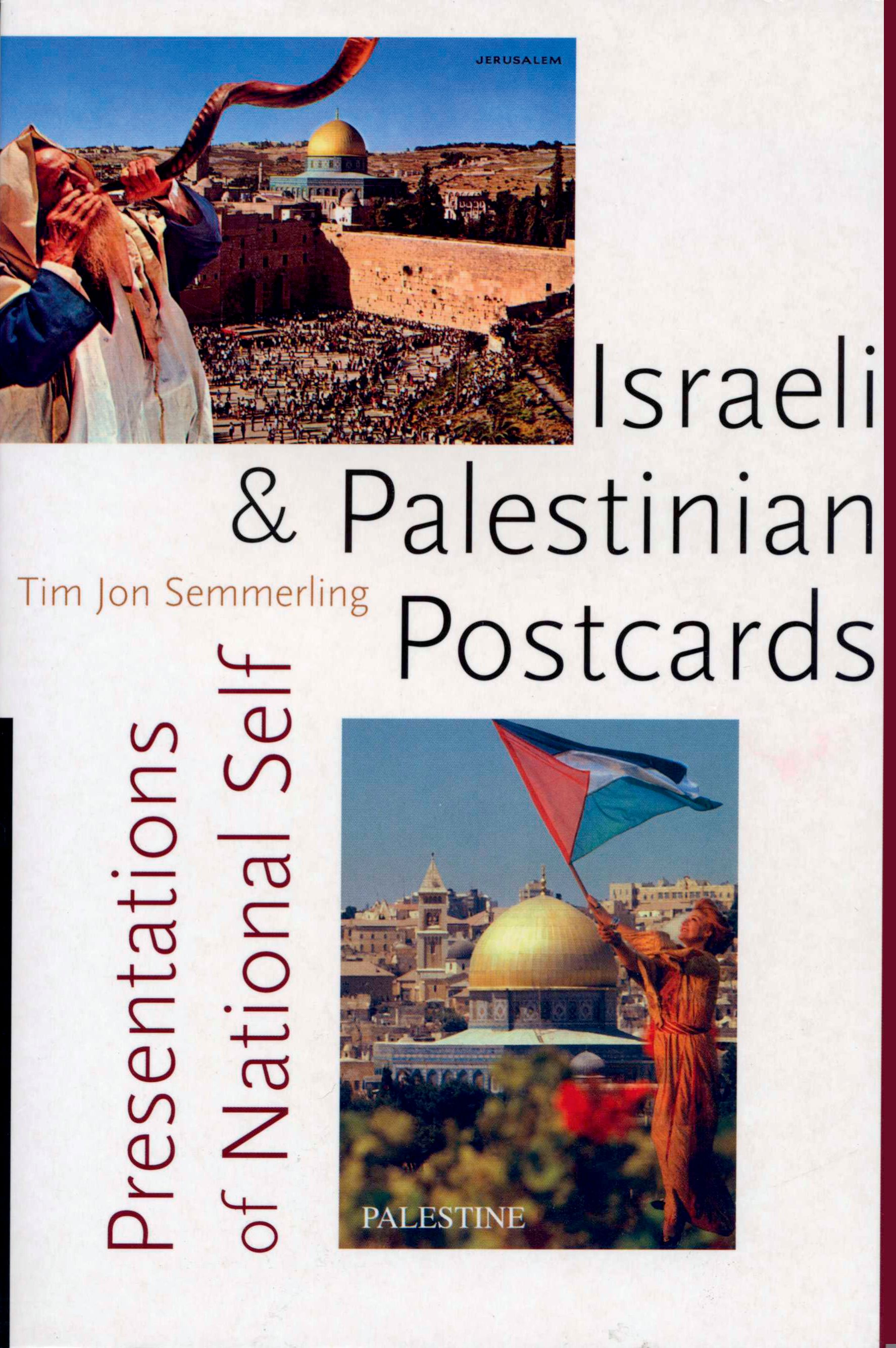
Searing images of suicide bombings and retaliatory strikes now define the Israeli-Palestinian conflict for many Westerners, but television and print media are not the only visual realms in which the conflict is playing out. Even tourist postcards and greeting cards have been pressed into service as vehicles through which Israelis and Palestinians present competing visions of national selfhood and conflicting claims to their common homeland. In this book, Tim Jon Semmerling explores how Israelis and Palestinians have recently used postcards and greeting cards to present images of the national self, to build national awareness and reinforce nationalist ideologies, and to gain international acceptance. He discusses and displays the works of numerous postcard/greeting card manufacturers, artists, and photographers and identifies the symbolic choices in their postcards, how the choices are arranged into messages, what the messages convey and to whom, and who benefits and loses in these presentations of national self. Semmerling convincingly demonstrates that, far from being ephemeral, Israeli and Palestinian postcards constitute an important arena of struggle over visual signs and the power to produce reality.
eBook
Israeli and Palestinian Postcards
Searing images of suicide bombings and retaliatory strikes now define the Israeli-Palestinian conflict for many Westerners, but television and print media are not the only visual realms in which the conflict is playing out. Even tourist postcards and greeting cards have been pressed into service as vehicles through which Israelis and Palestinians present competing visions of national selfhood and conflicting claims to their common homeland. In this book, Tim Jon Semmerling explores how Israelis and Palestinians have recently used postcards and greeting cards to present images of the national self, to build national awareness and reinforce nationalist ideologies, and to gain international acceptance. He discusses and displays the works of numerous postcard/greeting card manufacturers, artists, and photographers and identifies the symbolic choices in their postcards, how the choices are arranged into messages, what the messages convey and to whom, and who benefits and loses in these presentations of national self. Semmerling convincingly demonstrates that, far from being ephemeral, Israeli and Palestinian postcards constitute an important arena of struggle over visual signs and the power to produce reality.
eBook

Israeli and Palestinian Postcards
Searing images of suicide bombings and retaliatory strikes now define the Israeli-Palestinian conflict for many Westerners, but television and print media are not the only visual realms in which the conflict is playing out. Even tourist postcards and greeting cards have been pressed into service as vehicles through which Israelis and Palestinians present competing visions of national selfhood and conflicting claims to their common homeland.
In this book, Tim Jon Semmerling explores how Israelis and Palestinians have recently used postcards and greeting cards to present images of the national self, to build national awareness and reinforce nationalist ideologies, and to gain international acceptance. He discusses and displays the works of numerous postcard/greeting card manufacturers, artists, and photographers and identifies the symbolic choices in their postcards, how the choices are arranged into messages, what the messages convey and to whom, and who benefits and loses in these presentations of national self. Semmerling convincingly demonstrates that, far from being ephemeral, Israeli and Palestinian postcards constitute an important arena of struggle over visual signs and the power to produce reality.
eBook

Tradition and the Formation of the Talmud
Tradition and the Formation of the Talmudoffers a new perspective on perhaps the most important religious text of the Jewish tradition. It is widely recognized that the creators of the Talmud innovatively interpreted and changed the older traditions on which they drew. Nevertheless, it has been assumed that the ancient rabbis were committed to maintaining continuity with the past. Moulie Vidas argues on the contrary that structural features of the Talmud were designed to produce a discontinuity with tradition, and that this discontinuity was part and parcel of the rabbis' self-conception. Both this self-conception and these structural features were part of a debate within and beyond the Jewish community about the transmission of tradition.
Focusing on the Babylonian Talmud, produced in the rabbinic academies of late ancient Mesopotamia, Vidas analyzes key passages to show how the Talmud's creators contrasted their own voice with that of their predecessors. He also examines Zoroastrian, Christian, and mystical Jewish sources to reconstruct the debates and wide-ranging conversations that shaped the Talmud's literary and intellectual character.
eBook

\You Look, Thank God, Quite Good on the Outside\: Imitating the Ideal Self in a Jewish Ultra-Orthodox Rehabilitation Site
Rather than viewing therapeutic interventions as either compliance or resistance to the social order, I analyze them as mimesis of cultural ideal selves. In particular, I examine the new mediations of the social order constituted in mimetic therapeutic practices and their entailed creativity and ambivalence. Drawing on participant observation in a Jewish ultra-Orthodox (Haredi) rehabilitation site I explore how, given the ruptures brought about in mental disorders, caretakers offer their clients new ways to inhabit the normal self through its imitation. Specifically, caregivers construct replications of dominant selves by selectively deploying modern and neotraditional discourses of the self in diverse social contexts and in multiple registries like body, emotions, social relations, and ways of belonging to the community. I suggest that mimetic therapeutic work is carried out along emerging social distinctions that are associated with Haredim's complex relations with the secular society, and with cultural contestations within the community itself.
Journal Article

Defending the American Dream: Coverage of the Jonathan Pollard Spy Case
This article contemplates the journalistic coverage of American espionage as an attempt to maintain consonance with broader cultural discourses about what it means to be an American. Tracking the American press coverage of the Jonathan Pollard spy case, the article demonstrates that the press turns espionage into a phenomenon upholding fundamental American beliefs in openness, sincerity, and straightforwardness. It shows that, rather than represent espionage as a phenomenon embodying deceit, secrecy, and immoral action, the press turns espionage into a phenomenon that communicates that one is what one says one is and that one's self presentation reflects one's insides. Ultimately, however, this representation of espionage undermines a full understanding of how--and why--spying works in culture.[PUBLICATION ABSTRACT]
Journal Article

An Analysis of the Self of the Western Physician: A Study on the Evolution of Homo Hippocratus
This paper is about western physicians in general, and the Israeli variant in particular. The theoretical focus will be on the nature and dynamics of the medical professional self within this interplay between the cultural concepts of universality and difference. The discussion will address the genesis of this professional self and the implications of its extraordinary strength and tenacity, which has endured for centuries in different local contexts wherever western medicine has existed. The impetus for this study is the subdued rumbling which is echoing throughout the profession suggesting that this self is no longer the \"Rock of Gibraltar\" that it seemed in the past.
Journal Article

The Persecution of Self of Young Israeli Lesbians: A Discourse on Split Identity
Data collected via participant observation in the course of face-to-face encounters at various sites in central Israel, 1996-2002, are drawn on to examine the discourse used by young lesbians (ages 20-30) to define & present themselves in interactions with heterosexual women. Following a brief theoretical background that emphasizes the ever-evolving construction of identity & how this is accomplished & strengthened through dialogue, four main identity components -- the feminine, the lesbian, the individual, & the Israeli -- defined by these lesbian respondents are explored. Discursive strategies that these women use to either avoid revealing or subtly or overtly disclose their sexual identity are identified. Lesbians' use of heterosexual women as \"alternative significant others\" to whom they can display alternating aspects of their identity is described. References. K. Hyatt Stewart
Book Chapter
