
Catalogue Search | MBRL


Are you sure you want to remove the book from the shelf?

{{itemTitle}}
35
result(s) for
"Semitic languages, Northwest -- Grammar"
Sort by:

A Grammar of the Christian Neo-Aramaic Dialect of Diyana-Zariwaw
A study of a Neo-Aramaic variety by Lidia Napiorkowska in this volume is a contribution to the documentation of spoken Aramaic, covering the phonological, morphological and syntactic notions of the dialect.
eBook

Becoming Frum
When non-Orthodox Jews becomefrum(religious), they encounter much more than dietary laws and Sabbath prohibitions. They find themselves in the midst of a whole new culture, involving matchmakers, homemade gefilte fish, and Yiddish-influenced grammar.Becoming Frumexplains how these newcomers learn Orthodox language and culture through their interactions with community veterans and other newcomers. Some take on as much as they can as quickly as they can, going beyond the norms of those raised in the community. Others maintain aspects of their pre-Orthodox selves, yielding unique combinations, like Matisyahu's reggae music or Hebrew words and sing-song intonation used with American slang, as in \"mamish(really) keepin' it real.\"Sarah Bunin Benor brings insight into the phenomenon of adopting a new identity based on ethnographic and sociolinguistic research among men and women in an American Orthodox community. Her analysis is applicable to other situations of adult language socialization, such as students learning medical jargon or Canadians moving to Australia.Becoming Frumoffers a scholarly and accessible look at the linguistic and cultural process of \"becoming.\"
eBook

Scribal Memory and Word Selection
What were ancient scribes doing when they copied a manuscript of
a literary work? This question is especially problematic when we
realize that ancient scribes preserved different versions of the
same literary texts. In Scribal Memory and Word Selection: Text
Criticism of the Hebrew Bible , Raymond F. Person Jr. draws
from studies of how words are selected in everyday conversation to
illustrate that the same word-selection mechanisms were at work in
scribal memory. Using examples from manuscripts of the Hebrew
Bible, Person provides new ways of understanding the
cognitive-linguistic mechanisms at work during the
composition/transmission of texts. Person reveals that, while our
modern perspective may consider textual variants to be different
literary texts, from the perspective of the ancient scribes and
their audiences, these variants could still be understood as the
same literary text.
eBook

Syntactic and semantic variation in copular sentences : insights from classical Hebrew
This book presents a novel account of syntactic and semantic variation in copular and existential sentences in Classical Hebrew. Like many languages, the system of Classical Hebrew copular sentences is quite complex, containing zero, pronominal, and verbal forms as well as eventive and inchoative semantics. Approaching this subject from the framework of Distributed Morphology provides an elegant and comprehensive explanation for both the syntactic and semantic variation in these sentences. This book also presents a theoretical model for analyzing copular sentences in other languages included related phenomena- such as pseudo-copulas. It is also a demonstration of what can be gained by applying modern linguistic analyses to dead languages. Citing and building off previous studies on this topic, this book will be of interest to those interested in the theoretical examination of copular and existential sentences and to those interested in Classical Hebrew more specifically.
eBook
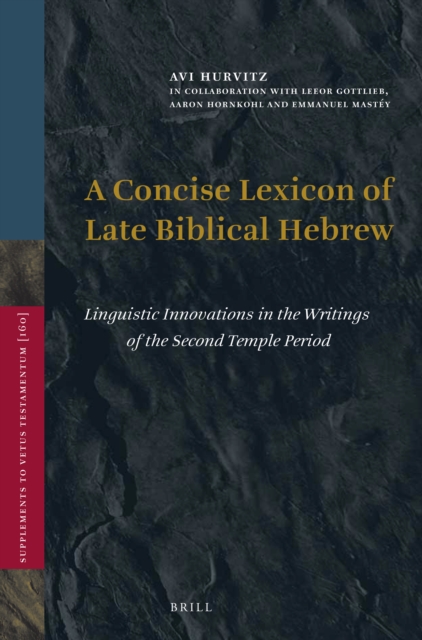
A concise lexicon of late biblical Hebrew : linguistic innovations in the writings of the Second Temple period
The eighty lexical entries exemplify a diachronic investigation of Late Biblical Hebrew, which reflects the transition period from the Hebrew Bible to Talmudic literature. Together with relevant bibliography for each entry, the Lexicon serves as an indispensable tool for understanding the emergence and development of Late Biblical Hebrew neologisms.
eBook

Historical Linguistics and Biblical Hebrew
A philologically robust approach to the history of ancient Hebrew
In this book the authors work toward constructing an approach to the history of ancient Hebrew that overcomes the chasm of academic specialization. The authors illustrate how cross-textual variable analysis and variation analysis advance research on Biblical Hebrew and correct theories based on extra-linguistic assumptions, intuitions, and ideologies by focusing on variation of forms/uses in the Masoretic text and variation between the Masoretic text and other textual traditions.
Features:
A unique approach that examines the nature of the sources and the description of their language togetherExtensive bibliography for further researchTables of linguistic variables and parallels
eBook

The syntax of volitives in biblical Hebrew and Amarna Canaanite prose
No detailed description available for \"The Syntax of Volitives in Biblical Hebrew and Amarna Canaanite Prose\".
eBook
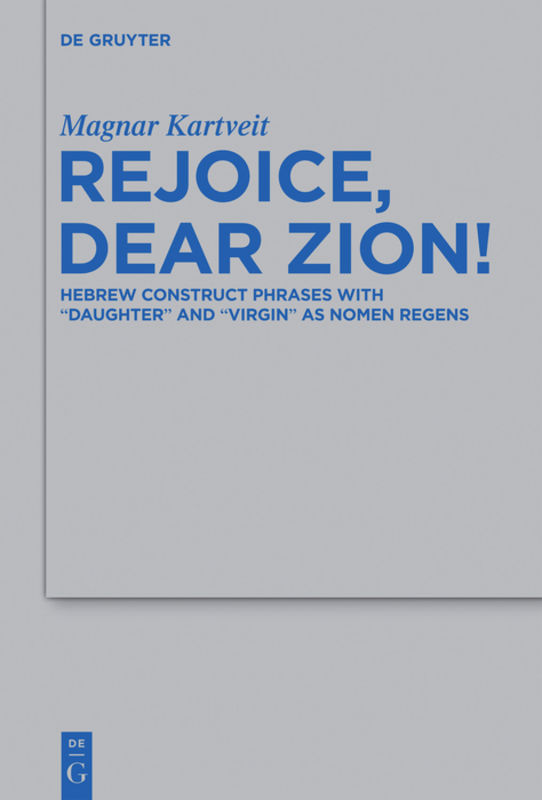
Rejoice, Dear Zion!
The series Beihefte zur Zeitschrift für die alttestamentliche Wissenschaft (BZAW) covers all areas of research into the Old Testament, focusing on the Hebrew Bible, its early and later forms in Ancient Judaism, as well as its branching into many neighboring cultures of the Ancient Near East and the Greco-Roman world. _x000D_.
eBook

The Verb and the Paragraph in Biblical Hebrew
In this book, Elizabeth Robar demonstrates how biblical Hebrew verbal patterns can reveal paragraph structure and themes.
eBook

A Grammar of the Eastern European Hasidic Hebrew Tale
This volume constitutes the first reference grammar of the Hasidic Hebrew hagiographic tales composed in late nineteenth- and early twentieth-century Eastern Europe. It presents a thorough survey of Hasidic Hebrew orthography, morphology, syntax, and lexis illustrated with extensive examples.
eBook