
Catalogue Search | MBRL


Are you sure you want to remove the book from the shelf?

{{itemTitle}}
12,276
result(s) for
"Separation of powers"
Sort by:


New Dynamics of the “Post-COVID-19 Era”: A Legal Conundrum
In this Article we analyze whether and how the legal reactions to COVID-19 brought permanent changes to three main areas that are at the very basis of the study of comparative constitutional law: the horizontal separation of powers in different forms of government; the vertical separation of powers and its effects on forms of state; and the reviewability of limitations to human rights and personal freedoms by bodies exercising constitutional review. Rather than just examining and categorizing the reactions, we search for the political, institutional, factual, and sometimes even cultural rationales at the basis of each trend. Our claim is that COVID-19 was a driving force for relevant changes in the three analyzed areas, but we also recognize that these changes did not come “out of the blue,” as they were already “latent” in considered legal systems. The analysis demonstrates that the traditional categories we use to classify the forms of government, forms of state, and the mechanisms of constitutional review, although being useful paradigms to study these topics, have in themselves the potential to be “stretched,” and even unhinged, when global and long-lasting emergencies, as COVID-19, are in place.
Journal Article

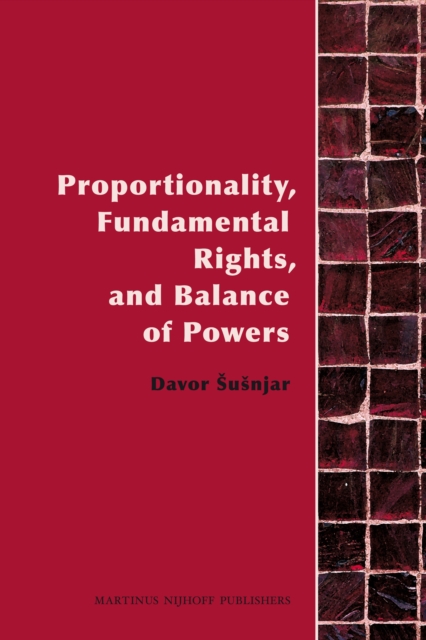
Proportionality, Fundamental Rights and Balance of Powers
This book offers a comprehensive account of the case law of the ECJ, the European Court of Human Rights, and the German Federal Constitutional Court regarding the application of fundamental rights and the application of the proportionality principle.
eBook


The Rise of the Unelected
Unelected bodies, such as independent central banks, economic regulators, risk managers and auditors have become a worldwide phenomenon. Democracies are increasingly turning to them to demarcate boundaries between the market and the state, to resolve conflicts of interest and to allocate resources, even in sensitive ethical areas such as those involving privacy or biotechnology. This 2007 book examines the challenge that unelected bodies present to democracy and argues that, taken together, such bodies should be viewed as a new branch of government with their own sources of legitimacy and held to account through a new separation of powers. Vibert suggests that such bodies help promote a more informed citizenry because they provide a more trustworthy and reliable source of information for decisions. This book will be of interest to specialists and general readers with an interest in modern democracy as well as policy makers, think tanks and journalists.
eBook

Courts, politics and constitutional law : judicialization of politics and politicization of the judiciary
\"This book examines how the judicialization of politics, and the politicization of courts, affect representative democracy, rule of law and separation of powers. This volume critically assesses the phenomena of judicialization of politics and politicization of the judiciary. It explores the rising impact of courts on key constitutional principles, such as democracy and separation of powers, which is paralleled by increasing criticism of this influence from both liberal and illiberal perspectives. The book also addresses the challenges to rule of law as a principle, preconditioned on independent and powerful courts, which are triggered by both democratic backsliding and the mushrooming of populist constitutionalism and illiberal constitutional regimes\"-- Provided by publisher.
Book

An Overview of Israel's ‘Judicial Overhaul’: Small Parts of a Big Populist Picture
In the comparative constitutional field relating to backsliding democracies, it is difficult to find an example of a single constitutional event that undermines the basic principles of democracy. Democracies die in a slow and gradual process. Each of the laws passed is not in itself fatal for democracy but when the measures are examined together, cumulatively, the whole is greater than the sum of its parts. It is the big picture, the whole series of legal moves, that brings about a fundamental change in the state's regime until it is no longer a liberal democracy. In these situations of gradual erosion there is no single law that can reveal the magnitude of the change inherent in it. To understand the risk, it is therefore necessary to refer to its overall institutional context. The proposed reform in Israel may result in serious harm to the principle of separation of powers. Moreover, given the importance of imposing limits on governmental power as a tool for protecting human rights and the ‘rules of the game’ in democratic regimes, the reform would seriously harm the protection afforded to these rights and principles, and constitute a clear and present danger to Israel's liberal democracy.
Journal Article

Ministers of Justice in Comparative Perspective
This book analyses the institution of Minister of Justice in the constitutional systems of several European countries: the United Kingdom, Ireland, Germany, Austria, France, Italy, and Poland. The research was based on the hypothesis that the Minister of Justice is, in fact, inessential, because the institution is to a large extent incompatible with the principles of the separation of powers and the independence of the judiciary. Certain competences currently assigned to this institution might be allocated to other bodies and departments, including those that function as part of the government (the Cabinet), without any prejudicial effect on the functioning of the state.
eBook