
Catalogue Search | MBRL


Are you sure you want to remove the book from the shelf?

{{itemTitle}}
1,867
result(s) for
"Serfdom"
Sort by:

The institutional framework of Russian serfdom
\"Russian rural history has long been based on a \"peasant myth\" which originated with nineteenth-century Romantics and is still accepted by many historians today. In this book, Tracy Dennison shows how Russian society looked from below, and finds nothing like the collective, redistributive, and market-averse behaviour often attributed to Russian peasants. On the contrary, the Russian rural population was as integrated into regional and even national markets as many of its west European counterparts. Serfdom was a loose garment that enabled different landlords to shape economic institutions, especially property rights, in widely diverse ways. Highly coercive and backward regimes on some landlords' estates existed side-by-side with surprisingly liberal approximations to a rule of law. This book paints a vivid and colourful picture of the everyday reality of rural Russia before the 1861 abolition of serfdom\"--Provided by publisher.
Book

The Institutional Framework of Russian Serfdom
Russian rural history has long been based on a 'Peasant Myth', originating with nineteenth-century Romantics and still accepted by many historians today. In this book, Tracy Dennison shows how Russian society looked from below, and finds nothing like the collective, redistributive and market-averse behaviour often attributed to Russian peasants. On the contrary, the Russian rural population was as integrated into regional and even national markets as many of its west European counterparts. Serfdom was a loose garment that enabled different landlords to shape economic institutions, especially property rights, in widely diverse ways. Highly coercive and backward regimes on some landlords' estates existed side-by-side with surprisingly liberal approximations to a rule of law. This book paints a vivid and colourful picture of the everyday reality of rural Russia before the 1861 abolition of serfdom.
eBook
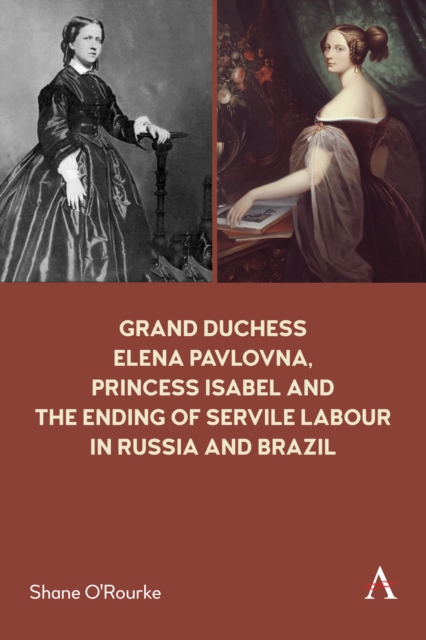
Grand Duchess Elena Pavlovna, Princess Isabel and the Ending of Servile Labour in Russia and Brazil
Grand Duchess Elena Pavlovna and Princess Isabel were key players in the political struggle ending servile labor in the empires of Russia and Brazil. This book chronicles the political activity of the two royal women to end servile labor in their respective countries.
eBook

Paying the Price of Freedom
Christine Hünefeldt documents in impressive, moving detail the striving and ingenuity, the hard-won triumphs and bitter defeats of slaves who sought liberation in nineteenth-century urban Peru. Drawing on judicial, ecclesiastical, and notarial records--including the testimony of the slaves themselves--she uncovers the various strategies slaves invented to gain their freedom. Hünefeldt pays particular attention to marriage relations and family life. Slaves used their family solidarity as a strategy, while slaveowners used the conflicts within families to prevent manumission. The author's focus on gender relations between slaveowners and slaves, as well as between slaves, is particularly original. Her eye for ethnographic detail and her perceptive reading of the documentary evidence make this book a rich and important contribution to the study of slavery in Latin America. This title is part of UC Press's Voices Revived program, which commemorates University of California Press's mission to seek out and cultivate the brightest minds and give them voice, reach, and impact. Drawing on a backlist dating to 1893, Voices Revived makes high-quality, peer-reviewed scholarship accessible once again using print-on-demand technology. This title was originally published in 1994. Many titles in the Voices Revived program are also newly available as ebooks, offered at a discounted price to support wider access to scholarly work.
eBook

Beyond Slavery and Freedom in Ancient Mesopotamia
This special issue aims to move beyond the traditional binary of slavery and freedom in the study of ancient Mesopotamian societies. Legal texts have long shaped our understanding of social status in this region, but a broader approach incorporating diverse textual genres and diachronic comparison reveals a far more nuanced social landscape. The articles collected here argue that ethnic, legal, political, religious, and socioeconomic factors continually shaped groups with ambiguous statuses who were neither clearly citizens nor enslaved individuals. Rather than locating a fixed “third” legal category of “serfs,” the contributors emphasize distinctions such as citizens versus noncitizens or emancipated versus dependent household members – both free and enslaved. The volume refines the binary legal model, reaffirming that ancient Mesopotamia recognized only two legal statuses – free and unfree – but complicates how these were lived and perceived. Six key insights emerge, including the legal and social diversity within both categories, the importance of household structures, and the precarious positions of groups like
(“those who prostrate themselves”),
(“menials”), temple dependents, war captives, freed slaves, and detained persons. Collectively, these studies challenge static interpretations and reveal the dynamic and context-dependent nature of social identity in ancient Mesopotamia.
Journal Article
An Uncomfortable Paradise
Simon's Town, the port city situated along the False Bay Coast of Cape Town, South Africa, is a popular tourist destination with a quintessentially British feel because of its historical links to the British Royal Navy.
eBook
Engendering Blackness
In this incisive new book, Patrice D. Douglass interrogates the relationship between sexual violence and modern racial slavery and finds it not only inseverable but also fundamental to the structural predicaments facing Blackness in the present. Douglass contends that the sexual violability of slaves is often misappropriated by frameworks on sexual violence that privilege its occurrences as a question of ethics, sexual agency, and feminine orders of gendering. Rather, this book foregrounds Blackness as engendered by sexual violence, which forcefully (re)produces Blackness, corporeally and conceptually, as a condition that lacks the capacity to ontologically distinguish its suffering from what it means to be human. By employing and critically revising Black feminist theory and Afro-pessimism, Douglass reveals that engaging primarily with the sexualization of the slave forces theories of sexual violence to interrogate why this violence-one of the most prevalent under slavery-continues to lack a grammar of fundamental redress. There are no reparations struggles for the generational transfer of sexual violation and the inability of present frameworks to rectify the sexual stains of slavery lies precisely in the fact that what made this history possible continues to haunt arrangements of life today. Engendering Blackness urgently articulates the way our present understandings of Blackness and humanness are bound by this vexed sexual history.
eBook

Troubled Feast, Contested Fast
This article reassesses the difficulties experienced in the Polish-Lithuanian Commonwealth by what was known as the Uniate Church, a Catholic Church of the Byzantine-Slavic rite that had been created through a union with the papacy in 1595/6. Analyzing the twin issues of holiday and fasting reform, the article reveals the extent to which economic concerns of the Enlightenment exacerbated the eighteenth-century crisis of the Union. How many holidays should peasants celebrate? How strictly should they be expected or allowed to fast? Such questions became crucial issues placing pressure on the Uniate Church, particularly in the 1780s. Faced with this pressure, the Church hierarchy was alarmed but rather powerless, caught in what this article conceptualizes as the Uniate dilemma. On the one hand, rivalry with the Orthodox Church meant that Uniate bishops could not really reform holidays and fasting without giving the impression that they cared less about the “purity” of the Eastern rite than their Orthodox counterparts did. On the other hand, leaving the Uniate holiday and fasting calendar unreformed made the Union more vulnerable to Roman Catholic competition, for economic as well as religious reasons. Specifically, more and more noble lords wanted to restructure their estates in line with the agrarian ideals of the Enlightenment, and to produce a healthier, more numerous, more hard-working peasantry in the process. In the Ruthenian parts of the Commonwealth, however, ostensible excesses of Uniate feasting and fasting stood in the way of these goals. Roman Catholic nobles therefore increasingly resorted to denigrating Uniate ritual precepts and to pushing enserfed village populations to observe the Latin rite, which prescribed fewer holidays and fasts. These developments put the Union very clearly on the defensive even before the final partitions of Poland-Lithuania.
Journal Article

Black Freedom and Education in Nineteenth-Century Cuba
Examining the educational legacy of Afro-Cuban teachers
and activists
In this book, Raquel Otheguy argues that Afro-descended teachers
and activists were central to the development of a national
education system in Cuba. Tracing the emergence of a Black Cuban
educational tradition whose hallmarks were at the forefront of
transatlantic educational currents, Otheguy examines how this
movement pushed the island's public school system to be more
accessible to children and adults of all races, genders, and
classes.
Otheguy describes Afro-Cuban education before public schools
were officially desegregated in 1894, from the maestras
amigas -Black and mulata women who taught in their homes-to
teachers in the schools of mutual-aid societies for people of
color. In the ways that Afro-descendants interacted with the
Spanish colonial school system and its authorities, and in the
separate schools they created, they were resisting the hardening
racial boundaries that characterized Cuban life and developing
alternative visions of possible societies, nations, and futures.
Otheguy demonstrates that Black Cubans pioneered the region's most
progressive innovations in education and influenced the trajectory
of public school systems in their nation and the broader
Americas.
A volume in the series Caribbean Crossroads: Race, Identity, and
Freedom Struggles, edited by Lillian Guerra, Devyn Spence Benson,
April Mayes, and Solsiree del Moral
Publication of this work made possible by a Sustaining the
Humanities through the American Rescue Plan grant from the National
Endowment for the Humanities
eBook

Captives and Cousins
This sweeping, richly evocative study examines the origins and
legacies of a flourishing captive exchange economy within and among
native American and Euramerican communities throughout the
Southwest Borderlands from the Spanish colonial era to the end of
the nineteenth century.
Indigenous and colonial traditions of capture, servitude, and
kinship met and meshed in the borderlands, forming a \"slave system\"
in which victims symbolized social wealth, performed services for
their masters, and produced material goods under the threat of
violence. Slave and livestock raiding and trading among Apaches,
Comanches, Kiowas, Navajos, Utes, and Spaniards provided labor
resources, redistributed wealth, and fostered kin connections that
integrated disparate and antagonistic groups even as these
practices renewed cycles of violence and warfare.
Always attentive to the corrosive effects of the \"slave trade\" on
Indian and colonial societies, the book also explores slavery's
centrality in intercultural trade, alliances, and \"communities of
interest\" among groups often antagonistic to Spanish, Mexican, and
American modernizing strategies. The extension of the moral and
military campaigns of the American Civil War to the Southwest in a
regional \"war against slavery\" brought differing forms of social
stability but cost local communities much of their economic
vitality and cultural flexibility.
eBook