
Catalogue Search | MBRL


Are you sure you want to remove the book from the shelf?

{{itemTitle}}
4,071
result(s) for
"Service-level agreements"
Sort by:

Service level management in emerging environments
Networks are now embedded in daily life thanks to smaller, faster, inexpensive components that are more powerful and increasingly connected. Parallel to this quantitative explosion of communication networks, technology has become more complex. This development comes with challenges related to management and control, and it has become necessary to manage the service level demands of the client to which the service provider commits. Different approaches to managing one or more service level components in different emerging environments are explored, such as: the Internet of Things, the Cloud, smart grids, e-health, mesh networking, D2D (Device to Device), smart cities and even green networking. This book therefore allows for a better understanding of the important challenges and issues relating to Quality of Service (QoS) management, security and mobility in these types of environment.
Book

The Role of Service Level Agreements in Relational Management of Information Technology Outsourcing: An Empirical Study
This study extends the view that formal contracts and relational governance function as complements rather than as substitutes. We investigate how specific characteristics of service level agreements (SLAs) impact relational governance in information technology outsourcing relationships. Eleven contractual elements (categorized into three SLA characteristics: foundation, change, and governance characteristics) are hypothesized to act as complements of three relational governance attributes: relational norms, harmonious conflict resolution, and mutual dependence. Data for the study were collected through a survey of South Korean IT executives. Results of the study support the fundamental proposition of complementarity between formal contracts and relational governance, and indicate that well-structured SLAs have significant positive influence on the various aspects of relational governance in IT outsourcing relationships. However, the study also reveals that change characteristics of SLAs may act as a substitute for relational governance as these characteristics were found to dampen the level of trust and commitment through moderation effects. Overall, the findings support the proposition that well-developed SLAs not only provide a way to measure the service provider's performance, but also enable effective management of outsourcing engagements through the development of partnership-style relationships with high levels of trust and commitment.
Journal Article
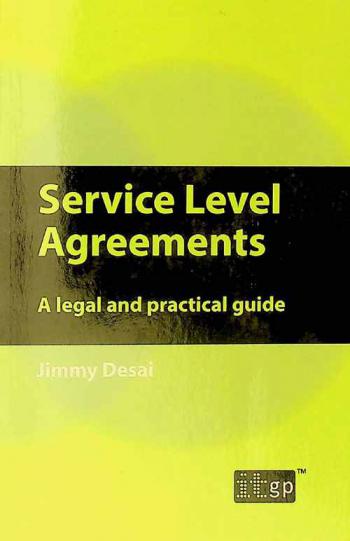
Service level agreements : a legal and practical guide
Annotation Make your SLA work for you _ Read this essential guide to SLAs today!
A wide range of industry sectors will outsource service provision (for example, banking, pharmaceuticals, and insurance companies). This can happen where an organisation outsources its IT payroll needs, its helpdesk and IT maintenance requirements, its payment processing, or its whole IT function.
The key risk
The key risk for an organisation that enters into an outsourcing transaction, are that the services that it receives from the supplier will be worse than the services they were receiving before, or that the cost savings that were anticipated or promised, are not achieved.
The SLA
To try and avoid this scenario, the outsourcing contract should include a Service Level Agreement (SLA). The SLA must be drafted to govern the standard of service that you require, including the cost of those services and the consequences of not achieving pre-agreed standards.
The wider environment
While Service Level Agreements are a key method, within ITIL, for setting out how two parties have agreed that a specific service (usually, but not necessarily, IT-related) will be delivered by one to the other, and the standards or levels to which it will be delivered, the basic concept is now far more widely applied than just in ITIL® and ITSM environments.
This pocket guide provides information and guidance on SLAs to those in the wider environment, from a legal and practical view point.
The benefits and the pitfalls
Identifying some of the benefits and the pitfalls that an organisation can encounter when negotiating and drafting SLAs, this pocket guide provides an overview of SLAs, highlighting typical scenarios that can arise, and provides information on typical solutions that have been adopted by other organisations.
Read this pocket guide to _
* Understand what an SLA is and why you need one
When negotiating any type of service-related deal (including any IT outsourcing deal), it is essential that sufficient time is devoted to ensuring that the service is of sufficient quality and that this is recorded in an SLA.
* Understand where SLAs go wrong.
SLAs can go wrong for a number of reasons. For example, the SLA may not reflect reality, your service requirements may not be defined properly, or there may be too many service levels and service level targets which can then become difficult to manage.
* Learn how to build foundations for the SLA.
There are elements that you should be considering well before even engaging with potential suppliers. This pocket guide details what your organisation should consider, in order to find the proposal which most closely matches its needs.
* Understand the issues to consider when drafting the SLA.
This pocket guide covers the issues to consider when drafting an SLA, as there are certain provisions in SLAs which either should, or should not, appear.
By reading this a short, legal and practical guide to SLAs, you should be able to quickly come up to speed with some of the legal and practical issues that might arise. Negotiating the SLA and putting the SLA into action are also discussed in the pocket guide. Whilst short and easy to digest, case references and weblinks have been provided in the text so readers can find out more information about SLAs.
A wide range of industry sectors will outsource service provision (for example, banking, pharmaceuticals, and insurance companies). This can happen where an organisation outsources its IT payroll needs, its helpdesk and IT maintenance requirements, its payment processing, or its whole IT function.
The key risk
The key risk for an organisation that enters into an outsourcing transaction, are that the services that it receives from the supplier will be worse than the services they were receiving before, or that the cost savings that were anticipated or promised, are not achieved.
The SLA
To try and avoid this scenario, the outsourcing contract should include a Service Level Agreement (SLA). The SLA must be drafted to govern the standard of service that you require, including the cost of those services and the consequences of not achieving pre-agreed standards.
The wider environment
While Service Level Agreements are a key method, within ITIL, for setting out how two parties have agreed that a specific service (usually, but not necessarily, IT-related) will be delivered by one to the other, and the standards or levels to which it will be delivered, the basic concept is now far more widely applied than just in ITIL® and ITSM environments.
This pocket guide provides information and guidance on SLAs to those in the wider environment, from a legal and practical view point.
The benefits and the pitfalls
Identifying some of the benefits and the pitfalls that an organisation can encounter when negotiating and drafting SLAs, this pocket guide provides an overview of SLAs, highlighting typical scenarios that can arise, and provides information on typical solutions that have been adopted by other organisations.
Read this pocket guide to _
* Understand what an SLA is and why you need one
When negotiating any type of service-related deal (including any IT outsourcing deal), it is essential that sufficient time is devoted to ensuring that the service is of sufficient quality and that this is recorded in an SLA.
* Understand where SLAs go wrong.
SLAs can go wrong for a number of reasons. For example, the SLA may not reflect reality, your service requirements may not be defined properly, or there may be too many service levels and service level targets which can then become difficult to manage.
* Learn how to build foundations for the SLA.
There are elements that you should be considering well before even engaging with potential suppliers. This pocket guide details what your organisation should consider, in order to find the proposal which most closely matches its needs.
* Understand the issues to consider when drafting the SLA.
This pocket guide covers the issues to consider when drafting an SLA, as there are certain provisions in SLAs which either should, or should not, appear.
By reading this a short, legal and practical guide to SLAs, you should be able to quickly come up to speed with some of the legal and practical issues that might arise. Negotiating the SLA and putting the SLA into action are also discussed in the pocket guide. Whilst short and easy to digest, case references and weblinks have been provided in the text so readers can find out more information about SLAs.
Book

Service Agreement Trifecta: Backup Resources, Price and Penalty in the Availability-Aware Cloud
Service Level Agreements (SLA) for cloud services entail complex trade-offs between interrelated variables such as price, penalty, and service availability (uptime) guarantee, with resource management strategies affecting fulfillment of the SLA. In this study, we address three key components of the SLA-based cloud resource management and pricing problem, from the service-provider’s perspective: (1)
availability-aware backup resource provisioning;
(2)
price-penalty schedule determination;
and (3)
penalty-deferred pricing over two periods.
Using the convexity of the provider’s expected total cost over the number of backup resources, we present a dichotomous search algorithm to derive the total cost minimizing number of backup resources for a given level of SLA-specified service availability guarantee. Next, we derive closed-form solutions for the lower bound of the feasible price range, yielding a schedule of breakeven price-penalty combinations, which establishes the baseline required in the economic modeling of the service contracts and related negotiation processes, and may also elicit client preference information. We then model a two-period pricing problem specifically designed to incentivize penalty deferrals in the event of an SLA violation. Detailed experimental studies of the proposed models have been carried out using real-world datacenter log data. The computational study validates the convexity of the probability density function of SLA violations over the number of backup resources. The results demonstrate significant interaction effects between the SLA parameters (price, penalty rate, and provisioning cost) and the backup resource provisioning decisions made by the provider, leading to key practical managerial implications for SLA design and resource deployment in the availability-aware cloud.
The online appendix is available at
https://doi.org/10.1287/isre.2017.0755
.
Journal Article

SLA-based task scheduling algorithms for heterogeneous multi-cloud environment
Service-level agreement (SLA) is a major issue in cloud computing because it defines important parameters such as quality of service, uptime, downtime, period of service, pricing, and security. However, the service may vary from one cloud service provider (CSP) to another. The collaboration of the CSPs in the heterogeneous multi-cloud environment is very challenging, and it is not well covered in the recent literatures. In this paper, we present two SLA-based task scheduling algorithms, namely SLA-MCT and SLA-Min-Min for heterogeneous multi-cloud environment. The former algorithm is a single-phase scheduling, whereas the latter one is a two-phase scheduling. The proposed algorithms support three levels of SLA determined by the customers. Furthermore, the algorithms incorporate the SLA gain cost for the successful completion of the service and SLA violation cost for the unsuccessful end of the service. We simulate the proposed algorithms using benchmark and synthetic datasets. The experimental results of the proposed SLA-MCT are compared with three single-phase task scheduling algorithms, namely CLS, Execution-MCT, and Profit-MCT, and the results of the proposed SLA-Min-Min are compared with two-phase scheduling algorithms, namely Execution-Min-Min and Profit-Min-Min in terms of four performance metrics, namely makespan, average cloud utilization, gain, and penalty cost of the services. The results clearly show that the proposed algorithms properly balance between makespan and gain cost of the services in comparison with other algorithms.
Journal Article

KNN-Based Consensus Algorithm for Better Service Level Agreement in Blockchain as a Service (BaaS) Systems
With services in cloud manufacturing expanding, cloud manufacturers increasingly use service level agreements (SLAs) to guarantee business processing cooperation between CSPs and CSCs (cloud service providers and cloud service consumers). Although blockchain and smart contract technologies are critical innovations in cloud computing, consensus algorithms in Blockchain as a Service (BaaS) systems often overlook the importance of SLAs. In fact, SLAs play a crucial role in establishing clear commitments between a service provider and a customer. There are currently no effective consensus algorithms that can monitor the SLA and provide service level priority. To address this issue, we propose a novel KNN-based consensus algorithm that classifies transactions based on their priority. Any factor that impacts the priority of the transaction can be used to calculate the distance in the KNN algorithm, including the SLA definition, the smart contract type, the CSC type, and the account type. This paper demonstrates the full functionality of the enhanced consensus algorithm. With this new method, the CSP in BaaS systems can provide improved services to the CSC. Experimental results obtained by adopting the enhanced consensus algorithm show that the SLA is better satisfied in the BaaS systems.
Journal Article

Analyzing the Performance of Nature-Inspired Optimization Algorithms with Modified Grey Wolf Optimization for VM Migration Problems
The virtualized framework was generated among the terminal user and the computer platform by the software called virtual machine. For the fundamental bare hardware an identical interface was obtained and the end-users are managed by the virtual machine software. For the cloud infrastructure and cloud computing services, simulation and modeling are given by an extensible simulation tool called CloudSim. During virtual machine migration the following challenges occur; Transfer rate, Page resend, Missing pages, migration over WAN network, large applications, Resource availability, Address wrapping, and migration in high-speed LAN. In cloud computing, scheduling is required to reduce task completion time and to boost the effective use of resources. It allocates the particular work to a particular resource at a particular time. Resource allocation is also required for assigning the available resources to the required cloud application over the internet. It allows the service provider to control every individual module resource. To get quasi-optimal solutions several meta-heuristic procedures are implemented with a Cloud simulator.
Journal Article
Analysis of a Personalized Provision of Service Level Agreement (SLA) Algorithm
The existence of restricted Service Level Agreement (SLA) choices, which typically correspond with a couple of service tiers, can result in a customer accepting a service that may not effectively respond to their needs. From a service provider perspective, it is also a less than optimum business model, with capacity being reserved for customers who will not use it and subsequently being unavailable for customers who would. We, therefore, advocate the use of personalized SLAs to avoid such situations, which can ideally be set up without the assistance of a human operator. We suggest classifying customers according to their distinguishing features, one of which includes a customer’s propensity to have online devices in their home. Through the results presented in this paper, we are confident about the accuracy of our classification results; however, we recognize that there are opportunities for latency improvements in the efficiency of the process.
Journal Article

Risk-aware service level agreement modeling in smart grid
As advanced Smart Grid environments grow from a simple grid towards a complex provider ecosystem, there is an uncertain challenge on those grid environments that need to manage a risk paradigm. We present an automated risk-aware service level agreements modeling to the grid provider for speed automated pricing and getting better performance to program as an agent-oriented platform. The key idea of our
novel approach
is proposing a
risk level agreements
contract and a
pricing model
to decrease the complexity of previous methods from an off-line
service level agreement
to an on-line
risk level agreement
for managing the risk lifecycle of contracts used to record the rights and obligations of the services and their consumers. Based on a risk level agreements contract the model optimizes resource management according to the business objective level of the provider with an online risk-aware rendezvous to define the penalty level of the cost model. The corresponding quality of service criteria is defined based on multi-class risk-aware service level agreements between Smart Grid providers and their power consumers which include the tail distributions of the per-class costs in addition to the more standard quality of service metrics such as throughput and mean delays. Our empirical experiments show the benefits of the proposed approach.
Journal Article

Fault tolerance using self-healing SLA and load balanced dynamic resource provisioning in cloud computing
Over the internet, application efficiency management has recently emerged as an essential service cloud computing. the cloud service provider (CSP) gives various cloud services based on pay per use, which requires efficient monitoring and measuring of services delivered for management of quality of service (QoS) through the internet of things (IoT) and therefore needs to fulfil the service level agreements (SLAs). However, avoiding SLA violations and ensuring a user’s dynamic demands as per QoS fulfilment are challenging in cloud computing while delivering dedicated cloud services. cloud environment intricacy, heterogeneity and dynamism are expanding quickly, making cloud frameworks unmanageable and unreliable. cloud systems need self-management of services to overcome these issues. therefore, there is a need to develop a resource-provisioning scheme that automatically fulfils cloud user’s QoS requirements, thus helping the CSP accomplish the SLAs and avoid SLA violations. this paper presents a prediction-based resource management technique called predictive cloud computing systems (PCCSs). Focus is on the self-healing-based prediction that handles unexpected failures and self-configuration-based prediction of resources for applications. the predictive cloud computing system (PCCS) performance is evaluated in the cloud simulator. the simulation results revealed that Predictive cloud Computing Systems (PCCSs) achieve better results than existing techniques, in terms of execution time, cost-effectiveness, resource conflict and SLA breach while delivering reliable services.
Journal Article