
Catalogue Search | MBRL


Are you sure you want to remove the book from the shelf?

{{itemTitle}}
17
result(s) for
"Sex role Great Britain History 17th century."
Sort by:


Gender and the English Revolution
In this fascinating and unique study, Ann Hughes examines how the experience of civil war in seventeenth-century England affected the roles of women and men in politics and society; and how conventional concepts of masculinity and femininity were called into question by the war and the trial and execution of an anointed King. Ann Hughes combines discussion of the activities of women in the religious and political upheavals of the revolution, with a pioneering analysis of how male political identities were fractured by civil war. Traditional parallels and analogies between marriage, the family and the state were shaken, and rival understandings of sexuality, manliness, effeminacy and womanliness were deployed in political debate.
In a historiography dominated by military or political approaches, Gender and the English Revolution reveals the importance of gender in understanding the events in England during the 1640s and 1650s. It will be an essential resource for anyone interested in women's history, feminism, gender or British History.
eBook

Gender, culture and politics in England, 1560-1640 : turning the world upside down
\"Gender, Culture and Politics in England, 1560-1640 integrates social history, politics and literary culture as part of a groundbreaking study that provides revealing insights into the lives of men and women in early modern England. Susan D. Amussen and David E. Underdown examine familiar chaotic characters from the period, such as scolds, cuckolds, witches and scandalous women, and consider the significance of the disorder they create and how they turn the ordered world around them upside down in a very specific, gendered way. Using case studies from theatre, civic ritual and witchcraft, the book demonstrates how the idea of an upside down world, centered on gender inversion, repeatedly permeates the mental world of early modern England. Amussen and Underdown show both how gender was central to understanding society, and the ways in which both unruly women and failed patriarchs were disciplined. In doing so, they give a glimpse of how we can connect different dimensions of early modern society. This is a vital study for anyone keen to know more about the importance of gender in society, culture and politics in 16th- and 17th-century England\"--Provided by publisher.
Book

Gender, Society and Print Culture in Late-Stuart England
Focusing on a largely unknown type of popular print culture that developed in the late 1600s-the coffee house periodical-Helen Berry here offers new evidence that the politics of gender, far from being a marginal or frivolous topic, was an issue of general interest and wide-spread concern to the early modern reader. Berry's study provides the first full length analysis of John Dunton's Athenian Mercury (1691-97), an influential specimen of the coffee-house periodical genre, as well as the original question-and-answer publication which addressed both men's and women's issues in one journal. As the chapter headings in this book indicate, the topics addressed in the \"agony column\" of the Athenian Mercury-for example, the body, courtship, and sex-are of enduring interest across the centuries. Berry's study of this periodical provides new insights into the gendered ideas and debates that circulated among middling sorts in early modern England. An historical survey of the social effects of mass communication in the early modern period, this volume makes an important contribution to the ongoing study of how gendered ideas and values were communicated culturally, particularly beyond the milieu of elite groups such as the nobility and gentry. It argues that the mass media was from its infancy an important means of communicating powerful messages about gender norms, particularly among the middling sorts. The study will appeal not only to historians, women and gender studies scholars and literature scholars, but also to scholars of publishing history.
Contents: Preface; Introduction: Pressing anxieties; Coffee houses, print culture and the public sphere; Authenticity and women readers; The community of readers; Casuistry and the ambiguity of advice; Interpreting the body; Courtship dilemmas; Problems with sex; Questioning friendship; Conclusion; Bibliography; Index.
eBook

Subordinate Subjects
Considering as evidence literary texts, historical documents, and material culture, this interdisciplinary study examines the entry into public political culture of women and apprentices in seventeenth-century England, and their use of discursive and literary forms in advancing an imaginary of political equality. Subordinate Subjects traces to the end of Elizabeth Tudor's reign in the 1590s the origin of this imaginary, analyses its flowering during the English Revolution, and examines its afterlife from the Restoration of Charles II in 1660 to the Glorious Revolution of 1688-89. It uses post-Marxist theories of radical democracy, post-structuralist theories of gender, and a combination of political theory and psychoanalysis to discuss the early modern construction of the political subject. Subordinate Subjects makes a distinctive contribution to the study of early modern English literature and culture through its chronological range, its innovative use of political, psychoanalytic, and feminist theories, and its interdisciplinary focus on literature, social history, political thought, gender studies, and cultural studies.
Contents: Introduction; Apprentices and the national-popular; Gender and the political imaginary; Women's writing and the politics of history; Petitioning apprentices, petitioning wives; 'Royalist' women and the English Revolution; Apprentices, wives, 'whores' and the political nation; Women, print culture, and the public sphere; Epilogue; Bibliography; Index.
Mihoko Suzuki is Professor of English at the University of Miami. She is the author of Metamorphoses of Helen: Authority, Difference, and the Epic (Cornell University Press 1989), editor of Critical Essays on Edmund Spenser (Macmillan, 1996) and co-editor, with Cristina Malcolmson, of Debating Gender in Early Modern England, 1500-1700 (Palgrave, 2002).
eBook
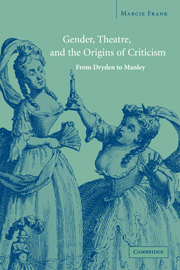
Gender, Theatre, and the Origins of Criticism
In Gender, Theatre and the Origins of Criticism, which was originally published in 2003, Marcie Frank explores the theoretical and literary legacy of John Dryden to a number of prominent women writers of the time. Frank examines the pre-eminence of gender, sexuality and the theatre in Dryden's critical texts that are predominantly rewritings of the work of his own literary precursors - Ben Jonson, Shakespeare and Milton. She proposes that Dryden develops a native literary tradition that is passed on as an inheritance to his heirs - Aphra Behn, Catharine Trotter, and Delarivier Manley - as well as their male contemporaries. Frank describes the development of criticism in the transition from a court-sponsored theatrical culture to one oriented toward a consuming public, with very different attitudes to gender and sexuality. This study also sets out to trace the historical origins of certain aspects of current criticism - the practices of paraphrase, critical self-consciousness and performativity.
eBook
English Masculinities, 1660-1800
This collection of specially commissioned essays provides the first social history of masculinity in the ‘long eighteenth century’. Drawing on diaries, court records and prescriptive literature, it explores the different identities of late Stuart and Georgian men. The heterosexual fop, the homosexual, the polite gentleman, the blackguard, the man of religion, the reader of erotica and the violent aggressor are each examined here, and in the process a new and increasingly important field of historical enquiry is opened up to the non-specialist reader. The book opens with a substantial introduction by the Editors. This provides readers with a detailed context for the chapters which follow. The core of the book is divided into four main parts looking at sociability, virtue and friendship, violence, and sexuality. Within this framework each chapter forms a self-contained unit, with its own methodology, sources and argument. The chapters address issues such as the correlations between masculinity and Protestantism; masculinity, Englishness and taciturnity; and the impact of changing representations of homosexual desire on the social organisation of heterosexuality. Misogyny, James Boswell's self-presentation, the literary and metaphorical representation of the body, the roles of gossip and violence in men's lives, are each addressed in individual chapters. The volume is concluded by a wide-ranging synoptic essay by John Tosh, which sets a new agenda for the history of masculinity. An extensive guide to further reading is also provided. Designed for students, academics and the general reader alike, this collection of essays provides a wide-ranging and accessible framework within which to understand eighteenth-century men. Because of the variety of approaches and conclusions it contains, and because this is the first attempt to bring together a comprehensive set of writings on the social history of eighteenth-century masculinity, this volume does something quite new. It de-centres and problematises the male ‘standard’ and explores the complex and disparate masculinites enacted by the men of this period. This will be essential reading for anyone interested in eighteenth-century British social history.
eBook

Changing The Subject
Lady Mary Wroth (c. 1587-1653) wrote the first sonnet sequence in English by a woman, one of the first plays by a woman, and the first published work of fiction by an Englishwoman. Yet, despite her status as a member of the distinguished Sidney family, Wroth met with disgrace at court for her authorship of a prose romance, which was adjudged an inappropriate endeavor for a woman and was forcibly withdrawn from publication. Only recently has recognition of Wroth's historical and literary importance been signaled by the publication of the first modern edition of her romance,The Countess of Mountgomeries Urania.
Naomi Miller offers an illuminating study of this significant early modern woman writer. Using multiple critical/theoretical perspectives, including French feminism, new historicism, and cultural materialism, she examines gender in Wroth's time. Moving beyond the emphasis on victimization that shaped many previous studies, she considers the range of strategies devised by women writers of the period to establish voices for themselves.
Where previous critics have viewed Wroth primarily in relation to her male literary predecessors in the Sidney family, Miller explores Wroth's engagement with a variety of discourses, reading her in relation to a broad range of English and continental authors, both male and female, from Sidney, Spenser, and Shakespeare to Aemilia Lanier, Elizabeth Cary, and Marguerite de Navarre. She also contextualizes Wroth's writing in relation to a variety of nonliterary texts of the period, both political and domestic. Thanks to Miller's sensitive readings, Wroth's writings provide a lens through which to view gender relations in the early modern period.
eBook
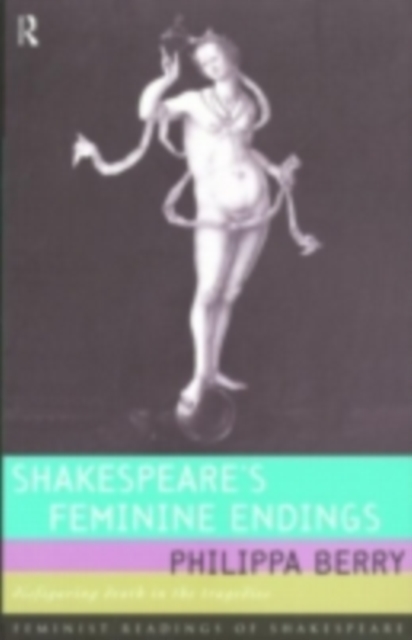
Shakespeare's Feminine Endings
Philippa Berry draws on feminist theory, postmodern thought and queer theory, to challenge existing critical notions of what is fundamental to Shakespearean tragedy. She shows how, through a network of images clustered around feminine or feminized characters, these plays 'disfigure' conventional ideas of death as a bodily end, as their figures of women are interwoven with provocative meditations upon matter, time, the soul, and the body. The scope of these tragic speculations was radical in Shakespeare's day; yet they also have a surprising relevance to contemporary debates about time and matter in science and philosophy.
eBook
Bodies and their spaces : system, crisis and transformation in early modern theatre
Bodies and their Spaces: System, Crisis and Transformation in Early Modern Theatre explores the emergence of the distinctively modern \"gender system\" at the close of the early modern period. The book investigates shifts in the gendered spaces assigned to men and women in the \"public\" and \"private\" domains and their changing modes of interconnection; in concert with these social spaces it examines the emergence of biologically based notions of sex and a novel sense of individual subjectivity. These parallel and linked transformations converged in the development of a new gender system which more efficiently enforced the requirements of patriarchy under the evolving economic conditions of merchant capitalism. These changes can be seen to be rehearsed, contested and debated in literary artefacts of the early modern period - in particular the drama. This book suggests that until the closure of the English theatres in 1642, the drama not only reflected but also exacerbated the turbulence surrounding gender configurations in transition in early modern society. The book reads a wide range of dramatic and non-dramatic texts, and interprets them with the aid of the \"systems theory\" developed by the German sociologist Niklas Luhmann.
eBook