
Catalogue Search | MBRL


Are you sure you want to remove the book from the shelf?

{{itemTitle}}
119
result(s) for
"Sexual Behavior history Germany."
Sort by:


Sexual Politics and Feminist Science
In Sexual Politics and Feminist Science, Kirsten Leng restores the work of female sexologists to the forefront of the history of sexology. While male researchers who led the practice of early-twentieth-century sexology viewed women and their sexuality as objects to be studied, not as collaborators in scientific investigation, Leng pinpoints nine German and Austrian \"women sexologists\" and \"female sexual theorists\" to reveal how sex, gender, and sexuality influenced the field of sexology itself. Leng’s book makes it plain that women not only played active roles in the creation of sexual scientific knowledge but also made significant and influential interventions in the field. Sexual Politics and Feminist Science provides readers with an opportunity to rediscover and engage with the work of these pioneers. Leng highlights sexology’s empowering potential for women, but also contends that in its intersection with eugenics, the narrative is not wholly celebratory. By detailing gendered efforts to understand and theorize sex through science, she reveals the cognitive biases and sociological prejudices that ultimately circumscribed the transformative potential of their ideas. Ultimately, Sexual Politics and Feminist Science helps readers to understand these women’s ideas in all their complexity in order to appreciate their unique place in the history of sexology.
eBook
Body, Femininity and Nationalism
This social and cultural history of girls in the German youth movements in the pre-Nazi era brings fascinating new light to bear on the history of the German youth movements. It contributes to our wider understanding of girlhood in the period, and investigates how mentalities, collective identities and German nationalism developed in the three decades before the Nazi period.
eBook

States of Liberation
States of Liberation traces the paths of gay men in East and West Germany from the violent aftermath of the Second World War to the thundering nightclubs of present-day Berlin. Following a captivating cast of characters, from gay spies and Nazi scientists to queer politicians and secret police bureaucrats, States of Liberation tells the remarkable story of how the two German states persecuted gay men – and how those men slowly, over the course of decades, won new rights and created new opportunities for themselves in the heart of Cold War Europe. Relying on untapped archives in Germany and the United States as well as oral histories with witnesses and survivors, Huneke reveals that communist East Germany was in many ways far more progressive on queer issues than democratic West Germany.
eBook
Life among the Ruins
As home to 1920s excess and Hitler's Final Solution, Berlin's physical and symbolic landscape was an important staging ground for the highs and lows of modernity. In Cold War Berlin, social and political boundaries were porous, and the rubble gave refuge to a re-emerging gay and lesbian scene, youth gangs, prostitutes, hoods, and hustlers.
eBook
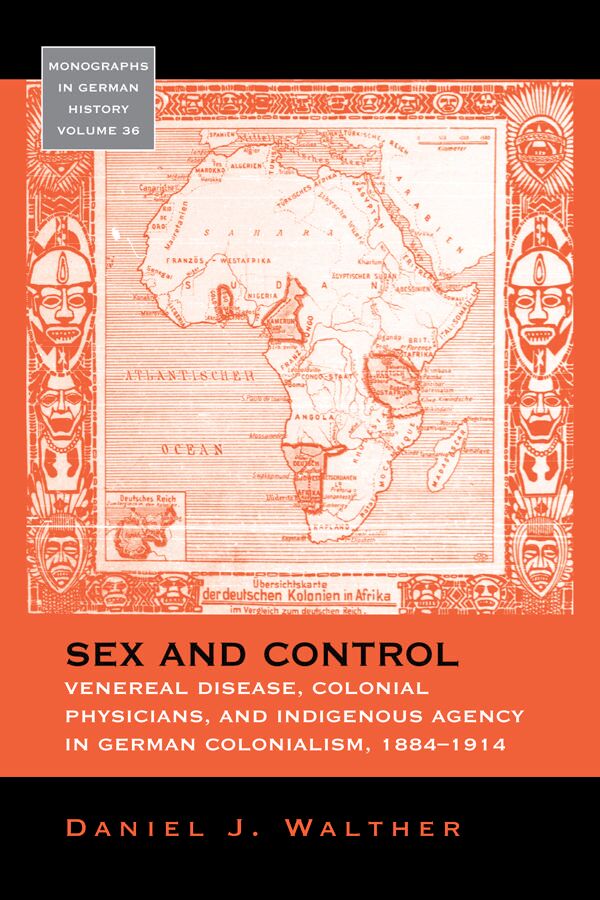
Sex and Control
In responding to the perceived threat posed by venereal diseases in Germany's colonies, doctors took a biopolitical approach that employed medical and bourgeois discourses of modernization, health, productivity, and morality. Their goal was to change the behavior of targeted groups, or at least to isolate infected individuals from the healthy population. However, the Africans, Pacific Islanders, and Asians they administered to were not passive recipients of these strategies. Rather, their behavior strongly influenced the efficacy and nature of these public health measures. While an apparent degree of compliance was achieved, over time physicians increasingly relied on disciplinary measures beyond what was possible in Germany in order to enforce their policies. Ultimately, through their discourses and actions they contributed to the justification for and the maintenance of German colonialism.
eBook

Effects of Individual Mortality Experience on Out-of-Wedlock Fertility in Eighteenth- and Nineteenth-Century Krummhörn, Germany
Life history theory predicts that exposure to high mortality in early childhood leads to faster and riskier reproductive strategies. Individuals who grew up in a high mortality regime will not overly wait until they find a suitable partner and form a stable union because premature death would prevent them from reproducing. Cox proportional hazard models were used to determine whether women who experienced sibling death during early childhood (0–5 years) reproduced earlier and were at an increased risk of giving birth to an illegitimate child, with illegitimacy serving as a proxy for risky sexual behavior. Furthermore, we investigate whether giving birth out of wedlock is influenced by individual mortality experience or by more promiscuous sexual behavior that is clustered in certain families. Models are fitted on pedigree data from the eighteenth- and nineteenth-century Krummhörn population in Germany. The results show a relationship between sibling death in early childhood and the risk of reproducing out of wedlock, and reproductive timing. The risk of giving birth out of wedlock is linked to individual mortality experience rather than to family-level effects. In contrast, adjustments in connubial reproductive timing are influenced more by family-level effects than by individual mortality experience.
Journal Article

The Masculine Woman in Weimar Germany
Throughout the Weimar period the so-called \"masculinization of woman\" was much more than merely an outsider or subcultural phenomenon; it was central to representations of the changing female ideal, and fed into wider debates concerning the health and fertility of the German \"race\" following the rupture of war. Drawing on recent developments within the history of sexuality, this book sheds new light on representations and discussions of the masculine woman within the Weimar print media from 1918-1933. It traces the connotations and controversies surrounding this figure from her rise to media prominence in the early 1920s until the beginning of the Nazi period, considering questions of race, class, sexuality, and geography. By focusing on styles, bodies and identities that did not conform to societal norms of binary gender or heterosexuality, this book contributes to our understanding of gendered lives and experiences at this pivotal juncture in German history.
eBook